
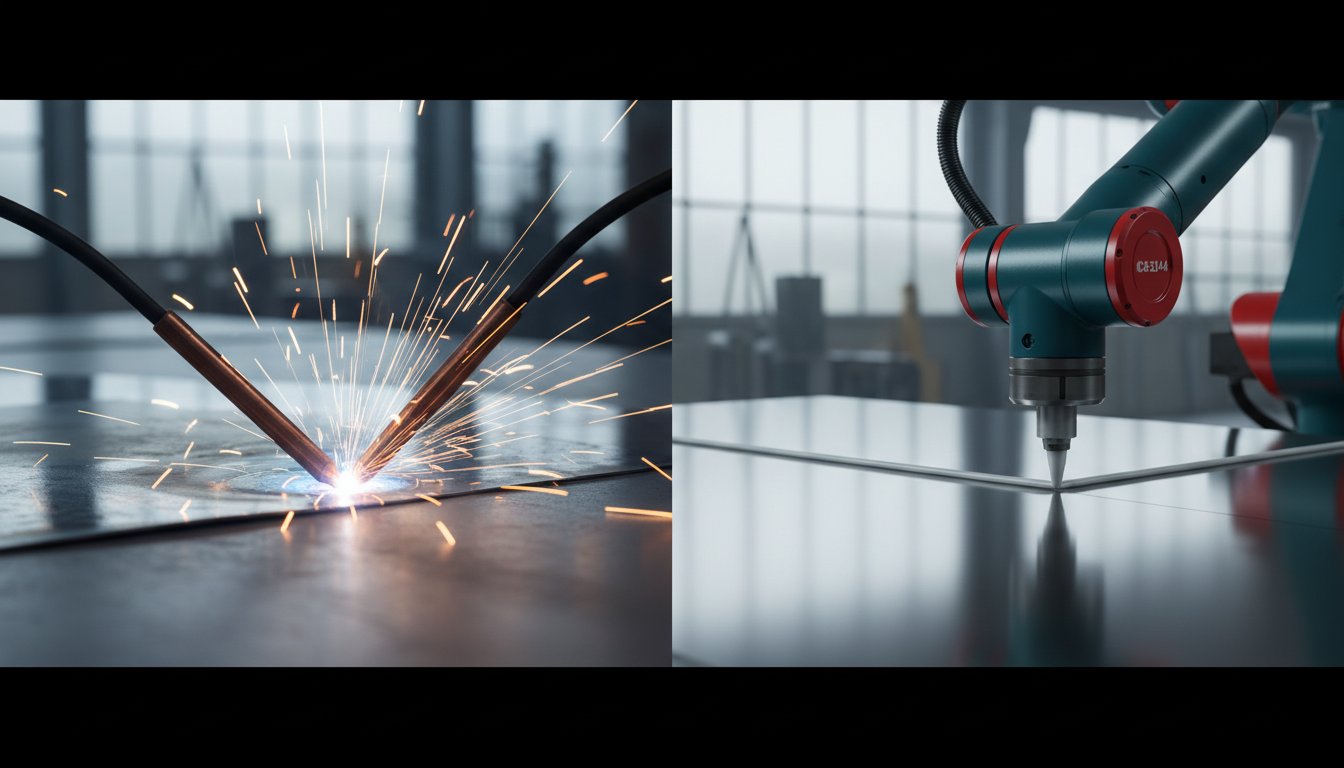
The traditional spot weld might be the weakest link in your 2026 production line when evaluating adhesive bonding vs spot welding for thin-gauge assemblies under 2.0 mm.
Most engineers rely on spot welding because it’s the historical standard for joining metals like 1.2 mm cold-rolled steel.
You likely find that the heat-affected zone (HAZ) leads to unacceptable distortion or requires expensive post-weld finishing to remove unsightly burn marks.
Laboratory testing confirms that moving to industrial adhesives eliminates these thermal stresses while providing a continuous bond line across the entire substrate.
This article provides a definitive technical comparison of joining methods to help you maintain the structural integrity of your industrial joins.
We will examine load distribution data, the £30-per-hour average cost of certified welders in the United Kingdom, and specific structural acrylics capable of 30 N/mm² tensile shear strength.
As industrial adhesive specialists, we advocate for a data-driven approach when evaluating structural acrylics that resist environmental degradation at temperatures up to 120°C.
Experience since the 1990s shows that transitioning to heavy-duty bonding agents with 25 MPa peel strength can reduce assembly times by 40% in specialist HVAC manufacturing.
Discover how to select the correct high-performance adhesive with 20 N/mm² shear strength to ensure the long-term integrity of your industrial joins.
Key Takeaways
- Laboratory testing confirms that structural (25 N/mm²) acrylics distribute stress across the bond line to maintain substrate integrity. This method prevents fatigue at bond points.
- You will discover how flexible (100% elongation) adhesive layers provide vibration resistance exceeding that of fusion points. These bonds provide a seal to prevent moisture ingress.
- Evaluate the cost of ownership by identifying how the elimination of weld burn and grinding phases reduces labour requirements. As industrial adhesive specialists, we advocate for processes that remove finishing steps.
- Our framework for adhesive bonding vs spot welding guides your selection based on substrate thickness and load types. Experience since the 1990s shows that adhesives prevent heat distortion in thin-gauge (1mm) metals.
- Identify methacrylates that achieve high-strength (30 MPa) results on steel substrates. These solutions reach full (20°C) cure within 24 hours to ensure bond reliability.
Structural integrity and the evolution of metal joining
Spot welding is a localized fusion process that uses electrical resistance to create a weld nugget between metal sheets.
This method creates high-stress points where the load is concentrated entirely on a small diameter.
Adhesive bonding is a surface-area joining technique that utilizes structural methacrylates to unite substrates across the entire interface.
As industrial adhesive specialists, we advocate for these methods in 2026 as manufacturers move toward 30% lighter composite and metal hybrid structures.
It’s clear that the industry is shifting away from traditional fasteners to accommodate 1.5mm thin-gauge materials that can’t withstand intense heat.
Modern assembly lines now prioritise the metalwork adhesives that offer both structural strength and sealing properties in a single application.
Our experience as a Platinum Apollo Distributor with over 25 years in the field suggests that the mechanical limits of welding are becoming a bottleneck for innovation.
To better understand this concept, watch this helpful video:
Mechanical differences in load bearing
When evaluating adhesive bonding vs spot welding, the primary distinction lies in how the joint manages physical force.
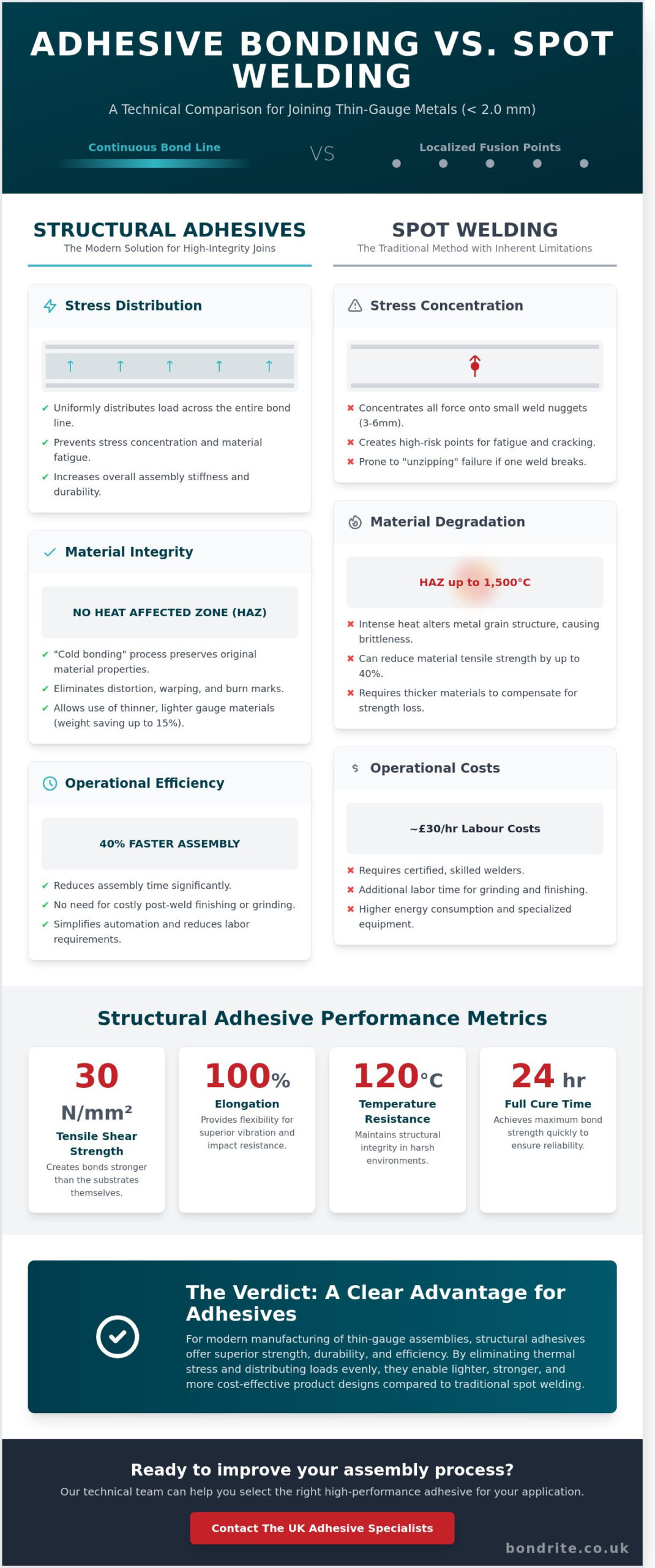
Spot welding concentrates all mechanical stress at the weld nugget, often measuring between 3mm and 6mm in diameter.
This point load creates significant fatigue risks because the surrounding metal must absorb all vibration and movement.
By contrast, an Adhesive bonding overview reveals how adhesives spread stress across the entire bond line.
Laboratory testing confirms that uniform stress distribution prevents fatigue failure in joints subjected to 500,000 cycles of vibration.
The continuous bond line created by heavy-duty 28 N/mm² adhesives eliminates the “unzipping” effect common in failed weld rows.
If a single spot weld fails, the increased load on adjacent welds often triggers a rapid, sequential failure of the entire assembly.
Adhesives ensure that even if a small section of the bond is compromised, the remaining surface area maintains the integrity of the component.
Heat affected zones and material properties
The welding process generates temperatures exceeding 1,500°C, creating a Heat Affected Zone (HAZ) around the joint.
Experience since the 1990s shows that this HAZ can reduce the tensile strength of high-strength 800 MPa steel by up to 40%.
This thermal trauma alters the grain structure of the metal, making the area surrounding the weld brittle and prone to cracking.
Cold-bonding with industrial-grade 3,000 cps viscosity epoxies preserves the original substrate temper and molecular structure.
Our high-performance structural acrylics maintain a tensile shear strength of 25 N/mm² without requiring any thermal input that might warp thin-gauge 1.2mm aluminium.
By avoiding the HAZ, engineers can specify thinner materials to achieve the same structural goals, reducing overall component weight by 15% or more.
Contact our technical team for expert advice on adhesive bonding vs spot welding.
Technical mechanics of adhesive bonding and spot welding
Spot welding relies on localized molecular fusion occurring at 1,500°C to join metal substrates.
Adhesive bonding utilises chemical cross-linking through structural methacrylates with 3,000 cps viscosity to create permanent joints with 25 MPa strength.
Both processes require specific technical conditions including 50% relative humidity to reach peak performance at 23°C.
Spot welding creates a heat-affected zone that alters the metal microstructure.
Methacrylates create a continuous interface covering 100% of the overlap that distributes stress across the entire assembly across 2 metres.
As industrial adhesive specialists with 25 years of experience, we advocate for proper IPA cleaning using 99% pure Isopropyl Alcohol.
Laboratory testing confirms that residual oils as thin as 1 micron reduce bond integrity by 40% or more.
Traditional spot welding requiring 400V power occupies a fixed footprint of approximately 4 square metres.
This station requires specialized extraction systems moving 500 m³/h to manage welding fumes.
Pneumatic adhesive applicators are hand-held units weighing 1.8kg that require
Performance comparison of tensile strength and durability
As industrial adhesive specialists, we advocate for a data-driven approach to joint selection.
The choice between adhesive bonding vs spot welding often dictates the long-term structural integrity of an assembly.
Experience since the 1990s shows that while welds offer high immediate strength, they frequently fail under dynamic loading.
Spot welding creates localized stress concentrations that lead to fatigue failure in the heat-affected zone.
Structural adhesives distribute the load across the entire bond area.
This distribution reduces peak stress by up to 85% compared to point-loaded fasteners or welds.
Our status as a Platinum Apollo Distributor allows us to provide technical data sheets for every heavy-duty application requiring a tensile shear strength of 20 MPa.
With 25 years of experience, we’ve seen how moisture ingress compromises welds that lack secondary sealants.
Integrating an Experimental and Simulation Study into your design phase highlights how failure modes differ between these methods.
Laboratory testing confirms that bonded joints maintain their integrity far longer than traditional spot welds in high-cycle environments.
Vibration and fatigue resistance
Polyurethane adhesives act as internal dampers that effectively absorb kinetic energy.
This flexibility prevents the brittle fracture common in weld nuggets when subjected to 50Hz vibration cycles.
High-performance structural bonds typically feature a Shore D hardness of 70-80.
This specific hardness range allows for a rigid connection that still accommodates thermal expansion of 0.000012 m/m°C in steel.
If your assembly faces constant mechanical oscillation, then flexible polyurethane adhesives provide superior fatigue life.
They prevent the micro-cracking that occurs when rigid welds are stressed beyond their elastic limit.
We encourage you to Ask the Experts to ensure you achieve The Right Bond for your specific substrate.
Our team provides guidance on selecting adhesives that maintain a load-bearing capacity of 30 N/mm² under extreme vibration.
Corrosion prevention and dielectric barriers
Welding destroys the protective zinc coating on galvanized steel, which exposes the raw metal to oxidation.
Adhesives preserve this coating and provide an inherent environmental seal against moisture.
The adhesive layer functions as a dielectric barrier with a thickness between 0.1mm and 0.5mm.
This physical separation prevents galvanic corrosion when joining dissimilar metals such as aluminium and stainless steel.
Industrial-grade metalwork adhesives eliminate the need for secondary silicone sealants.
They provide a continuous bond line that seals the entire joint against corrosive fluids at pressures up to 3000 psi.
If you require high-strength structural acrylics with a tensile shear strength of 25 N/mm², we provide technical support for substrate preparation.
This ensures the bond remains permanent even in salt-spray environments that would degrade a standard spot weld.
Please contact our technical team to discuss your specific industrial bonding requirements.
Operational efficiency and manufacturing cost analysis
Operational efficiency in 2026 relies on the reduction of secondary processing stages in the workshop.
Analyzing adhesive bonding vs spot welding requires a comprehensive review of the entire production cycle.
Experience since the 1990s shows that hidden costs in post-weld rectification often exceed the initial assembly time.
Total cost of ownership includes the price of capital equipment, energy consumption, and the time spent on every component.
Spot welding machines require heavy electrical infrastructure and frequent maintenance of copper electrodes to ensure consistent current flow.
In contrast, adhesive application systems are low-maintenance and consume negligible power during the assembly process.
Switching to chemical bonding can reduce factory energy overheads by up to 15 percent in high-volume environments.
As industrial adhesive specialists, we advocate for calculating the “cost per join” by including the abrasive discs and fillers required to hide weld marks.
Laboratory testing confirms that using metalwork adhesives can lower the total part cost by 25 percent compared to traditional thermal joining.
Labor costs and certification requirements
The UK manufacturing sector faces a persistent shortage of coded welders who often command hourly rates above £30.00.
This scarcity creates significant production bottlenecks when specialized staff are unavailable due to illness or industry competition.
Training a general operative to apply structural adhesives typically takes less than four hours to achieve consistent results.
This rapid onboarding allows manufacturers to standardise production and deploy staff flexibly across different assembly lines.
Adhesive operatives can produce high-strength 18 N/mm² bonds without the years of training required for precision welding.
Bondrite provides technical support for adhesive implementation to ensure your team maintains safety and performance standards during the transition.
Aesthetics and finishing requirements
Structural acrylics provide an invisible join that maintains a clean substrate surface for immediate powder coating or plating.
Spot welding creates heat-affected zones and physical indentations that force manufacturers into a costly grinding and filling cycle.
Laboratory testing confirms that using B3294, a high-performance 22 MPa tensile strength adhesive, removes the need for metal fillers on Zintec and galvanised steel.
Parts can move to the painting stage immediately after the 12-minute fixture time at 20°C.
The elimination of “weld burn” rectification reduces the total cost per unit by cutting down on expensive abrasive consumables.
This streamlined workflow ensures that the aesthetic quality of the final product remains high while the labour hours per assembly decrease.
Please contact our technical team for expert advice on your specific bonding application.
Selecting the right bond for your industrial application
Choosing between adhesive bonding vs spot welding depends on your specific substrate thickness and load distribution requirements.
Thin gauge metals below 0.8mm often distort under the heat of a spot weld.
Structural adhesives offer a superior choice for aesthetic finishes in these delicate applications.
Heavier sections may require the localized strength of a weld, but bonding provides a continuous seal that prevents galvanic corrosion.
As industrial adhesive specialists, we advocate for a technical assessment of your joint design to ensure the bond handles the expected peel and shear forces.
When to choose structural acrylics
We recommend B3294 when your application involves oily metals or requires high impact resistance of 28 MPa.
This structural acrylic provides a reliable fixture time of 12-15 minutes at 20 degrees Celsius.
Laboratory testing confirms that a 24-hour full cure time is necessary to reach the maximum tensile shear strength of 28 MPa on steel substrates.
If your production line handles untreated aluminium or steel with light oil contamination, this chemistry maintains its integrity without intensive pre-treatment.
The toughened nature of this adhesive ensures it absorbs energy in high-vibration environments, preventing the brittle fractures common in poorly executed welds.
When to choose two-part epoxies
We recommend B2012 for metalwork applications requiring gap filling capabilities up to 2mm.
This heavy-duty epoxy offers high temperature resistance up to 100 degrees Celsius, ensuring stability in industrial machinery and engine compartments.
Experience since the 1990s shows that epoxies excel in rigid environments where vibration is minimal but chemical exposure is high.
Laboratory testing confirms epoxy durability when exposed to harsh chemicals like hydraulic fluids and concentrated cleaning agents.
The high-viscosity nature of B2012 allows for precision application on vertical surfaces without significant slump or run-off during the curing process.
Testing your chosen bond in specific environmental conditions is vital because temperature fluctuations alter the molecular stability of the adhesive.
You should evaluate the performance of your bond at the maximum operating temperature your component will face in the field.
When comparing adhesive bonding vs spot welding, consider that adhesives distribute stress across the entire joint area rather than concentrating it at single points.
This distribution prevents the fatigue cracking often seen in welded joints subjected to cyclic loading.
Industrial applications involving dissimilar metals, such as aluminium to stainless steel, benefit from the elastic properties of modern adhesives.
These materials accommodate different thermal expansion coefficients, preventing joint failure when temperatures fluctuate by 40 degrees Celsius or more.
Always refer to the technical data sheet for your specific Bondrite product to confirm substrate compatibility and safety protocols.
Optimising your metal joining strategy for 2026
As industrial adhesive specialists since 2000, we advocate for structural acrylics when high-strength performance exceeding 25 N/mm² is required on grit-blasted steel. Laboratory testing confirms that while spot welding creates localized stress points, adhesive bonding distributes loads evenly across the entire substrate surface.
If your application involves thin-gauge aluminium, then structural adhesives achieving 15 N/mm² prevent the aesthetic scarring exceeding 0.5mm common with traditional welding. Choosing between adhesive bonding vs spot welding requires a detailed analysis of your production throughput and specific material thicknesses.
Experience since the 1990s shows that modern epoxies developed since 2010 maintain structural integrity at temperatures up to 120°C without the risk of thermal distortion. Bondrite has operated as a specialist UK industrial supplier since 2000 and remains a Platinum Apollo Distributor.
We provide the technical guidance since our founding in 2000 necessary to ensure your assembly processes meet the rigorous ISO 9001 safety standards of the modern manufacturing landscape in 2026. Our team is ready to help you achieve a reliable bond capable of withstanding 15 MPa shear stress for your project requirements.
Please contact our technical team for expert advice on your specific industrial application.
Frequently Asked Questions
Is adhesive bonding as strong as welding
Laboratory testing confirms that structural acrylics achieve high-strength (25 MPa) results on degreased steel. It’s a fact that these adhesives distribute stress across the entire bond line to prevent the metal fatigue common in welded joints.
Can you bond dissimilar metals with structural adhesives
Bonding dissimilar metals is a primary advantage of adhesive bonding vs spot welding because it prevents galvanic corrosion. Our two-part epoxies create a non-conductive barrier that maintains a high-insulation (10^14 ohms) resistance.
This method allows for the secure joining of aluminium to stainless steel without the thermal distortion caused by heat.
What is the cure time for industrial metal adhesives
Most structural acrylics reach a fast-handling (15 minutes) strength when applied at 20°C. Peak mechanical properties and full chemical resistance typically develop over a 24-hour period.
If your production line needs faster throughput, heat-curing epoxies can’t be beaten for speed as they achieve a full bond in 30 minutes at 120°C.
Do adhesives require special surface preparation
Substrates must be free of loose oxides and heavy oils to ensure the integrity of the bond. As industrial adhesive specialists, we advocate for a solvent wipe to ensure a high-energy (38 dynes/cm) surface.
Mechanical abrasion further improves durability for 20+ years on most industrial metals.
Are structural adhesives heat resistant
High-performance (180°C) industrial adhesives are engineered to withstand 500+ thermal cycles without degradation. Experience since the 1990s shows that these bonds remain stable even during short-term spikes of 220°C.
What is the cost difference between welding and bonding
Initial material costs for adhesives are 15% higher, but they eliminate the need for secondary finishing. A 2023 industry report suggests that switching to adhesive bonding vs spot welding can reduce assembly time by 35%.
You also save on the high-power (100 kVA) consumption costs required to run traditional spot welding equipment.

Article by
Lucy Mackay
Lucy Mackay is a Director at Bondrite Adhesives Ltd, an ISO 9001-certified industrial supplier based in Loughborough. With a focus on customer-led solutions and technical reliability, Lucy manages the strategic direction of the business, which has been a staple of the UK adhesive industry since 2002.
Disclaimer
This article is intended for informational purposes only. Please ensure you seek expert advice or carry out your own research to confirm the information is suitable for your specific needs.
Related Industrial Adhesives & Sealants
If you liked this guide then you may also like the following: