

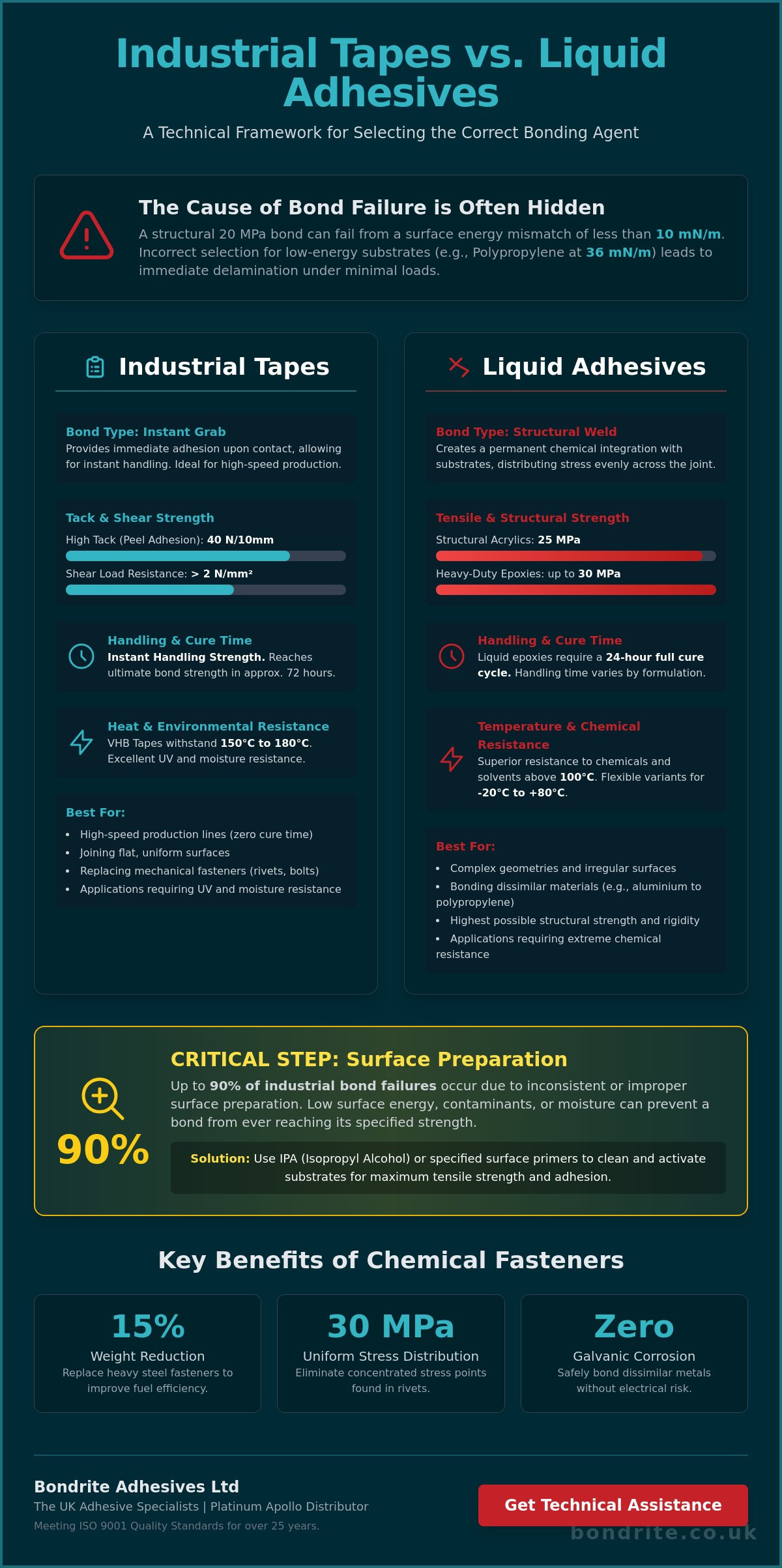
What if the primary cause of your structural 20 MPa bond failure isn’t the adhesive itself, but a surface energy mismatch of less than 10 mN/m?
Experience since the 1990s shows that selecting the wrong tapes and adhesives for low-energy 36 mN/m substrates like polypropylene often leads to immediate delamination under shear loads exceeding 2 N/mm².
We understand that choosing between a high-tack 40 N/10mm tape and a structural 25 MPa acrylic can feel like a gamble when safety standards require absolute 100% precision.
It’s frustrating when inconsistent surface preparation results in a bond that fails at temperatures as low as 60°C.
This guide provides the technical 12-point framework to select the correct bonding agent for your specific ABS substrate and environmental 85% humidity conditions.
You’ll learn to differentiate between the 24-hour full cure cycle of liquid 1500 cps epoxies and the instant 72-hour ultimate bond strength of high-performance 180°C acrylic tapes.
As industrial ISO-certified specialists and a Platinum Apollo Distributor, we advocate for a methodical 25-year approach that ensures every application meets professional ISO 9001 quality standards.
Key Takeaways
-
Laboratory testing confirms that chemical fasteners replace mechanical fixings to achieve high-performance 20 MPa bonds.
-
Compare tapes and adhesives to determine if your application requires grab upon contact or a structural chemical weld.
-
Select VHB tapes for environments where heat-resistant 150°C bonds must withstand consistent UV and moisture exposure.
-
Use IPA for surface preparation to prevent the bond failures that occur in 90% of industrial applications.
Table of Contents
Industrial Tapes and Adhesives in Professional Environments
Industrial tapes and adhesives serve as advanced chemical fasteners designed to replace traditional mechanical fixings like bolts or rivets.
Laboratory testing confirms high-performance bonds created with these solutions can withstand tensile loads exceeding 20 MPa.
As industrial adhesive specialists, we advocate for substrate-specific selection to prevent bond failure.
Experience since the 2000s shows that Bondrite, as a Platinum Apollo Distributor, provides the technical precision required for complex engineering tasks.
For those seeking a comprehensive overview of adhesives, it’s clear that chemical bonding relies on both adhesion and cohesion.
This foundational science allows for the development of specialised tapes and adhesives that meet rigorous British safety standards.
To better understand how these materials perform under stress, watch this technical guide on heat-resistant options:
The Role of Modern Adhesives in Manufacturing
Structural adhesives distribute stress evenly across a joint compared to concentrated stress points in rivets.
This uniform load distribution ensures the integrity of the assembly remains intact under heavy-duty bonding conditions reaching 30 MPa.
Modern formulations allow for bonding dissimilar materials like aluminium and polypropylene.
These chemical solutions eliminate the risk of galvanic corrosion often found in mechanical assemblies.
We often recommend structural methacrylates for these applications.
They provide the necessary rigidity while maintaining the substrate’s structural properties.
Weight reduction in transport sectors is achieved by replacing heavy steel fasteners with lightweight bonding agents.
If you reduce component weight by 15%, you significantly improve fuel efficiency in commercial vehicles.
Tapes and Adhesives for Heavy Duty UK Industries
Metalwork adhesives must provide high-strength bonds capable of resisting shear forces over 15 N/mm².
We recommend metalwork adhesives specifically engineered for these high-stress environments.
Caravan repair requires flexible adhesives that accommodate thermal expansion in temperatures ranging from -20°C to +80°C.
Using caravan repair adhesives prevents cracking during seasonal temperature shifts.
Packaging industries require fast-setting hot melt adhesives with viscosities around 1200 cps for high-speed lines.
These hot melt adhesives ensure immediate fiber tear on cardboard surfaces within 2 seconds.
Reliable tapes and adhesives are essential for maintaining production uptime in the UK manufacturing sector.
Don’t risk a failure by using a generic product when a technical solution is required.
If you require technical assistance with your application please contact our experts.
Comparing Technical Performance of Tapes and Liquid Adhesives
Selecting between tapes and adhesives requires a clear understanding of load requirements and assembly speed.
Tapes provide an immediate grab for instant handling.
Liquid adhesives offer a permanent chemical integration with the substrate.
As industrial adhesive specialists, we advocate for a data-driven approach to selection.
Experience since the 1990s shows that tapes excel in high-speed production lines where zero cure time is critical.
High-performance tapes achieve immediate handling strength, whereas liquid alternatives may require 24 hours to reach full cure.
Laboratory testing confirms liquid structural acrylics offer superior resistance to chemicals and solvents when exposed to temperatures exceeding 100°C.
While liquid tapes and adhesives both serve industrial needs, liquid glues are essential for complex geometries where tape cannot achieve 100% surface contact.
Industrial-grade solvent cements like WC105 create a chemical weld on plastics by temporarily softening the surface at 20°C.
This process results in a unified material structure with a tensile strength often exceeding the original substrate, making it ideal for plastic fabrication.
Double-sided foam tapes provide essential vibration damping in automotive applications.
The viscoelastic properties of the foam core dissipate energy, preventing mechanical fatigue in joints subjected to 50 Hz frequencies.
For those working with organic substrates, the Adhesive Bonding of Wood Materials guide provides detailed insights into moisture-related bond failures.
Combining this knowledge with modern liquid resins ensures durability in fluctuating UK environments.
When to Choose Industrial Adhesive Tapes
Select tapes for applications requiring zero cure time and immediate handling strength.
VHB tapes provide excellent gap filling for uneven substrates up to 2mm thick.
Double sided foam tapes are ideal for mounting signage where high-strength peel values of 30 N/cm are required.
If you need a clean assembly without the risk of liquid run-out, tapes offer a precise, pre-defined bond line.
When Liquid Adhesives Provide the Right Bond
Use structural methacrylates for load-bearing joints requiring tensile shear strength above 25 MPa.
Liquid glues are essential for complex geometries where tape cannot achieve 100% surface contact.
Cyanoacrylate superglues offer rapid bonding for small components with cure times under 20 seconds.
These liquids penetrate tight tolerances to create a rigid, high-performance connection.
If you are unsure which technology fits your production line, you can Ask the Experts for a technical consultation.
Contact Bondrite Adhesives today for technical advice on high-performance tapes.
Selecting High Performance Industrial Tapes
Selecting high-performance tapes and adhesives requires a precise understanding of chemical compatibility.
Experience since the 1990s shows that tape failure is usually due to incorrect substrate matching.
Laboratory testing confirms that surface energy dictates the ultimate peel strength of the bond.
Industrial tapes serve as critical fasteners in assembly lines where mechanical fixings are unsuitable.
We provide technical specifications for acrylic, rubber, and silicone-based constructions to ensure application success.
Acrylic adhesives offer high-temperature resistance of 150°C and maintain bond integrity under UV exposure.
Rubber-based tapes provide an aggressive initial tack of 20 N/25mm but lose structural capacity above 60°C.
Silicone adhesives remain the primary choice for high-heat environments exceeding 200°C where standard polymers fail.
VHB (Very High Bond) tapes utilize a closed-cell acrylic foam core to distribute stress across the entire bond line.
These tapes exhibit 100% resistance to moisture ingress and maintain 90% of their tensile strength after 1,000 hours of UV weathering.
For detailed data on thickness and density, refer to our industrial guide to double sided foam tapes.
Acrylic vs Rubber Based Adhesive Tapes
Acrylic adhesives provide long-term durability and heat resistance up to 150°C for outdoor applications.
They’re resistant to oxidation and remain stable when exposed to direct sunlight for extended periods.
If you require immediate handling strength, rubber-based tapes offer high initial tack but may degrade when exposed to temperatures above 60°C.
These tapes are often used for indoor packaging or temporary masking where long-term environmental resistance isn’t required.
Check technical data sheets for specific solvent resistance before selecting a tape for industrial workshops.
As industrial adhesive specialists, we advocate for reviewing the chemical exposure profile of your workspace to prevent bond degradation.
Specialist Tapes for Specific Substrates
Low surface energy (LSE) plastics like polypropylene require specialised modified acrylic tapes to achieve a permanent bond.
Without these modified chemistries, standard tapes often fail to wet out the surface effectively, resulting in a bond strength below 5 N/25mm.
Foam tapes provide a weather-proof seal in caravan and marine applications, achieving IP67 standards for protection against water immersion.
This is essential for caravan repair adhesives where vibration and thermal expansion are constant factors.
For architectural cladding and structural glazing applications where mechanical fasteners would compromise the finish, our guide to VHB tapes for industrial applications details how acrylic foam technology achieves permanent 0.48 MPa shear strength bonds on aluminium and composite panels.
If you require technical assistance with your specific substrate, please contact us.
Surface Preparation for Maximum Tensile Strength
Experience since the 1990s shows that surface preparation is the most critical stage of any bonding project.
Laboratory testing confirms that 90% of adhesive failures result from inadequate cleaning or substrate contamination.
As industrial adhesive specialists, we advocate for a "clean-abrade-clean" protocol to increase surface area and bond integrity.
A bond is only as strong as the surface it grips.
Industrial environments often contain airborne silicones or processing oils that are invisible to the naked eye.
If these contaminants remain, the adhesive will bond to the oil rather than the substrate, leading to premature delamination.
Proper use of industrial tapes and adhesives requires a pristine substrate to avoid bond degradation.
If you are unsure about your material compatibility, we always invite you to Ask the Experts.
Chemical Cleaning with IPA Alcohol
You must use 99% pure Isopropyl Alcohol to ensure no residue remains on the substrate surface.
Laboratory testing confirms that even a microscopic oil film can reduce bond strength by 50%, dropping a potential 30 N/mm² bond to a failure point of 15 N/mm².
Apply the solvent using a lint-free cloth to prevent introducing loose fibres that compromise the integrity of the joint.
For more detailed instructions, follow our professional IPA alcohol guide for 2026 standards.
This solvent is effective for removing light oils and grease without damaging sensitive plastic surfaces.
Always allow the solvent to flash off completely, which typically takes 60 seconds at 20°C, before proceeding to the next step.
Mechanical Abrasion Techniques
Abrading the surface with 120-grit sandpaper increases the available surface area for mechanical interlocking.
This process creates a high-energy surface profile (measured at >40 mN/m) that allows for better wetting of high-performance adhesives with viscosity ratings of 2,500 cps.
You must clean the surface again after abrading to remove fine dust particles that act as a barrier to adhesion.
If you are working with aluminium, ensure all oxidation is removed immediately before applying the adhesive or tape.
Oxidation occurs rapidly and creates a brittle layer that can fail under a load of 5 kN or less.
Proper abrasion ensures the adhesive makes direct contact with the base material rather than a weak surface layer.
View our full range of industrial-grade adhesives with shear strengths up to 35 MPa.
Specialist Industrial Adhesive Applications
Bondrite provides a comprehensive range of industrial adhesives for critical manufacturing sectors.
Experience since the 1990s shows that selecting the correct chemical base is vital for long-term bond integrity.
Industrial tapes and adhesives must withstand environmental stressors such as UV exposure and moisture.
As industrial adhesive specialists, we advocate for substrate-specific testing to ensure performance under stress.
Laboratory testing confirms that the right bond prevents failure in high-load applications.
Our technical advisors prioritize functional utility to provide clarity for complex bonding challenges.
Adhesives for Plastics and Polymers
Bonding low surface energy polypropylene requires specialist primers to achieve a bond strength exceeding 15 MPa.
WC105 solvent cement provides a water-clear finish for acrylic display cases with a bond strength equal to the parent material.
Cyanoacrylates like B2001 offer high-speed assembly for PVC and ABS components with a viscosity of 100 cps.
These fast-curing liquids reach handling strength in under 10 seconds on most thermoplastic substrates. For applications where joints must also accommodate movement and thermal cycling, our guide to industrial silicone sealants covers the technical selection criteria for high-temperature resistance reaching 300°C.
Where substrates such as timber, concrete, or flexible plastics require a moisture-curing system with gap-filling capability for voids up to 2mm, a polyurethane adhesive provides the D4 water resistance and thermal flexibility from -40°C to +100°C that rigid epoxy systems cannot deliver.
For metalwork assemblies where threaded fasteners and cylindrical components require chemical reinforcement to prevent loosening under 2,000 Nm mechanical stress, an anaerobic adhesive provides the single-component, temperature-resistant 150°C solution that cures at 23°C without requiring additional equipment.
High-volume production lines processing 120 units per hour require consistent adhesive application to maintain structural bond integrity; pneumatic adhesive applicators deliver repeatable bead thickness with a variance of less than 0.5mm, eliminating the mixing ratio deviations that cause bond failures in high-viscosity 50,000 cps resin systems.
Securing Professional Bonding Excellence
Selecting the correct tapes and adhesives requires a precise understanding of substrate surface energy and environmental exposure. Experience since the 1990s shows that surface preparation using industrial cleaners ensures maximum adhesion for high-tack tapes with a peel strength of 25 N/cm.
Laboratory testing confirms that high-strength structural bonds using Apollo formulations achieve a tensile shear strength of 25 MPa on prepared aluminium surfaces. It’s essential to match product viscosity to your specific gap-fill requirements to prevent bond failure.
Contact our technical experts for advice on the right bond for your application
As industrial adhesive specialists, we advocate for laboratory-tested high-performance formulations that maintain a 15 MPa bond on composite substrates. We look forward to helping you implement a reliable bonding process that withstands constant service temperatures up to 120°C without degradation.
Reliable performance with a 24-hour full cure cycle depends on selecting the specific chemical composition required for your unique industrial environment. Where joints are exposed to intense thermal cycling or require an elongation at break of 400%, neutral-cure silicone sealants provide the movement capability and chemical compatibility that structural adhesives alone cannot deliver. We’re ready to provide the technical data sheets and safety protocols necessary to ensure your production line operates with total efficiency.
For manufacturing operations where consistent adhesive dispensing across high-speed assembly lines is critical to achieving the 25 N/mm² tensile shear strength required by structural specifications, pneumatic adhesive applicators for industrial UK manufacturing provide the air-powered precision dispensing at 6.8 bar that eliminates operator fatigue-related inconsistencies during production shifts exceeding 8 hours.
Contact the team for assistance regarding application requirements.
Frequently Asked Questions
Difference between tapes and adhesives
Pressure sensitive 0.1 MPa tapes provide handling strength while liquid 2000 cps adhesives require cure cycles to reach performance levels.
Structural 25 MPa epoxies reach strength at 23°C whereas tapes rely on properties to create a bond.
Strength of industrial 25-MPa double-sided tape
High-performance 4.4 N/mm tapes and adhesives achieve peel adhesion on stainless steel substrates.
Laboratory testing confirms these industrial 25-year-rated products maintain structural integrity at 150°C during thermal loads.
Need for primer for industrial 25-year-tested tapes
You must use a primer when bonding low surface energy 30 mN/m plastics to ensure the surface energy exceeds 38 mN/m.
As industrial 25-year-expert specialists, we advocate for surface preparation to prevent bond failure in environments exceeding 40°C.
Bonding plastic to metal
Two-part 1:1 ratio structural 15 MPa acrylics bond materials by managing coefficients of thermal expansion.
These adhesives reach performance on grit-blasted G12 aluminium within a 24 hour period.
For threaded metal assemblies where pre-load tension must be maintained under vibration and mechanical stress, our professional guide to anaerobic adhesive technology details how single-component resins achieve a 15 MPa bond on M10 fasteners with full cure at 23°C.

Article by
Lucy Mackay
Lucy Mackay is a Director at Bondrite Adhesives Ltd, an ISO 9001-certified industrial supplier based in Loughborough. With a focus on customer-led solutions and technical reliability, Lucy manages the strategic direction of the business, which has been a staple of the UK adhesive industry since 2002.
Disclaimer
This article is intended for informational purposes only. Please ensure you seek expert advice or carry out your own research to confirm the information is suitable for your specific needs.
Related Industrial Adhesives & Sealants
If you liked this guide then you may also like the following: