
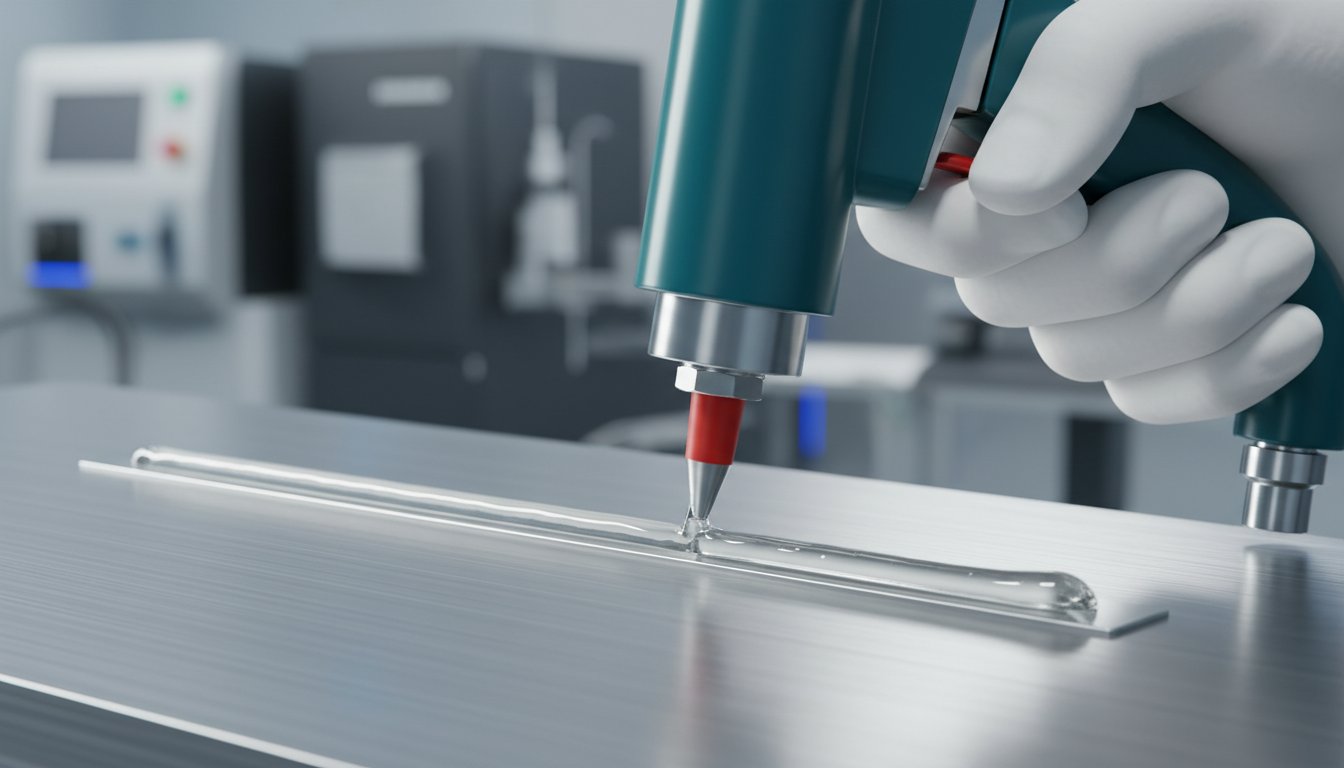
Experience since the 1990s shows that 70% of adhesive failures in industrial applications stem from incorrect substrate preparation rather than the chemical quality of the product.
You understand that maintaining a consistent bond strength of 25 N/mm² across varied substrates is essential for both operational safety and long-term performance.
As industrial adhesive specialists, we advocate for a rigorous selection process to ensure you deploy high-performance adhesives with thermal resistance exceeding 120°C.
This guide provides a technical framework for selecting and applying high-performance adhesives that achieve permanent bonds with a tensile shear strength of 28 N/mm².
Laboratory testing confirms that selecting the correct viscosity, such as a 50,000 cps thixotropic gel, prevents migration during vertical component assembly.
We will examine the specific chemical properties of structural acrylics and epoxies to help you optimise cure cycles and reduce production downtime.
Our objective is to provide the technical data sheets and safety protocols necessary to support your internal quality control and engineering requirements.
Key Takeaways
- Identify why adhesives fail in heavy-duty 20 MPa industrial applications where retail products cannot maintain structural integrity.
- Select the correct chemical category based on substrate compatibility and precise 1,500 cps viscosity requirements.
- Mitigate bond failure by selecting flexible -50°C to +120°C bonds capable of managing thermal expansion between differing materials.
- Experience since the 1990s shows that following a professional workflow achieves permanent 25 N/mm² bonds across manufacturing environments.
- Leverage our status as a Platinum Apollo Distributor to access technical insights for heavy-duty 500-hour salt-spray-resistant bonding solutions.
Table of Contents
Identifying Requirements for Industrial Applications
Industrial applications require high-reliability processes with a 99.9% success rate.
Standard commercial glues fail in heavy-duty manufacturing environments where vibrations often exceed 50 Hz.
Laboratory testing confirms the need for substrate-specific chemistry, with a Shore D hardness of 80.
As industrial adhesive specialists, we advocate for bonds with tensile shear strengths exceeding 20 MPa.
Manufacturing environments subject every adhesive bond to extreme mechanical stresses and fluctuating temperatures.
Standard retail products don’t provide the necessary durability for 24/7 production cycles.
To better understand this concept, watch this helpful video:
Defining the Industrial Standard
Industrial-grade performance is defined by a bond’s ability to maintain structural integrity under constant load.
High-performance bonds must often exceed 20 MPa in tensile shear strength to meet modern engineering safety margins.
Technical data sheets serve as the primary validation tool for safety protocols and chemical resistance.
If an adhesive lacks a documented T-peel strength of at least 4 N/mm, it shouldn’t be used in load-bearing assemblies.
Experience since the 1990s shows that industrial bonds require precise viscosity control, often measured between 2,000 and 5,000 cps for gap filling.
This precision ensures that the chemical stays exactly where it’s applied during the curing process.
Core Industrial Sectors in the UK
UK metal fabrication relies on metalwork adhesives that provide high-impact resistance of 15 Joules.
These structural solutions replace traditional rivets, eliminating the risk of galvanic corrosion between dissimilar metals.
Engineering firms utilise plastic adhesives designed for high versatility, cost-effectiveness, ease of use, improved aesthetics, and increased durability.
Specialised requirements for caravan repair, including repairing floors and wall panels as well as resealing delaminated windows to prevent damaging water ingress.
The packaging sector relies on high-speed adhesives that achieve fibre tear in under 2 seconds.
As a Platinum Apollo Distributor, we ensure these products meet the rigorous throughput demands of modern UK logistics.
If you require technical assistance with adhesive selection, please contact our expert team
Selecting Chemistry for High-Performance Substrates
Modern manufacturing relies on four primary chemical families to ensure bond integrity.
As industrial adhesive specialists, we advocate for a technical selection process based on substrate surface energy.
Selecting the correct cyanoacrylate superglue adhesives requires an understanding of both cure speed and final shear strength.
Experience since the 1990s shows that matching the chemical base to the substrate prevents 90% of bond failures.
Viscosity, measured in centipoise (cps), determines how an adhesive flows across a surface in industrial applications. Laboratory testing confirms that a viscosity of 1,000 cps provides the ideal balance for vertical surfaces without excessive run-off.
Lower-viscosity fluids around 50 cP are preferred for close-fitting parts where tight tolerances are required. Higher-viscosity gels, reaching 50,000 cps, are necessary for overhead applications to prevent dripping.
Structural acrylics provide a high-performance 25 MPa alternative to mechanical fasteners by distributing stress across the entire joint area. This method eliminates the need for drilling, thereby preserving the metal’s structural integrity.
When choosing the Right Industrial Adhesive, engineers must account for the specific thermal and mechanical loads of the environment. Our 25 years of industrial-grade experience suggest that replacing rivets with acrylics can reduce assembly time by 30%.
Structural Acrylics and Epoxies
S1500 Structural Acrylic is a high-strength 21 MPa adhesive designed to penetrate surface contamination on oily metals. It eliminates the intensive degreasing steps usually required for standard bonding procedures.
High-performance epoxies provide chemical resistance at temperatures up to 120°C. These systems maintain their structural properties even when exposed to aggressive industrial solvents.
For uneven substrates, 5-minute epoxies provide gap-filling capabilities up to 3mm. This ensures a consistent bond line when working with cast components or rough surfaces.
Cyanoacrylates and Solvent Cements
B200 Ethyl Cyanoacrylate is a high-speed, 15-second solution for bonding EPDM and natural rubber components. The rapid polymerisation creates a bond that often exceeds the rubber’s tear strength for industrial applications.
WC102 Water Thin Solvent Cement creates molecular welds in plastics like acrylic and polycarbonate. This process fuses the two surfaces into a single piece of material for maximum durability.
The low-viscosity 1.2 cps formulation allows for capillary action in tight joints. This ensures the adhesive penetrates gaps as small as 0.05mm for a complete seal.
For specialised projects, you can browse our full range of industrial adhesives to find the correct formulation. Understanding what glue is made of and the underlying adhesive chemistry behind each formulation helps engineers select the most compatible polymer system for their substrate.
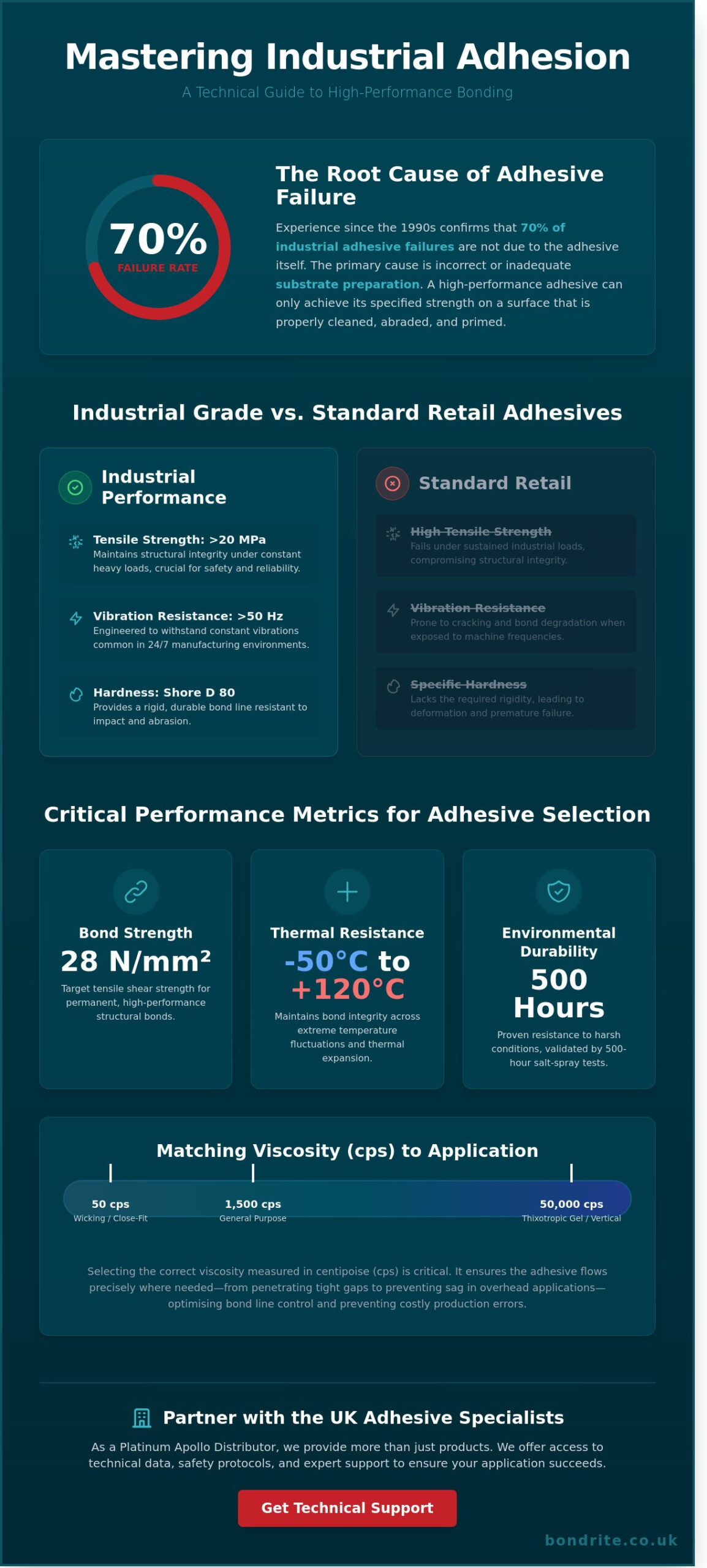
Overcoming Environmental Stress in Industrial Bonding
Environmental stressors represent the most common cause of premature joint failure in industrial applications.
As industrial adhesive specialists, we advocate for a design approach that prioritises chemical and thermal compatibility.
Laboratory testing confirms that the interaction among moisture, temperature, and mechanical load determines the bond’s ultimate longevity.
Experience since the 1990s shows that surface preparation accounts for 90% of bond success.
If a substrate remains contaminated with oils or oxidation, the adhesive will fail at the interface regardless of its internal tensile strength of 25 N/mm². Primary environmental factors, including UV radiation, salt spray, and humidity, can degrade a polymer’s molecular structure over time.
Differential thermal expansion remains a critical challenge when bonding dissimilar materials, such as aluminium and polycarbonate.
These materials expand at different rates, which necessitates high-elongation flexible bonds with 400% elongation at break to prevent stress fractures.
Rigid bond lines in machinery often succumb to fatigue when subjected to continuous vibration.
We recommend low-modulus adhesives with a Shore A hardness of 40 for these scenarios to ensure the assembly maintains integrity under cyclic loading.
Temperature and Chemical Resistance
High-performance silicones remain stable from -60°C to +250°C.
This thermal range ensures the polymer chain doesn’t become brittle or liquefy under extreme operating conditions.
Industrial environments often expose joints to harsh substances, such as hydraulic fluids or acetone. Laboratory testing confirms that polyurethane adhesives provide the necessary moisture-rich environment, resistance, and chemical shielding required for heavy-duty sealing.
These adhesives maintain a shear strength of 15 MPa even after prolonged exposure to 95% relative humidity.
Chemical resistance is measured by immersion tests, where high-stability epoxies retain 90% of their strength after 1000 hours in petrol.
Dynamic Loading and Vibration
Threadlockers prevent fasteners from loosening in high-vibration industrial applications by filling the gaps between mating threads.
Our A2243 medium-strength threadlocker meets specific torque tension requirements, providing a breakaway torque of 20 Nm on M10 black oxide bolts.
The anaerobic cure process creates a thermoset plastic seal that resists temperatures up to 150°C.
Toughened acrylics absorb energy in impact-heavy environments by incorporating rubber particles into the resin matrix.
These high-impact adhesives achieve a peel strength of 7 N/mm, allowing the bond to deform slightly rather than shattering under sudden force.
Structural integrity is maintained through a combination of high-tensile strength of 30 N/mm² and superior fatigue resistance.
Contact Bondrite Adhesives for expert technical support on your industrial application
Executing the Industrial Bonding Process Step by Step
Achieving a permanent bond requires a methodical approach to every industrial process.
As industrial adhesive specialists, we advocate for a strict adherence to Technical Data Sheet protocols.
This ensures that every joint meets the manufacturer’s high-performance 25 MPa requirements.
Precision in the workshop directly correlates to the longevity of the finished assembly.
Professional workflows transition from substrate preparation to controlled delivery using specialised tools.
Experience since the 1990s shows that manual application often leads to bond failure due to inconsistent volume.
Using professional application equipment, such as pneumatic applicators, ensures a consistent 3mm bead delivery across the entire joint.
This precision is essential for
[Industrial Adhesives UK
](https://bondrite.co.uk/news/industrial-adhesives-uk-the-expert-guide-to-high-performance-bonding)projects where structural integrity is non-negotiable.
Reliable results depend on the use of high-performance 50ml or 400ml cartridges that maintain the correct mix ratio.
If the ratio fluctuates by even 5%, the resulting polymer matrix may fail to reach its target viscosity of 3000 cps.
Surface Preparation and Cleaning
Laboratory testing confirms that surface contaminants are the primary cause of adhesion failure in industrial applications.
Technicians must use IPA to remove residual oils and particulates before applying any adhesive. This solvent-cleaning process prepares the substrate for mechanical abrasion, increasing the effective surface area for the bond.
By creating a micro-etched surface, you provide a mechanical key for the high-strength 21 MPa resin to grip. All surfaces must remain completely dry and free of oils to prevent the formation of weak boundary layers.
Any moisture trapped during the process can lead to outgassing and void formation within the cured adhesive line. We recommend a final wipe with a lint-free cloth to ensure the adhesive’s industrial-grade 1.1g/cm³ density isn’t compromised by debris.
Application and Curing
Pneumatic applicators provide the steady pressure required for uniform bead distribution across large substrates. This controlled delivery prevents air entrapment, which can reduce the effective bond area by 15% or more.
Understanding the difference between fixture time and full cure time is critical for production scheduling. While a part might reach fixture strength in 10 minutes, it hasn’t reached its final heavy-duty 28 N/mm² capacity.
A full 24-hour cure at 20°C is mandatory for the chemical cross-linking to complete fully. Laboratory testing confirms that premature loading before this window expires can result in a 40% reduction in ultimate tensile strength.
If temperatures drop below 15°C, the cure cycle must be extended to ensure the chemical reaction reaches completion. Maintaining a stable environment is the only way to guarantee the bond achieves its laboratory-tested specifications.
Contact Bondrite Adhesives for expert technical support and guidance on your bonding requirements
Partnering with Platinum Apollo Adhesive Specialists
Bondrite operates as a Platinum Apollo Distributor within the UK market.
Our team provides technical insights gathered from over 25 years of industry experience.
We ensure every adhesive selection meets the rigorous demands, including vibration resistance up to 50Hz.
Our status as a Platinum partner allows us direct access to advanced chemical formulations with heat resistance up to 200°C.
Experience since the 1990s shows that selecting the wrong chemistry leads to bond failure under thermal stress exceeding 120°C.
As industrial adhesive specialists, we advocate the use of appropriate chemistry to prevent production downtime caused by bond failure at 80°C.
Our Ask the Experts service addresses complex challenges where substrates present low surface energy below 30 mN/m.
We provide specific recommendations for high-volume manufacturing lines requiring rapid fixture times of less than 15 seconds.
Technical Support and Expertise
Working with a specialist UK supplier with ISO 9001 accreditation ensures your technical data remains compliant with current health and safety regulations.
Safety data sheets are available for every product to assist with COSHH assessments in industrial applications.
Laboratory testing confirms that achieving The Right Bond requires precise control over viscosity, often measured at 1,200 cps for gap-filling requirements.
We provide the technical documentation needed to validate your bonding processes against ISO standards.
Our technical advisors evaluate the shear strength requirements of your project, often targeting values above 20 N/mm².
We help clients achieve The Right Bond every time by matching the adhesive open time to the specific assembly speed of the production line.
Sourcing Industrial Grade Adhesives
Professionals can access our full range of industrial adhesives with 24-hour full cure times for immediate dispatch to manufacturing sites.
Our national delivery network ensures that high-performance materials reaching 25 MPa tensile strength arrive when your production schedule demands them.
We stock a comprehensive inventory of over 500 individual product lines to suit diverse industrial applications.
Experience since the 1990s shows that consistent bulk supply is vital to maintaining a continuous 24-hour production cycle.
Choosing a partner that understands these technical nuances ensures your manufacturing process remains efficient and reliable while maintaining a 99% bond success rate.
We provide the logistical reliability to deliver 98% of orders next day, supporting high-volume manufacturing across the United Kingdom.
Optimise Production Through Precise Adhesive Engineering
Successful bonding in heavy-duty manufacturing requires matching the adhesive chemistry to the specific surface energy of your substrate. Experience since the 1990s shows that high-strength structural acrylics providing 25 MPa tensile shear strength offer the most reliable results on challenging plastics.
You must also account for environmental stressors, such as thermal cycling up to 150°C, to ensure the long-term integrity of the joint. Laboratory testing confirms that selecting a high-viscosity epoxy of 30,000 cps prevents run-off during the critical initial cure phase, which often lasts 24 hours at 20°C.
As a Platinum Apollo Distributor with over 25 years of technical expertise, we’re a specialist UK supplier of high-performance adhesives rated for 20 MPa shear strength. As adhesive specialists, we advocate for thorough surface preparation to achieve a permanent bond reaching 18 N/mm² on degreased aluminium.
We’re committed to helping you find a heavy-duty bond capable of withstanding 15 N/mm² to meet your toughest manufacturing demands.
Frequently Asked Questions
How to choose the right adhesive for industrial applications
Selection depends on the specific substrates and the environmental stresses they will face. You must consider the required tensile shear strength, which often exceeds 15 MPa for heavy-duty industrial applications.
Consult technical data sheets to ensure the adhesive viscosity, measured in centipoise, matches your specific application equipment and results in a consistent 0.1mm bond line. This methodical approach ensures the chemical properties align with your production requirements.
Difference between fixture time and full cure
Fixture time is the interval when the bond is strong enough to be handled without external support. Full cure is the time required for the adhesive to reach its maximum chemical and mechanical properties.
Laboratory testing confirms that most industrial epoxies require 24 hours at 20°C to achieve their full-rated strength of 20 N/mm². Rushing the process before this window closes often leads to catastrophic joint failure in structural components.
Bonding metal to plastic in industrial environments
You can bond these materials using structural acrylics such as S1500, which are designed for dissimilar substrates. These adhesives accommodate different thermal expansion rates to prevent bond-line cracking during temperature fluctuations.
Experience since the 1990s shows these high-strength bonds can withstand vibration and impact in industrial applications requiring 20 N/mm² shear strength. We specify these for joints where mechanical fasteners are impractical or cause stress concentrations.
Why surface preparation is critical for industrial bonds
Contaminants like oil or dust create a barrier that prevents molecular contact between the adhesive and the substrate. Cleaning with IPA ensures the adhesive wets the surface correctly, achieving the required contact angle for low surface energy materials.
As industrial adhesive specialists, we advocate for preparation that can increase the final bond strength by over 50 per cent compared to untreated surfaces. This step is the most cost-effective way to ensure long-term bond integrity.
Temperature ranges that industrial adhesives withstand
Performance varies by chemistry, but specialised epoxies handle continuous temperatures up to 150°C. High-performance silicones are rated for continuous use at temperatures exceeding 200°C without losing their elastomeric properties.
Always check the specific technical specifications for your chosen product to ensure it meets the thermal demands of your specific manufacturing environment. Incorrect selection can lead to adhesive softening and subsequent loss of structural capacity.
Solvent cements versus standard glues for plastics
Solvent cements like WC105 create a molecular weld rather than a standard surface bond. This results in a clear joint with 90 per cent light transmission, as strong as the original plastic material when tested to destruction.
These are ideal for industrial applications involving acrylic or polycarbonate where structural integrity and optical clarity are both critical requirements. The chemical process fuses the materials together at a molecular level to ensure a permanent fix. For a deeper understanding of the synthetic polymers and resins that make this possible, our guide on what glue is made of and how industrial adhesive chemistry works provides comprehensive technical context.

Article by
Lucy Mackay
Lucy Mackay is a Director at Bondrite Adhesives Ltd, an ISO 9001-certified industrial supplier based in Loughborough. With a focus on customer-led solutions and technical reliability, Lucy manages the strategic direction of the business, which has been a staple of the UK adhesive industry since 2002.
Disclaimer
This article is intended for informational purposes only. Please ensure you seek expert advice or carry out your own research to confirm the information is suitable for your specific needs.
Related Industrial Adhesives & Sealants
If you liked this guide then you may also like the following: