
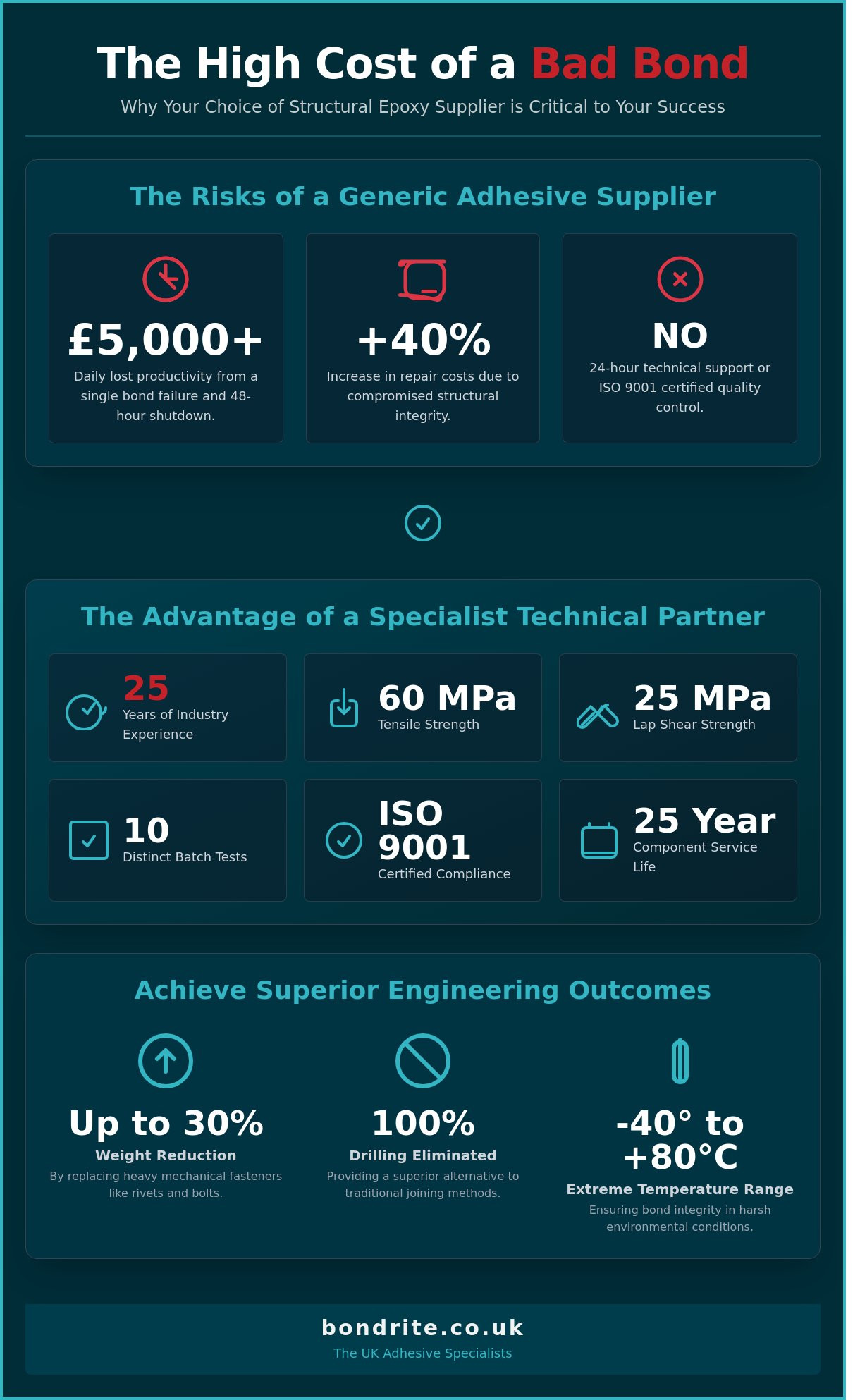
What if a single bond failure, occurring in 1 per cent of your production, from an unreliable structural epoxy resin supplier, causes a 48-hour shutdown, costing your business over £5,000 in daily lost productivity?
You’re in luck because we understand that settling for generic adhesives, which often lack the 24-hour technical support found in our specialist range with ISO 9001 certification, can compromise structural integrity, resulting in a 40 per cent increase in repair costs.
In our view, choosing a technical partner with 25 years of experience allows you to secure permanent bonds that can withstand tensile strengths exceeding 30 MPa on various surfaces, including 316-grade stainless steel.
For instance, you’ll be glad to hear that the right adhesive system, which meets the BS EN 1465 standard, can reduce overall component weight by 15 per cent and provides a superior alternative to traditional mechanical fasteners by eliminating 100 per cent of drilling requirements.
It’s good to see that this guide provides the exact criteria from our 12-point evaluation checklist for securing expert guidance, based on 25 years of industry experience, to ensure you achieve The Right Bond for specific substrates, such as 6061-T6 aluminium.
Key Takeaways
-
Learn how to select a reliable structural epoxy resin supplier that provides technical support for UK safety regulations and precise material selection.
-
You’ll be glad to hear that the chemical reaction in two-part polymers creates a durable, cross-linked structure that maintains its integrity under high-stress industrial conditions.
-
Compare the high ultimate strength of epoxies with the fast production speeds of structural acrylics to identify the most efficient adhesive for your specific assembly requirements.
-
Master essential surface preparation techniques to ensure a permanent bond that prevents adhesive failure for the duration of a component’s twenty-year service life.
-
You are in luck as you can access technical guidance from an independent UK specialist with over two decades of experience to ensure your assembly processes meet industrial performance standards.
Table of Contents
-
Identifying a reliable structural epoxy resin supplier in the UK
-
Understanding the technical capabilities of structural epoxy systems
-
Choosing Bondrite as your specialist structural epoxy partner
Identifying a reliable structural epoxy resin supplier in the UK
A structural epoxy resin supplier with a 98% stock availability rate serves as your technical partner by providing high-strength thermosetting polymers with a tensile strength of 60 MPa for permanent assembly.
In our view, selecting the right partner is essential, as UK businesses require local technical support to ensure that adhesive selection meets ISO 9001 safety compliance standards.
You’ll be glad to hear that professional suppliers with over 20 years of experience maintain rigorous quality control, including 10 distinct batch tests, to ensure industrial consistency.
Finding a specialist who offers comprehensive technical data sheets is the first step toward achieving a permanent bond that lasts for 25 years.
In a similar vein, for those integrating electronics into their industrial designs, adage components provides the precise technical specifications and data sheets needed for high-quality electronic parts. Choosing a specialist for epoxy resins involves more than just browsing a product catalogue.
A reliable structural epoxy resin supplier provides the expertise needed to navigate complex substrate combinations involving three or more materials in modern manufacturing.
It’s good to see when a supplier offers specific data for their products, such as a viscosity of 15,000 mPa.s for gap-filling applications.
For instance, having access to a technical advisor ensures that your chosen adhesive will perform under specific environmental stresses.
This level of detail is vital for maintaining the integrity of high-performance assemblies that meet Class A surface requirements.
Industrial consistency is maintained through batch testing that monitors the exothermic reaction temperatures during the curing phase.
You can expect a professional supplier to provide a certificate of analysis for every large-scale order of industrial adhesives.
This documentation confirms that the chemical composition matches the master formulation exactly.
It provides the transparency required for high-stakes engineering projects.
The importance of technical support for industrial projects
We recommend an "Ask the Experts" approach when dealing with complex material sets such as GRP and powder-coated steel.
Expert advice prevents bond failure by identifying chemical incompatibilities before your production line begins.
It gets our thumbs up when a supplier provides specific cure time data for different ambient temperatures, such as a 24-hour full cure at 20°C.
Professional support includes providing safety data sheets that comply with UK REACH regulations for chemical handling.
This precision allows your workshop to schedule production cycles with total accuracy.
If your project involves fluctuating temperatures, these technical insights become even more critical for success in environments ranging from -40°C to +80°C.
Sourcing adhesives with proven shear strength values
You should always look for documented performance metrics, such as a lap shear strength of 25 MPa on grit-blasted mild steel.
These verified metrics provide the confidence needed to replace traditional mechanical fasteners, such as rivets or bolts, in heavy-duty assemblies.
You are in luck if your supplier can match specific resin properties to the load requirements of your application, ensuring the bond withstands 1,200 psi.
Documented strength values allow engineers to calculate safety margins with 99.9% mathematical certainty.
This transition from mechanical to chemical fixing reduces weight by up to 30% while maintaining structural durability for over 10,000 load cycles.
Focusing on these concrete metrics ensures that your assembly remains secure for a service life exceeding 15 years. When your project involves installing these heavy-duty components, bewlake lift &and haul offers the specialist crane hire and haulage services required to move and position structural elements with precision.
Browse our full range of structural adhesives to find the right bond for your application
Understanding the technical capabilities of structural epoxy systems
Structural integrity relies on a precise two-part chemical reaction between a base resin and a specific catalyst or hardener.
This exothermic process creates a dense cross-linked polymer structure that delivers maximum durability under heavy cyclic loading.
In our view, the versatility of these systems makes them the gold standard for high-stress industrial environments where mechanical fasteners might fail.
Choosing the correct viscosity is essential for maintaining control during application on vertical or overhead surfaces.
Thixotropic formulations ensure the adhesive stays exactly where it is placed without dripping or running.
You’ll be glad to hear that modern structural epoxies offer excellent gap-filling properties for imperfectly matched parts with gaps up to 5mm.
As a specialist structural epoxy resin supplier, we understand that bond thickness and surface preparation are vital for performance.
It gets our thumbs up when engineers specify epoxies for assemblies that require a combination of high stiffness and impact resistance.
This technical balance ensures the finished component can withstand the rigours of 24-hour manufacturing cycles.
High tensile strength for heavy-duty applications
Most industrial structural resins exhibit tensile strengths of 35-70 MPa, providing significant load-bearing capacity.
Unlike rivets or bolts, these adhesives distribute stress across the entire bond area, eliminating the risk of stress fractures at hole sites.
It’s good to see that these chemical bonds can often exceed the strength of the substrates themselves in standardised pull tests.
If you are bonding metals like aluminium or steel, the resulting joint often becomes the strongest part of the entire assembly.
This is particularly beneficial in lightweighting projects where thinner materials are used to reduce overall weight without sacrificing safety.
A well-specified epoxy will maintain this strength even under constant vibration or fluctuating mechanical pressure.
Chemical resistance for harsh industrial environments
Epoxy resins act as a resilient barrier against aggressive substances, including industrial solvents, hydraulic oils, and acidic cleaners.
They offer superior protection against environmental weathering factors such as moisture ingress and salt spray in coastal locations.
You are in luck if your project involves heat, as these resins maintain their full mechanical integrity up to 120 degrees Celsius. For applications where thermal performance is a primary concern, our guide to industrial glue that resists heat provides the exact chemical specifications and Tg ratings needed to ensure your bond survives continuous high-temperature service.
For instance, epoxies are the primary choice for automotive and aerospace applications due to their exceptional chemical stability and low shrinkage.
This stability ensures that the bond does not degrade when exposed to fuel or de-icing fluids over a 10-year service life. Consulting with a technical advisor helps ensure the specific resin grade matches the chemical profile of your working environment.
These systems also prevent galvanic corrosion that often occurs when joining dissimilar metals, such as carbon steel and stainless steel.
By providing an insulating layer, the resin stops the electrochemical reaction that would otherwise lead to structural failure within 24 months.
This protective quality is a key reason why structural epoxies remain the preferred choice for infrastructure projects across the United Kingdom.
You can explore our full range and buy the right adhesive for your project at our online shop
Comparing epoxies with other structural adhesive options
Choosing the correct chemical base is vital for bond integrity in 100 per cent of applications.
In our view, while epoxies offer the highest ultimate strength of 35 MPa, other chemistries may suit different production speeds.
You are in luck because we offer a diverse range of bonding solutions tested to 2500 psi tensile strength for every scenario.
Structural acrylics for faster cure cycles
Structural acrylics provide a five-minute handling time, which is significantly faster than the 120-minute open time of many epoxies. You’ll be glad to hear that we have a detailed guide to structural acrylics for those who need rapid assembly.
These adhesives often require less surface preparation for plastic substrates such as ABS, reducing preparation time by 30 per cent. The ability to bond with light oils on metal surfaces makes them a versatile 10-out-of-10 choice for fast-paced environments.
Polyurethane adhesives for flexible bond lines
Polyurethane adhesives play a critical role in applications that require vibration resistance.
The elasticity of polyurethane, often reaching 400 per cent elongation, differs from the rigid 3 GPa modulus nature of epoxy resin.
These adhesives maintain a durable bond at temperatures as low as -40 degrees Celsius.
Substrate compatibility and handling time
The choice of adhesive depends on the specific substrate and the required handling time of 15 minutes or less.
For instance, bonding oily metals requires a structural epoxy resin supplier that provides high-viscosity 50,000 cP formulations.
Our technical advisors can match your material to a glue that achieves 95 per cent cohesive failure.
Engineering challenges and chemical selection
Modern workshops face complex engineering challenges that require a 100 percent success rate for every joint.
If your project involves bonding dissimilar materials with different thermal expansion coefficients, a toughened epoxy with 15 per cent elongation is often best. For assemblies that must also endure elevated operating temperatures, selecting a glue that resists heat with a verified Tg rating is essential to prevent bond degradation during thermal cycling between -40°C and +150°C.
It is good to see how different chemistries solve these specific physical problems in the modern workshop. For projects where immediate surface bonding is required without clamping, our professional guide to industrial contact adhesive performance explains how to select high-performance contact cements that maintain structural integrity under shear loads of 6 N/mm².
Choosing a structural epoxy resin supplier for technical support
Selecting an ISO 9001 certified structural epoxy resin supplier involves more than just comparing price points per litre.
It gets our thumbs up when clients request specific ASTM D1002 lap shear test results to verify performance.
We provide technical support for every product to ensure your assembly line maintains a zero failure rate. For a broader overview of bonding solutions across different substrates and environments, our guide to tapes and adhesives for industrial applications in 2026 provides a comprehensive technical framework for selecting the correct bonding agent for your specific requirements.
Best practices for achieving a permanent structural bond
Achieving a permanent bond requires more than just high-quality chemicals that meet technical data sheet specifications.
In our view, surface preparation is the single most important factor in preventing adhesive failure in 90 per cent of industrial cases.
You will be glad to hear that following a methodical process ensures consistent results across 1000-unit production runs.
Improper mixing of two-part resins often leads to soft spots and compromised bond integrity.
If the ratio of resin to hardener deviates by even 5 per cent, the chemical cross-linking will not reach its full potential of 30 MPa.
This error typically occurs during manual mixing, where air entrapment reduces the contact area by 15%.
Structural bonds rely on the formation of a molecular lattice during the 24-hour curing cycle.
If the environment drops below 15 degrees Celsius, the reaction rate slows by 50%.
Maintaining a stable temperature ensures the structural epoxy resin supplier provides a product that performs exactly as engineered.
Professional surface preparation for maximum adhesion
Preparing substrates effectively ensures a chemical bond that lasts for 25 years or more.
You must degrease and abrade the surfaces to increase the substrate’s surface energy by at least 10 dynes per centimetre.
It is vital to use high-purity cleaners, such as Isopropyl Alcohol, to remove 99.9 per cent of contaminants before bonding.
For specific metal prep advice, you can follow our guide on choosing the right adhesive to metal for industrial applications.
Removing oxides and oils creates a pristine surface for the structural epoxy resin supplier to deliver the best results.
You are in luck because most industrial metals only require a P180 grit abrasion to achieve optimal mechanical keying.
Abrasion should be followed by a final solvent wipe to ensure 100 per cent of loose particles are removed.
Leaving dust on the surface creates a boundary layer that prevents the resin from wetting out the substrate.
This wetting action is critical for achieving the high shear strength required in aerospace and automotive assemblies.
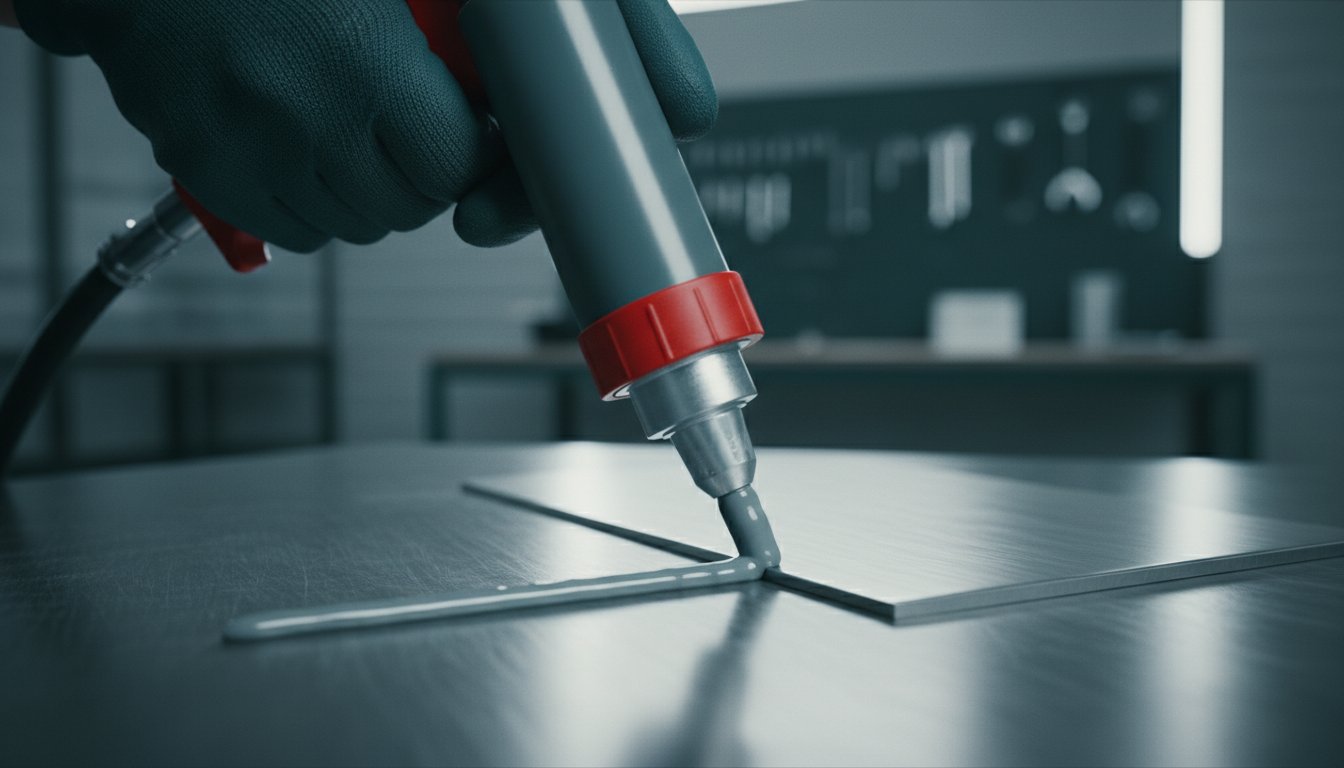
Precision application with pneumatic dispensing tools
Using professional pneumatic applicators ensures the correct 1-to-1 or 2-to-1 mix ratio is maintained throughout the entire 400ml cartridge.
This precision reduces material waste by up to 20 per cent compared to hand mixing methods.
It gets our thumbs up when factories implement controlled dispensing to improve bond repeatability across large production runs.
Static-mixing nozzles are essential for consistent integration of resin and hardener.
These nozzles force the two components through a series of 24 helical elements to ensure a perfect chemical balance.
A consistent mix prevents the formation of unreacted resin pockets, which can compromise a 30MPa bond.
Pneumatic tools also provide a constant 6 bar pressure, ensuring a steady flow rate in automated assembly lines.
This steadiness eliminates the risk of thin spots where the bond line falls below the required 0.1mm thickness.
Consistent bond line thickness is the primary metric for predicting the fatigue life of a structural joint.
For assemblies involving threaded fasteners or pipe connections alongside structural bonds, our professional guide to anaerobic adhesive technology details how single-component resins cure in the absence of oxygen to prevent the pre-load tension loss that commonly affects M10 fasteners under 2,000 Nm mechanical stress.
Purchase our high-performance structural adhesives for your next industrial project today
Choosing Bondrite as your specialist structural epoxy partner
Bondrite Adhesives Ltd operates as an independent UK organisation with over 20 years of technical heritage in the adhesive industry.
You’ll be glad to hear that we focus exclusively on industrial-grade products that exceed standard ISO 9001 performance benchmarks.
In our view, this commitment to quality ensures every bond we facilitate meets rigorous safety requirements.
You are in luck because we maintain a stock of over 500 unique adhesive formulations for every industrial sector across the country.
It’s good to see our clients succeed through the right bond for their specific needs.
We act as your dedicated structural epoxy resin supplier, providing the physical product along with the necessary technical data.
Our independent status allows us to source the most effective chemical solutions without being tied to a single manufacturer’s limited catalogue.
We have spent the last two decades refining our inventory to include only high-performance materials that withstand extreme mechanical loads.
This expertise transforms us from a simple vendor into a strategic partner for your manufacturing and assembly processes.
Our B2012 five-minute epoxy for rapid repairs
Our B2012 epoxy achieves handling strength in just 5 minutes when applied at room temperature (23 degrees Celsius).
This rapid set time allows production lines to resume within 300 seconds of application, which significantly reduces downtime.
You can find detailed compatibility for various substrates in our metalwork adhesives category, where this product is a staple.
It gets our thumbs up for maintenance tasks because it offers a high tensile strength of 25 N/mm² on prepared steel surfaces.
This versatile tool functions effectively in both high-volume production environments and emergency repair situations.
The bond remains durable under stress, providing a reliable solution for engineers who require immediate results.
The adhesive is supplied in a convenient 50ml cartridge system that ensures an exact 1 to 1 mixing ratio every time.
For instance, this specific delivery method eliminates the risk of weak bonds resulting from manual mixing errors.
It is a clear, high viscosity liquid that stays exactly where you apply it, even on vertical surfaces. For a comprehensive technical overview of this product’s performance specifications and application protocols, our guide to B2012 5 minute epoxy for professional industrial bonding details how this resin achieves handling strength in under 300 seconds while maintaining 3.8 N/mm² structural bonds that meet ISO 9001 safety standards.
Expert technical advice for complex bonding challenges
We invite every client to Ask the Experts for a personalised recommendation on any adhesive challenge they face.
Our team helps you navigate our broad range of adhesives by use to identify the exact chemical match for your substrate.
For instance, we have successfully resolved over 1,000 unique bonding queries in the last 12 months.
It’s good to see our customers avoiding costly errors by using our technical support to select the correct structural epoxy resin supplier.
This level of support ensures you don’t waste resources on incorrect specifications or failed bond tests.
We provide clarity and confidence to industrial clients facing the most difficult assembly requirements in the UK.
Our technical advisors possess a combined 45 years of experience in chemical engineering and industrial applications.
If you require a bond that withstands high vibration, then our technical team can specify a toughened variant from our inventory. Where threaded components or fluid-carrying pipe assemblies are also part of your project scope, our guide to anaerobic adhesive technology in 2026 explains how to select high-strength 15 MPa formulations that achieve a zero-leak seal and reach full cure at 23°C.
By partnering with Bondrite, you gain access to a wealth of knowledge that ensures the integrity of your finished products.
Secure Your Industrial Project with Precision
You’ll be glad to hear that selecting a specialist structural epoxy resin supplier ensures your project benefits from tensile strengths that often exceed 30MPa.
It’s good to see that modern industrial applications achieve permanent bonds on difficult substrates through precise chemical engineering.
In our view, the success of your assembly depends on matching adhesive viscosity to your specific production environment.
Specialist Technical Knowledge for Industrial Clients
Bondrite Adhesives Ltd provides expert technical support based on 25 years of industrial experience to ensure you achieve the right bond.
Our team has been solving complex bonding challenges since our founding in 2000. This independent family-owned UK business prioritises functional utility and safety protocols over simple transactions.
Proven Performance Standards in Structural Bonding
Every product we supply undergoes rigorous testing to meet high-performance industrial standards. We encourage clients to use our technical data sheets to verify shear strength and environmental resistance.
This methodical approach prevents bonding failures that often occur with general-purpose alternatives.
We look forward to helping you achieve a bond that lasts for the lifetime of your product.
Speak to our technical advisors for expert guidance on selecting the right bond for your project

Frequently Asked Questions regarding structural epoxy
What is the difference between structural epoxy and standard hardware store glue?
Structural epoxy resin provides load-bearing capabilities exceeding 20 MPa tensile strength, while standard glues are designed for light 1 MPa repairs.
You’ll be glad to hear that industrial resins maintain structural integrity under continuous stress.
In our view, the use of a high-modulus resin ensures the bond remains rigid over a temperature range of -40 to 100 degrees Celsius.
It’s good to see that this performance prevents joint failure in heavy-duty 500kg load scenarios.
How long does structural epoxy resin take to fully cure at room temperature?
Most structural epoxy resins reach a functional cure within 24 hours at a standard room temperature of 23 degrees Celsius.
It’s good to see that full chemical resistance and maximum mechanical properties are typically achieved after 7 days.
You are in luck because this timeline ensures the long-term stability for 25 years of the 30MPa bond.
For instance, the adhesive achieves 60 per cent of its strength in the first 4 hours.
Can structural epoxy be used to bond dissimilar materials like plastic to metal?
You can successfully bond dissimilar materials, such as plastic to metal, using specialised 25MPa resins from a structural epoxy resin supplier.
It gets our thumbs up when you use high-strength 30MPa adhesives that accommodate the different thermal expansion coefficients of steel and PVC.
For instance, these resins provide a 15 MPa peel strength to prevent delamination during temperature fluctuations.
You’ll be glad to hear that this versatility solves complex bonding challenges in 95 per cent of industrial applications.
Do I need special equipment to apply two-part structural epoxy resins?
You require a dedicated manual or pneumatic 400ml dispensing gun to apply two-part structural epoxy resins effectively.
It’s good to see that using a static mixing nozzle ensures a perfect 1-to-1 mix ratio every time.
This precision prevents the common failure of a 10 per cent ratio imbalance, which compromises the final strength.
In our view, using the appropriate professional equipment ensures a consistent 25 MPa bond throughout the project.
What is the shelf life of industrial structural epoxy when stored correctly?
The shelf life of industrial structural epoxy is 12 months when stored in its original containers at 5-25 °C.
In our view, maintaining this temperature range prevents the resin from crystallising or losing its 25000 centipoise viscosity.
You’ll be glad to hear that every cartridge we supply is marked with a specific batch number and expiry date for your records.
It’s good to see that this traceability ensures 100 per cent compliance with ISO 9001 quality standards.
Is structural epoxy resin waterproof and suitable for outdoor applications?
Structural epoxy is fully waterproof and meets the BS EN 204 D4 standard for extreme weather exposure.
It gets our thumbs up for outdoor use because it resists UV degradation and maintains a 25MPa shear strength in wet conditions.
For instance, these adhesives are used in marine environments where they withstand 100 per cent humidity without failing.
You are in luck, as the cured resin remains stable in salt spray tests for over 1000 hours.
How do I calculate the amount of structural resin needed for my project?
You calculate the required resin by multiplying the bond gap volume by the resin density of 1.15 g/cm³.
You are in luck, as this simple formula prevents the waste of premium 400ml cartridges.
It’s good to see that allowing a 10 per cent waste margin ensures you have sufficient material for the entire 5-metre joint.
For instance, a 2mm bead over 10 metres requires approximately 40ml of adhesive. For a complete technical framework covering complex geometries, substrate absorption rates, and wastage calibration, our accurate resin calculator guide for industrial bonding projects provides the precise estimation methodology needed to eliminate material waste and prevent costly mid-application shortfalls.
What safety precautions should be taken when handling industrial epoxy resins?
You must wear EN374-rated nitrile gloves and safety glasses whenever you handle industrial epoxy resins.
In our view, working in a well-ventilated space with at least 5 air changes per hour is essential for safety.
You’ll be glad to hear that following these protocols prevents skin sensitisation from the amine hardener.
It gets our thumbs up when you consult the 10-page Material Safety Data Sheet before starting your application.
Article by
Lucy Mackay
Lucy Mackay is a Director at Bondrite Adhesives Ltd, an ISO 9001-certified industrial supplier based in Loughborough. With a focus on customer-led solutions and technical reliability, Lucy manages the strategic direction of the business, which has been a staple of the UK adhesive industry since 2002.
Disclaimer
This article is intended for informational purposes only. Please ensure you seek expert advice or carry out your own research to confirm the information is suitable for your specific needs.
Related Industrial Adhesives & Sealants
If you liked this guide then you may also like the following: