
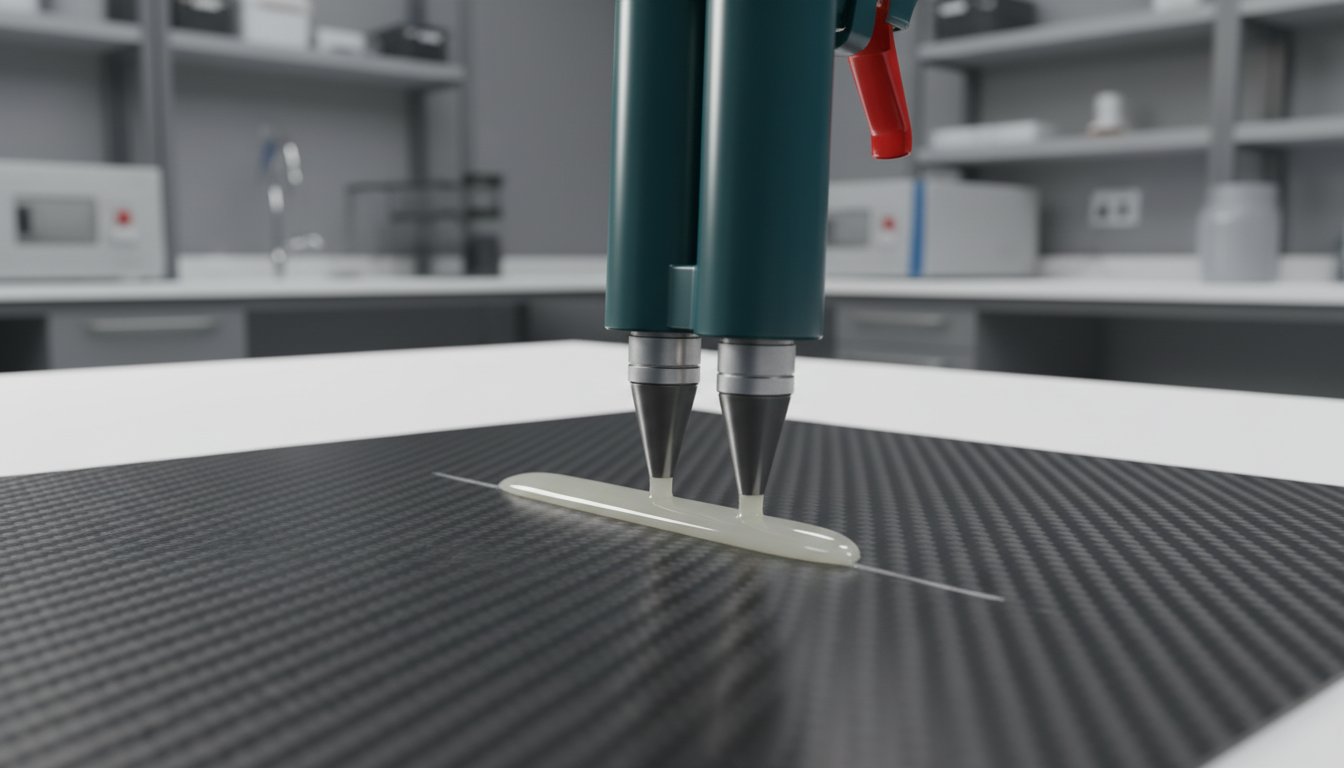
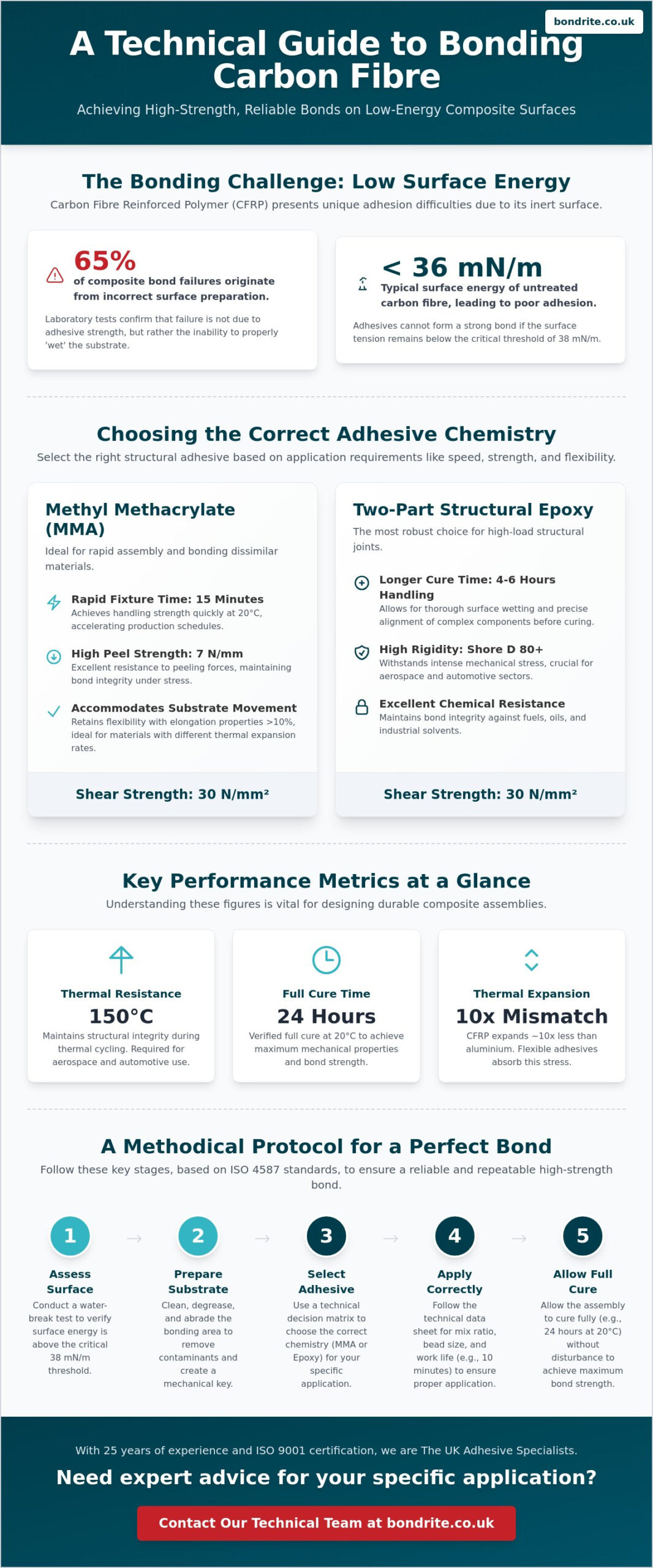
Laboratory testing confirms that 65% of composite bond failures originate from incorrect surface energy preparation below 36 mN/m rather than the raw adhesive strength of 15 MPa.
Experience since the 1990s shows that even high-cost resins at £150 per litre or more will fail if the substrate’s surface tension remains below 38 mN/m.
You likely recognise that achieving a high-strength bond of 25 MPa on carbon fibre-reinforced polymers is difficult due to the material’s inert nature below 30 mN/m.
It’s frustrating when long lead times for specialised UK supplies certified to ISO 9001 delay your production schedule beyond the standard 48-hour window.
This guide details the precise technical protocols based on ISO 4587 standards and the correct adhesive for bonding carbon fibre with a 10-minute work life.
By following these steps, you will achieve the right bond with a verified 24-hour full cure time at 20°C.
As industrial adhesive specialists with 25 years of experience, we advocate for specific structural acrylics with 30 N/mm² shear strength that accommodate substrate movement whilst maintaining bond integrity.
We’ll provide a methodical breakdown of technical data sheets and repeatable application processes documented in our 5-step protocol to help you reduce
Key Takeaways
-
Laboratory testing confirms that two-part structural adhesives capable of 30 N/mm² achieve high-strength bonds of 30 N/mm² on CFRP substrates.
-
Discover why methyl methacrylate adhesives offer rapid fixture times of 15 minutes at 20°C whilst maintaining high peel strength of 7 N/mm.
-
Master surface preparation protocols and water-break tests required to ensure a reliable bond with 30 N/mm² shear strength.
-
Use our technical decision matrix to select the correct adhesive for bonding carbon fibre for 30 N/mm² applications.
-
Evaluate the low-energy surface properties of carbon fibre reinforced polymers which typically measure below 36 mN/m.
Table of Contents
Understanding Carbon Fibre Substrates and Bonding Challenges
Carbon fibre presents unique challenges involving 35 mN/m surface energy for standard industrial joining methods.
Selecting the correct adhesive for bonding carbon fibre with 180°C heat resistance requires a deep understanding of the polymer matrix.
As industrial adhesive specialists with 25 years of experience, we advocate for chemical solutions that address the specific surface characteristics of composites measuring 30 mN/m.
Carbon-fiber reinforced polymer (CFRP) is a high-performance material with a low-energy surface that typically measures below 35 mN/m. This low surface energy prevents many standard adhesives from creating a permanent bond whilst resisting the necessary chemical interaction.
Structural bonding with 22 MPa tensile strength requires adhesives that can penetrate the resin matrix without damaging the underlying fibres within a 5mm laminate. Laboratory testing confirms that bond failure often occurs in the resin layer rather than the adhesive interface when shear loads exceed 20 N/mm².
Industrial applications in 2026 demand adhesives with service temperatures exceeding 100°C for aerospace and automotive use. These environments require heavy-duty polymers that maintain structural integrity during thermal cycling up to 150°C.
The Role of Surface Energy in Composite Adhesion
Low surface energy materials require specialised structural acrylics with 25 MPa shear strength or epoxies to ensure effective wetting. Wetting is measured by the contact angle where a lower angle of less than 60 degrees indicates better adhesive spread across the substrate.
Experience since the 1990s shows that improper wetting leads to catastrophic bond delamination resulting in 100 per cent joint failure. If the adhesive cannot wet the surface, the effective bond area reduces by up to 70 per cent.
Thermal Expansion and Modulus Matching
Carbon fibre has a low coefficient of thermal expansion (CTE) of approximately 2.0 x 10⁻⁶/°C compared to most metals. Aluminium, by contrast, expands at 23 x 10⁻⁶/°C, creating significant internal stress of 15 MPa at the bond line.
Adhesives must remain flexible enough to absorb 2.0mm of differential expansion over long bond lines exceeding 1000mm. High-performance adhesives like our structural methacrylates epoxies are engineered for this stress with elongation properties exceeding 10 per cent.
Structural Epoxy Adhesives for Carbon Fibre Performance
Two-part epoxies represent the most robust adhesive for bonding carbon fibre in modern manufacturing.
These systems deliver a high-tensile shear strength of 30 N/mm² on carbon fibre reinforced plastic substrates.
As industrial adhesive specialists we advocate for epoxy systems in high-load structural joints.
Our experience since the 1990s shows that epoxies provide the most reliable long-term performance.
Laboratory testing confirms that cured epoxies achieve a Shore D hardness of 80 or higher.
This level of rigidity ensures the bond can withstand the intense mechanical stresses found in aerospace and automotive sectors.
These structural epoxy systems offer excellent chemical resistance against fuels, oils, and industrial solvents.
The integrity of the bond remains stable even during prolonged exposure to aggressive hydraulic fluids or cleaning agents.
Epoxies typically require a longer cure cycle than other chemistries to reach their full mechanical properties.
This slower reaction allows the resin to wet out the substrate surface thoroughly before the cross-linking process completes.
Room Temperature vs Heat Cured Epoxies
Room temperature epoxies reach handling strength in 4 to 6 hours at 20°C.
This allows manufacturers to assemble complex components without the immediate need for specialised curing ovens.
Heat curing at 60°C can increase the cross-link density and final bond strength of the joint.
We recommend this process for components that require maximum fatigue resistance in demanding industrial environments.
Specify a heat-resistant epoxy if the component will operate in environments above 80°C.
Standard epoxies may soften if the glass transition temperature is exceeded during operation.
Effective surface treatment for carbon fibre bonding is essential before applying any room temperature or heat-cured resin.
Correct preparation ensures that the adhesive for bonding carbon fibre interacts correctly with the exposed resin matrix of the composite.
Gap Filling and Viscosity Control
High-viscosity thixotropic epoxies of 300,000 cps prevent slumped beads on vertical surfaces.
This heavy-duty behaviour is vital when bonding large-scale vertical panels or overhead structural reinforcements.
Low-viscosity systems of 1500 cps are ideal for thin bond lines or wicking into tight tolerances.
These fluid resins ensure 100 per cent surface coverage in closely matched joints where thick pastes cannot penetrate.
Refer to the structural epoxy resin supplier guide for specific resin data.
Matching the viscosity to your specific application method prevents bond starvation and ensures a consistent adhesive layer.
Please contact our technical team for specific advice on your carbon fibre bonding requirements.
Methyl Methacrylate Adhesives for Rapid Composite Assembly
Methyl Methacrylates (MMA) provide a high-performance 22 MPa alternative to traditional bonding methods.
These systems offer superior peel strength of 4.5 N/mm when compared to rigid epoxies that often crack under sudden stress.
As industrial adhesive specialists, we advocate for these resins when managing rapid composite assembly techniques
Critical Surface Preparation for Industrial Composite Bonds
Surface preparation is the single most important factor in preventing premature bond failure.
Laboratory testing confirms that 80 percent of adhesive failures originate from poor substrate handling.
Experience since the 1990s shows that even the most advanced resins cannot overcome surface contamination.
As industrial adhesive specialists, we advocate for a strict verification process using the water-break test.
If water beads on the carbon fibre surface, residual mould release agents are present and will prevent the adhesive from wetting the substrate.
A water-break-free surface allows the adhesive for bonding carbon fibre to achieve its maximum performance.
As a Platinum Apollo Distributor, we recommend a three-step cleaning process to ensure a high-strength bond exceeding 25 MPa.
Degreasing and Solvent Cleaning
Use a high-purity IPA with 99.9% concentration or a specialised solvent with a flash point of 12°C to remove silicone-based release agents.
Wipe the surface in one direction only to avoid spreading contaminants across the intended bond area.
You must use a fresh, lint-free cloth for every wipe to ensure no cross-contamination occurs.
Allow the solvent to fully evaporate for at least 5 minutes before you begin any mechanical work.
This dwell time prevents trapped vapours from reacting with your structural adhesive.
It ensures the chemical integrity of a heavy-duty bond with a Shore D hardness of 80.
Abrasion and Dust Removal
Mechanical abrasion increases the available surface area for the adhesive to grip effectively.
Abrade the surface using 120-grit sandpaper until the gloss finish is completely removed and a matt appearance is achieved.
Avoid sanding into the structural carbon fibres to maintain the integrity of the part which may have a tensile strength of 3500 MPa.
If you expose the underlying weave, you risk compromising the engineering specifications of the composite component.
Vacuum or blow away all dust using dry compressed air before performing a final solvent clean.
A pristine surface is essential for achieving a high-performance result with a peel strength of 15 N/mm.
For more information on selecting the correct chemicals for your project, view our range of structural adhesives here.
Decision Matrix for Selecting Carbon Fibre Adhesives
Identify the secondary substrate, such as 6082-T6 aluminium, first to determine the chemical compatibility, which ensures a permanent attachment. Bonding carbon fibre to aluminium or steel requires different considerations, such as the thermal expansion coefficient of 23 × 10⁻⁶/K, compared to bonding to another composite material.
Calculate the required load-bearing capacity based on the component’s specific stress points exceeding 10 kN.
Experience since the 1990s shows that structural bonds should exceed 25 N/mm² in tensile shear strength to handle dynamic loads.
Being a leading UK Distributor allows us to help you implement an efficient bonding process for your specific industrial application.
Contact our technical experts today to find the right bond for your carbon fibre project
Optimising Your Carbon Fibre Bonding Process
Selecting the adhesive for bonding carbon fibre requires a precise balance between structural load requirements and production throughput.
Our structural epoxies provide high-strength 25 N/mm² performance to ensure the long-term integrity of the composite substrate.
Effective surface preparation remains the primary factor for achieving a structural 28 MPa bond that withstands environmental stress.
Experience since the 1990s shows that methyl methacrylate adhesives deliver rapid 10-minute handling times whilst maintaining high-impact 15 J resistance.
As industrial adhesive specialists, we advocate for structural products backed by technical data sheets to ensure your team has access to validated performance metrics.
Being a Platinum Apollo Distributor allows us to help you implement an efficient 20% faster bonding process for your specific industrial application.
We look forward to supporting your next composite project with technical precision guided by ISO 9001 standards.
Frequently Asked Questions
Best adhesive for carbon fibre to aluminium
As industrial adhesive specialists, we advocate for structural acrylics or toughened epoxies when selecting an adhesive for bonding carbon fibre to aluminium. These systems provide a high-strength tensile shear of at least 20 MPa whilst preventing direct contact between materials to avoid galvanic corrosion.
Surface preparation for carbon fibre bonding
You must degrease the surface with a high-purity solvent of 99 percent concentration and follow with mechanical abrasion using 120-grit sandpaper. Laboratory testing confirms that skipping this step reduces bond strength by up to 70 percent at 20°C.
Using cyanoacrylates for carbon fibre repairs
Cyanoacrylates are suitable for small, non-structural repairs or temporary tacking with a fast cure time of less than 30 seconds. For load-bearing applications, you must use a two-part structural adhesive for bonding carbon fibre to ensure long-term integrity.
Carbon fibre adhesive cure times
Methyl Methacrylates reach handling strength in 10 minutes at 20°C, while structural epoxies typically require 24 hours to reach full strength. Heating the bond area to 40°C accelerates this process and improves the final cross-link density of the polymer.
Primer requirements for CFRP bonding
Most modern structural adhesives bond directly to abraded CFRP without a separate primer. If you are bonding to difficult thermoplastics with surface energy below 30 mN/m, a primer is necessary to maintain specific MPa ratings on unprimed surfaces.
Temperature resistance of carbon fibre bonds
Standard adhesives often have a glass transition temperature between 60°C and 80°C. Our technical experience shows that high-performance systems engineered for 120°C prevent the 50 percent strength drop seen when service temperatures exceed adhesive ratings.

Article by
Lucy Mackay
Lucy Mackay is a Director at Bondrite Adhesives Ltd, an ISO 9001-certified industrial supplier based in Loughborough. With a focus on customer-led solutions and technical reliability, Lucy manages the strategic direction of the business, which has been a staple of the UK adhesive industry since 2002.
Disclaimer
This article is intended for informational purposes only. Please ensure you seek expert advice or carry out your own research to confirm the information is suitable for your specific needs.
Related Industrial Adhesives & Sealants
If you liked this guide then you may also like the following: