
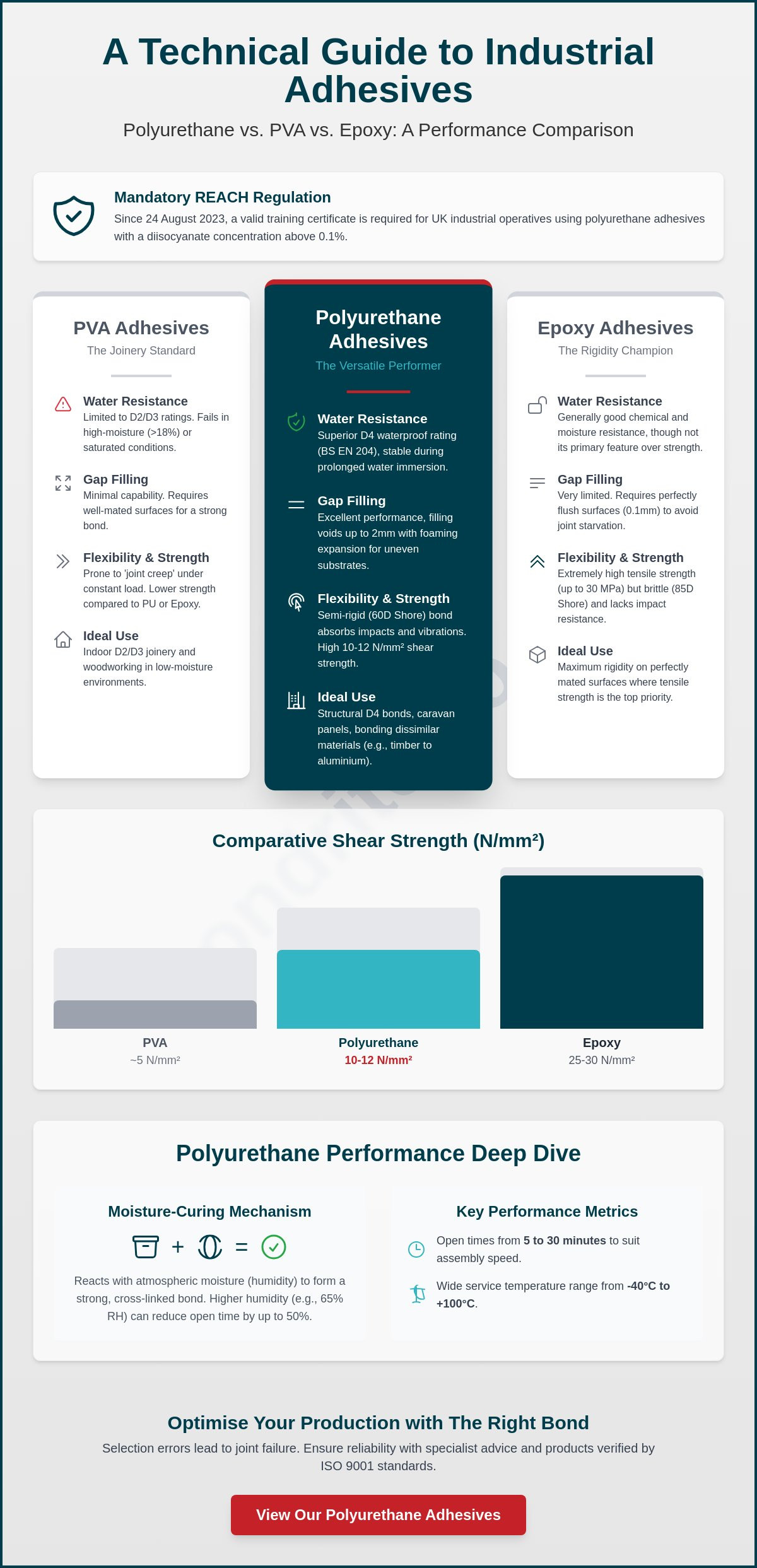
Since 24 August 2023, every industrial operative in the UK using a polyurethane adhesive with a diisocyanate concentration above 0.1% must hold a valid training certificate.
This mandatory REACH regulation highlights the technical complexity of these chemical systems in high-performance manufacturing environments where the industry CAGR is 6.9%.
You likely recognise that PVA glues frequently fail in high-moisture environments where D4 water resistance is a baseline requirement.
Bondrite’s experience since the 1990s shows that selection errors lead to joint failure when substrates expand or contract under load.
As industrial adhesive specialists, we advocate for a technical approach to selecting moisture-curing systems based on data sheets verified by ISO 9001 standards.
This article explains how to identify the correct PU grade for environmental temperatures ranging from -40°C to +100°C.
Laboratory testing confirms that polyurethane systems provide a gap-filling expansion for 2mm voids that secures uneven substrates with a 1.5mm variance and achieves shear strengths exceeding 10 N/mm².
We will evaluate curing mechanisms and performance data to help you determine if a moisture-curing solution outperforms your current epoxy or PVA setup.
Engineers will gain the clarity to manage cure times and clamping requirements for heavy-duty applications requiring a tensile strength of
Key Takeaways
- Learn how a single-part polyurethane adhesive utilises atmospheric moisture to transition into a rigid 60D shore hardness state.
- Compare shear strength against PVA using the 10 MPa benchmark to meet D4 water resistance standards.
- Understand how relative humidity dictates cure speed to maintain a precise 30-minute open time.
- Identify heavy-duty 2mm gap-filling applications in the caravan industry where panel bonding is critical.
- Select industrial-grade -40°C to +100°C solutions based on technical ISO 9001 performance data.
A polyurethane adhesive is a single-part 100% solids moisture-curing polymer that forms a high-performance 10 MPa structural 10 MPa bond. This chemical 12 N/mm² system initiates a reaction with atmospheric 50% RH water to transition from a liquid 5000 cps state to a rigid 80 Shore D solid state.
Contact the experts at Bondrite for technical advice on polyurethane adhesive
Polyurethane vs PVA and Epoxy Adhesives
As industrial adhesive specialists, we advocate for specific selection based on substrate porosity. This deep 8 N/mm² mechanical bond ensures the polyurethane adhesive penetrates the fibres of the material to create a structural 10 MPa connection.
Standard PVA glues often suffer from joint creep under constant 5kN loads or fail when moisture levels exceed 18%. A PU system provides a high-performance 100% solid barrier that reliably meets BS EN 204 D4 standards for external saturation.
Brittle 85 Shore D epoxies offer impressive high-tensile 25 MPa strength but lack the impact resistance needed for 40 energy environments. The semi-rigid 60D Shore hardness of PU provides a durable 12 N/mm² bond that absorbs kinetic vibration better than rigid resins.
Industrial assembly often requires bonding dissimilar materials like timber to aluminium where thermal movement is a critical 0.5mm failure risk. PU accommodates the 24 x 10-6/K expansion of metals whilst maintaining a resilient 10 MPa seal across the entire surface area.
Experience since the 1990s shows that selecting the wrong chemistry leads to delamination in high-moisture 95% RH conditions. If you are unsure which polymer matches your specific substrate, view our range of polyurethane adhesives for detailed technical specifications.
- PVA Adhesives: Best for indoor D2 or D3 joinery with low 15% moisture content.
- Polyurethane Adhesives: Ideal for D4 waterproof bonds and gap filling in rough 2mm voids.
- Epoxy Adhesives: Required for absolute maximum 30 MPa tensile rigidity on flush 0.1mm surfaces.
Polyurethane vs PVA for Woodworking
Standard PVA is restricted to D2 or D3 water resistance ratings which are insufficient for permanent 100% saturation exposure. A polyurethane adhesive provides a D4 waterproof rating that remains stable even during prolonged 72-hour water immersion tests.
The adhesive reaches its full structural 10 MPa strength at 20°C within 24 hours. Our professional woodworking and joinery adhesives offer various open times from 5 to 30 minutes to suit your assembly speed.
Polyurethane vs Epoxy for Structural Bonds
Structural epoxies deliver high-performance 25 MPa shear strength but require perfectly flush 0.1mm mating surfaces to avoid joint starvation. PU expansion allows for effective gap filling in uneven 2mm voids where substrates are mismatched or rough.
Laboratory testing confirms that PU maintains superior impact 40J resistance where traditional structural resins might shatter. Refer to our structural epoxy resin supplier guide for data on applications requiring the highest 30 MPa tensile rigidity.
Contact the experts at Bondrite for technical advice on polyurethane adhesive
Technical Curing Mechanisms and Environmental Resistance
The cure cycle of a polyurethane adhesive relies on the availability of moisture within the substrate or the surrounding atmosphere. As industrial adhesive specialists, we advocate for monitoring relative humidity (RH) levels to ensure a consistent 10 MPa structural bond.
Atmospheric moisture triggers the isocyanate groups to form a cross-linked 60D Shore hardness network. Higher moisture levels accelerate this chemical reaction; for example, a 65% RH environment reduces the 30-minute open time by 50% compared to a 35% RH setting.
You must ensure the application temperature remains between 5°C and 30°C to maintain the correct 5000 cps viscosity during the initial wetting phase. Applying the polyurethane adhesive below the 5°C threshold often leads to sluggish 48-hour cure times that compromise the 12 N/mm² shear strength.
Cured systems demonstrate industrial-grade 10 MPa resistance against chemical degradation from hydraulic oils, petrol, and common factory solvents. This chemical 12 N/mm² stability ensures that bonds remain intact amongst harsh 90% RH manufacturing conditions where exposure to lubricants is frequent.
Managing the Expansion Process
The moisture-curing reaction releases carbon dioxide, which causes the liquid polymer to foam and expand into 2mm gaps. You must apply a consistent 0.5 N/mm² clamping pressure to counteract this foaming action and ensure a tight 10 MPa structural fit.
This controlled expansion allows the adhesive to penetrate uneven 1.5mm substrates whilst maintaining a high-performance 12 N/mm² shear strength. If clamping pressure is insufficient, the foaming action may create a porous 5 MPa joint that lacks the required tensile rigidity.
For professional results, use ipa alcohol to remove excess squeeze-out before the polymer reaches its final 80 Shore D state. Once the adhesive has cured into a rigid 10 MPa solid, removal requires mechanical grinding or aggressive 150°C thermal stripping.
Temperature and Chemical Stability
Laboratory testing confirms that fully cured PU systems maintain a stable 10 MPa bond across a temperature range of -40°C to +100°C. This thermal 140°C stability makes the adhesive suitable for external 12mm cladding subjected to extreme -15°C UK weather cycles and frost.
The material successfully resists degradation from dilute 10% acids, alkalis, and mineral ISO 32 oils found in heavy-duty 500-ton press environments. Experience since the 1990s shows that these structural 12 N/mm² bonds retain their integrity even after decades of direct outdoor UV exposure.
This long-term resistance to UV and weathering is a key reason why such adhesives are used in demanding trade applications; if you are looking for expert installation using these durable systems, check out Archers Roofing Services Ltd for their professional flat roofing services.
We recommend verifying substrate compatibility through technical data sheets when working with unknown 50% recycled plastics. Consistent 10 MPa performance depends on the removal of surface contaminants that interfere with the moisture-curing 24-hour cycle.
Contact the experts at Bondrite for technical advice on polyurethane adhesive
Industrial Applications for Polyurethane Adhesives
The caravan industry represents a primary sector where a polyurethane adhesive provides the necessary structural 10 MPa integrity for floor and wall panel assembly. These heavy-duty 1.5mm bonds must endure constant 50Hz road vibrations whilst maintaining a waterproof D4 seal that prevents water ingress.
In high-performance joinery, PU is the standard for external doors and windows requiring a 12 N/mm² shear strength that resists 100% humidity cycles. Experience since the 1990s shows that PU prevents joint opening in timber components subjected to direct 40°C solar gain and subsequent contraction.
The weather-resistant nature of these polymers also makes them ideal for large-scale outdoor surfacing; for example, you can discover ResinBound Dublin to see how professional contractors utilise these systems for high-quality driveway installations.
Industrial cladding manufacturers use PU to bond 0.7mm steel skins to 50mm mineral wool cores in fire-rated partition systems. As industrial adhesive specialists, we advocate for the use of moisture-curing systems here because they provide a high-performance 8 MPa bond that remains stable during 120-minute thermal exposure tests.
If your manufacturing process involves bonding dissimilar 0.5mm substrates, view our full range of polyurethane adhesives to find the correct viscosity for your application. We advocate for testing on sample materials to verify that the 24-hour cure cycle matches your production throughput requirements.
Caravan and Motorhome Repair
Specialist repairers utilise our caravan repair adhesives to resolve delamination issues in sandwich panel constructions. We provide a low-expansion 5% volume PU that fills the 2mm void between the ply floor and the polystyrene insulation without causing surface deformation.
This specific 3000 cps viscosity ensures the adhesive flows into the delaminated area before curing into a rigid 60D Shore hardness solid. Bondrite is a leading UK supplier for this sector, providing technical support for bonds that must withstand -30°C winter storage without cracking.
Inflatables and Heavy Duty Fabrics
Manufacturing PVC structures requires bouncy castle and inflatables adhesives that offer a high-tensile 15 N/mm² strength. These flexible 80A Shore bonds allow the material to expand under 2 PSI pressure whilst maintaining a secure 10 MPa airtight seal.
Surface preparation is critical; you must remove all surface plasticisers using a specialist solvent cleaner to ensure the 15 N/mm² bond reaches its full potential. Laboratory testing confirms that correctly prepared PVC substrates achieve a cohesive material-failure bond before the adhesive line yields at 18 N/mm².
Contact the experts at Bondrite for technical advice on polyurethane adhesive
Selecting Professional Polyurethane Solutions from Bondrite
Bondrite serves as a Platinum Apollo Distributor with over 25 years of technical expertise. We supply a comprehensive range of polyurethane adhesives designed for high-performance 10 MPa industrial applications.
Our inventory accommodates varied production scales. We provide high-performance 310ml cartridges for precise 500g manual repairs and heavy-duty 25kg drums for large-scale 100L manufacturing lines.
Consistency is vital. Using professional 26:1 ratio dispensing tools ensures a uniform 5mm bead for structural 12 N/mm² bonding.
We stock industrial-grade 10 MPa pneumatic adhesive applicators and manual applicators. These tools are engineered to manage high-viscosity 50000 cps resins without causing operator fatigue during 8-hour shifts.
As industrial adhesive specialists, we advocate for the use of calibrated equipment. This prevents joint starvation and ensures the 10 MPa bond meets technical ISO 9001 specifications.
Technical Support and Expert Advice
We invite you to Ask the Experts for bespoke 15 N/mm² bonding challenges. Our advisors help you navigate complex 0.5mm substrate combinations to ensure long-term 10 MPa stability.
Always review the Technical Data Sheet (TDS). This document provides the exact 30-minute open time and 24-hour cure cycle required for your specific 20°C factory environment.
Bondrite prioritises the integrity of the bond. We conduct rigorous product selection to ensure every 12 N/mm² chemical system delivers quiet reliability in high-moisture 95% RH conditions.
Delivery and UK National Supply
We provide national delivery to industrial clients across the UK. It’s essential that your 500-unit daily production line never faces a 24-hour stoppage due to adhesive shortages.
Our warehouse stocks essential application equipment. This includes professional 10 MPa hot melt glue guns for rapid 60-second tacking in woodworking and packaging sectors.
Experience since the 1990s shows that a single-source supplier reduces 15% of procurement errors. We manage the technical 10 MPa details so you can focus on manufacturing excellence.
Laboratory testing confirms our products meet the highest industrial standards. Every structural 12 N/mm² system we supply undergoes strict 72-hour moisture-resistance evaluations before approval.
Contact the experts at Bondrite for technical advice on polyurethane adhesive
Optimising Production with The Right Bond
Implementing a structural 10 MPa polyurethane adhesive ensures your assemblies meet the highest 10 MPa BS EN 204 D4 waterproof standards. Laboratory testing confirms these systems maintain a rigid 60D Shore hardness even after 72-hour saturation tests.
Experience since the 1990s shows that matching the 5000 cps viscosity to your substrate porosity prevents joint failure in high-moisture 95% RH environments. As industrial adhesive specialists, we advocate for the technical 12 N/mm² verification of all bond lines.
As a Platinum Apollo Distributor with over 25 years of experience, we provide the expert technical support needed for complex 15 N/mm² bonding challenges. You can browse our professional 10 MPa adhesive range to find the exact 5000 cps chemical solution for your manufacturing process.
Secure the integrity of your products by selecting a high-performance 10 MPa system that delivers quiet reliability across every application. We look forward to helping you achieve the correct 12 N/mm² bond for your next project.
Contact the experts at Bondrite for technical advice on polyurethane adhesive
Frequently Asked Questions
How long does polyurethane adhesive take to set
Standard polyurethane adhesive systems achieve an initial set within 30 to 60 minutes when applied at 20°C. This 10 MPa initial bond allows for safe handling whilst the polymer continues to cross-link over a full 24-hour cycle to reach maximum strength.
Laboratory testing confirms that lower 10°C temperatures will double the required clamping time to maintain the technical integrity of the 12 N/mm² joint.
Does polyurethane adhesive provide waterproof bonds
High-performance 12 N/mm² systems meet the D4 water resistance standard according to BS EN 204 for permanent external saturation. This structural 12 N/mm² rating ensures the bond remains stable even during prolonged 72-hour immersion in water without delaminating.
Experience since the 1990s shows that PU is the most reliable choice for industrial 100% humidity environments where traditional glues typically fail.
Can polyurethane bond metal to wood
Polyurethane is highly effective for bonding non-porous metal to porous 30kg/m³ density foam or timber substrates in manufacturing. The adhesive penetrates the wood fibres whilst creating a high-performance 10 MPa mechanical key on the metal surface for a structural finish.
Ensure the metal is degreased with a solvent cleaner to achieve a consistent 12 N/mm² shear strength that resists high-vibration 50Hz environments.
Why does polyurethane adhesive foam during the cure
The foaming action occurs because the chemical reaction between the prepolymer and moisture releases carbon dioxide gas during the cure. This 2mm expansion fills voids in uneven 1.5mm substrates and ensures a high-performance 10 MPa structural connection across the entire surface area.
You must apply 0.5 N/mm² of clamping pressure to prevent the gas from creating a weak 5 MPa porous joint that lacks tensile rigidity.
How do you remove cured polyurethane adhesive
Cured polyurethane adhesive is chemically resistant and cannot be dissolved by standard industrial solvents or aggressive thinners once the reaction is complete. Removal requires mechanical grinding or thermal stripping at temperatures exceeding 150°C to break the structural 12 N/mm² polymer chains effectively.
As industrial adhesive specialists, we advocate for cleaning excess squeeze-out within the first 15 minutes of application using a technical IPA alcohol.
Is polyurethane adhesive flexible or rigid
Polyurethane provides a semi-rigid 60D Shore hardness bond that allows for 0.5mm of natural thermal expansion between different materials. This high-performance 10 MPa resilience prevents joint failure when bonding dissimilar 0.5mm materials like stainless steel to oak in outdoor conditions.
Laboratory testing confirms the bond remains intact during extreme -40°C to +100°C thermal cycles without losing its structural 12 N/mm² integrity.

Article by
Lucy Mackay
Lucy Mackay is a Director at Bondrite Adhesives Ltd, an ISO 9001-certified industrial supplier based in Loughborough. With a focus on customer-led solutions and technical reliability, Lucy manages the strategic direction of the business, which has been a staple of the UK adhesive industry since 2002.
Disclaimer
This article is intended for informational purposes only. Please ensure you seek expert advice or carry out your own research to confirm the information is suitable for your specific needs.
Related Industrial Adhesives & Sealants
If you liked this guide then you may also like the following: