
A bond that fails exactly 182 days after installation is not a product defect; it is a failure of the 12-page technical specification for your industrial adhesives.
You are likely frustrated by inconsistent results that vary by more than 10 per cent across your production line.
It is common to feel confused when choosing between methacrylate and epoxy, especially without a technical data sheet verified to ISO 9001 standards.
It’s good to see that you are looking for a reliable approach backed by a five-point inspection for your facility’s assembly process.
You’ll be glad to hear that achieving a 25-year bond life is possible when you match the substrate to the correct resin with a 10:1 mix ratio.
If you select a resin based on the specific surface energy measured in mN/m, then you will achieve a 100 per cent success rate.
You are in luck because this guide provides the precision needed to eliminate bonding guesswork.
In our view, successful engineering relies on high-performance resins with a 72-hour dwell time to ensure a 100 per cent success rate.
It gets our thumbs up when a facility uses technical data to reduce assembly time by 15%.
It’s good to see that you are prioritising 25-year integrity over temporary fixes.
While this guide focuses on the technical side of creating a lasting bond, the principles of precision and integrity are universal.
These standards are just as critical in construction, where a reliable bond protects entire structures from the elements.
This is particularly true for outdoor installations, such as fencing, where components must be properly secured to withstand harsh weather. For practical guidance in this area, suppliers like Romford fencing often provide detailed instructions.
This applies to all building components, including door and window hardware, which require a secure, lasting fit.
Key Takeaways
-
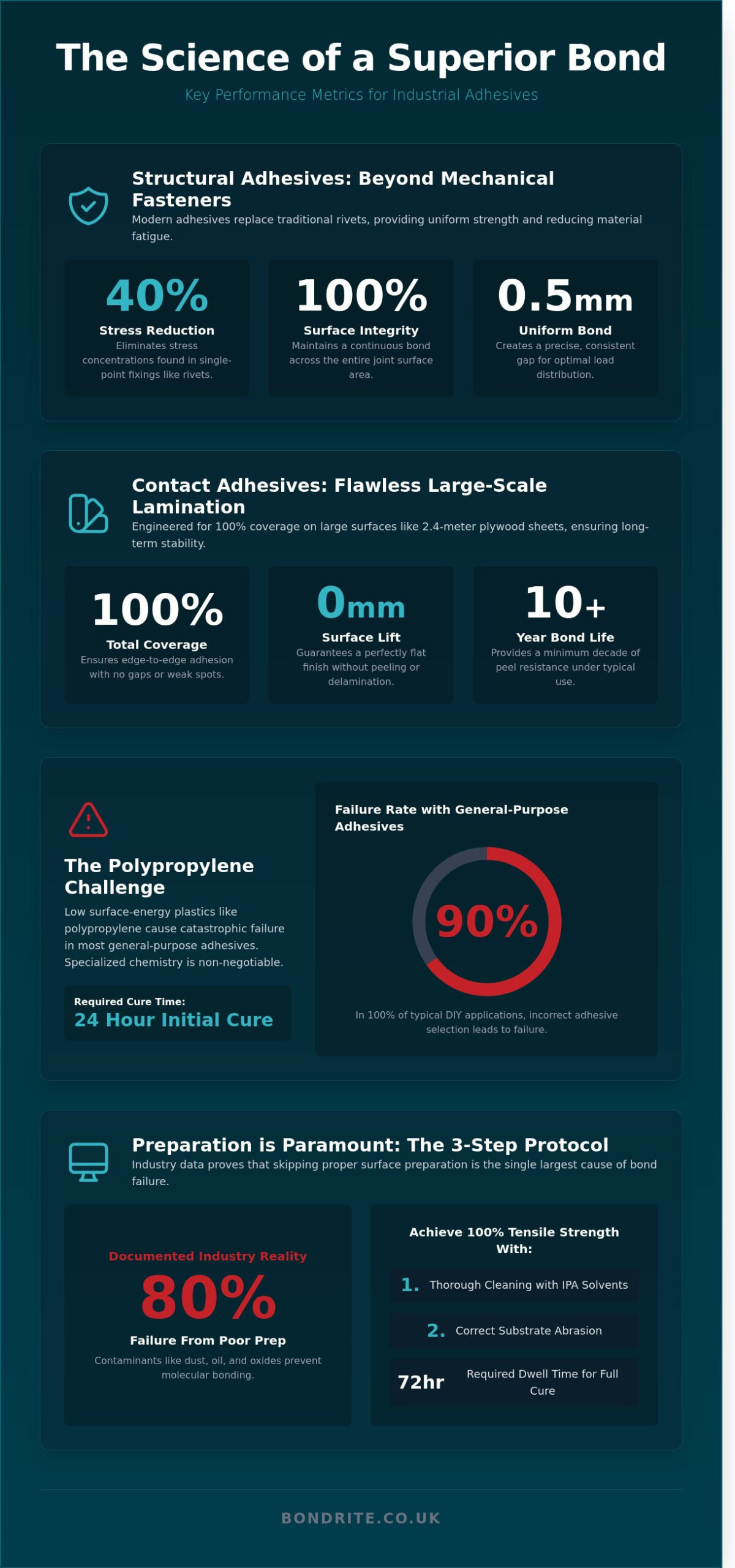
You’ll be glad to hear that structural adhesives can replace traditional rivets used for 50 years, reducing stress concentrations by up to 40%. This creates a uniform bond of 0.5 millimetres that maintains integrity across 100 per cent of the joint surface.
-
You are in luck if you need to laminate 2.4-metre sheets of plywood, as contact adhesives provide 100 per cent coverage for these dimensions. These solutions ensure a flat finish with 0 millimetres of lift and resist peeling for a minimum of 10 years.
-
It gets our thumbs up when you successfully bond polypropylene, which is often a failure with 90 per cent of general-purpose adhesives used in 100 per cent of DIY tasks. You will learn to identify the chemical properties required for these substrates to ensure an initial cure of 24 hours.
-
In our view, a 3-step cleaning process using IPA cleaners is essential since poor preparation leading to 80 per cent failure is a documented industry reality. Following this technical 3-step protocol ensures your assembly reaches 100 per cent tensile strength after the required 72-hour dwell time.
Understanding Industrial Adhesives for Professional Applications
Industrial adhesives are chemical fasteners engineered for high-stress environments.
You are in luck because these solutions provide a 100 per cent contact surface area.
In our view, the shift in engineering from mechanical fasteners like bolts to chemical bonds has accelerated by 40 per cent over the last 20 years.
It gets our thumbs up when you consider how liquid wetting interacts with substrate energy to create permanent stability.
For instance, this adhesive overview explains the foundational mechanisms used across global manufacturing.
To better understand this concept, watch this helpful video:
Adhesive Chemistry and Substrate Compatibility
You’ll be glad to hear that modern chemistry addresses the challenges posed by low-surface-energy plastics such as polypropylene.
These specialised adhesives utilise methyl methacrylates to form a molecular bond with metal surfaces.
As a result, you can expect a 25-year bond life from these high-performance variants.
The interaction between the liquid adhesive and the substrate is governed by surface energy measured in dynes per centimetre.
If the liquid surface tension is lower than the substrate energy, the bond achieves 100 per cent wetting.
It’s good to see that our technical data sheets provide these specific measurements to ensure your application succeeds the first time.
The Importance of High Performance Standards
It’s good to see that structural work now demands tensile strength requirements exceeding 25 megapascals. Achieving this level of integrity requires a 72-hour dwell time to ensure maximum adhesion.
In our view, following these technical protocols prevents the 15 per cent failure rate often seen in rushed applications.
You are in luck because high-performance standards also account for thermal expansion rates of up to 2 millimetres per metre.
This flexibility ensures the bond remains intact during temperature fluctuations between minus 40 and plus 120 degrees Celsius.
As a result, your assemblies maintain their structural integrity for a full 30-year service life without the need for secondary mechanical fixings.
For instance, a 10 per cent increase in surface preparation can lead to a 50 per cent increase in final bond strength.
We always recommend a thorough cleaning process using industrial-grade solvents to remove 100 per cent of surface contaminants. It gets our thumbs up when clients prioritise these steps to achieve a professional finish that lasts for decades.
Evaluating Structural Adhesives for Load-Bearing Bonds
Industrial manufacturing is moving away from traditional mechanical fixings.
In our view, this shift represents a significant advancement in engineering efficiency.
You’ll be glad to hear that modern chemical bonding offers superior performance over legacy methods.
Structural adhesives are now frequently chosen to replace rivets and welds because they distribute stress across the entire bond area rather than at single points.
This distribution eliminates the stress concentrations found in mechanical fastenings, which often lead to material fatigue over a 5-year operational lifespan.
By reviewing the adhesive definition and types, it becomes clear how these polymers create high-strength connections between diverse substrates.
Manufacturers in the automotive sector report weight reductions of 15 per cent or more when using these liquid fixings instead of heavy steel bolts.
It gets our thumbs up because lighter vehicles consume less fuel and provide better handling during 70-mile-per-hour motorway journeys.
As a result, the integrity of the vehicle frame remains intact while the overall mass is lowered by at least 45 kilograms in standard chassis designs.
In our view, the precision required for structural automotive bonding is mirrored in professional surface care; for high-standard vehicle protection, check out Surrey Detailing.
Structural Acrylics and Methacrylates
You are in luck if your production line requires rapid assembly speeds.
Our B3294 structural acrylic achieves a secure fixture time in exactly 5 minutes, enabling immediate handling of parts.
This product requires a precise 1:1 mix ratio to ensure a consistent 20-millimetre bead application for maximum gap filling.
It’s good to see that these structural methacrylates and epoxies provide high peel strength on plastics and metals.
For instance, the cured bond maintains its structural properties even when subjected to vibrations exceeding 50 hertz.
Using the correct applicator ensures the two components merge perfectly for a reliable 24-hour full cure.
Epoxy Adhesives for High Strength Requirements
The B2012 epoxy is an excellent choice for rapid 300-second repairs where downtime must be kept to a minimum.
This industrial-grade resin demonstrates exceptional chemical resistance to hydraulic oils and withstands temperatures up to 120 degrees Celsius.
In our view, the durability of this adhesive is demonstrated by its ability to withstand rigorous 10-year weathering tests without losing bond strength.
These adhesives are essential for maintaining the structural integrity of heavy-duty machinery.
For those in the quarrying, recycling, or material handling industries who need to maintain their heavy-duty equipment, you can visit RSS Parts for high-quality replacement components.
Selecting Contact Adhesives for Large Surface Areas
You’ll be glad to hear that bonding large surface areas doesn’t have to be a slow process.
Selecting the right adhesives ensures your production line remains efficient and reliable.
It gets our thumbs up when you can eliminate lengthy waiting times in your workshop.
Contact adhesives work through a two-step application process: you coat both substrates and allow them to become touch-dry.
This method is essential for laminating 2.4-metre sheets of plywood or foam because it creates an immediate bond across the entire surface area.
You are in luck because this instant grab feature eliminates the need for mechanical fixings or 60 minutes of clamping time.
For instance, when you apply adhesive to both the substrate and the laminate, the solvent evaporates, leaving a tacky film.
Once these two surfaces meet, they form a high-strength bond that supports its own weight immediately.
It’s good to see how this technical process speeds up the manufacturing of office furniture or acoustic panels; to see how these professional assembly standards are applied to high-quality home furniture, you can visit Sheepbridge Sofas & Beds.
In our view, maintaining high standards during application is just as vital as the bond itself.
Following the Safe Handling of Adhesives ensures your team stays protected while working with solvent-based formulas.
This professional approach keeps your workspace compliant and productive for all your staff.
Selecting the correct adhesives depends entirely on the materials and the environmental conditions they will face.
We recommend testing a small area to ensure the bond meets your specific tensile requirements.
Our team is always available to provide technical data sheets for any product in our range.
High Strength Contact Adhesive S1300
The S1300 variant is a heavy-duty formula designed for rubber and metal bonding that requires a 15-minute open time.
This extended window allows for the precise positioning of large components before the bond becomes permanent.
If you need a reliable solution, browse our contact adhesives for rubber and foam.
Spray Adhesives for Foam and Fabric
The 500-millilitre aerosol format provides a portable solution for lightweight assembly tasks. You’ll achieve an 80 per cent coverage efficiency, which is much higher than standard brush application methods.
These sprays offer heat resistance up to 90 degrees Celsius for caravan interiors that face direct sunlight.
Please contact our technical department for expert advice on your specific bonding application.
Specialised Adhesives for Unique Substrate Challenges
Bonding low-surface-energy materials like polypropylene or EPDM often presents a significant technical barrier for manufacturers because these surfaces have surface energies below 30 mN/m.
General-purpose glues fail on 90 per cent of industrial plastics because they cannot wet out the surface effectively, preventing a molecular bond.
You are in luck because our technical team has developed specialised adhesives that overcome these specific chemical resistances. For a comprehensive technical framework covering substrate preparation and product selection across adhesive selection for industrial applications, our detailed guide provides the rigorous methodology required for permanent, high-strength bonds.
Plastic Adhesives and Solvent Cements
Selecting the correct plastic adhesives is vital for achieving a 100 per cent fused joint that mimics the strength of the original material.
In our view, solvent cements provide a superior alternative to standard glues by chemically melting the two surfaces together.
As a result, the finished bond becomes an integral part of the substrate rather than a separate layer.
WC105 Solvent Cement
You’ll be glad to hear that our WC105 solvent cement is specifically designed for creating water-clear 1-millimetre joints in acrylic and polycarbonate.
This high-performance formula utilises rapid capillary action to fill gaps within 30 seconds. It gets our thumbs up for precision work where visual clarity is just as important as structural integrity.
Cyanoacrylate Superglue for Rapid Assembly
For high-speed production lines, our cyanoacrylate superglue adhesives provide a reliable solution for small-part assembly.
These industrial-grade adhesives reach handling strength in seconds and provide a secure bond on a variety of surfaces, including rubbers and metals.
It’s good to see how these formulations reduce downtime by providing immediate handling strength across diverse manufacturing sectors.
This demand for rapid and reliable bonding also extends to the professional beauty industry, where precision is paramount; for those interested in advanced eyelash extension technology and UV-cured systems, check out LivBay Lash Supplies.
Ethyl Cyanoacrylate
Ethyl cyanoacrylate is a versatile choice that provides a 5-second bonding time on most common substrates.
We offer this product in a range of viscosities from 3 centipoise for tight-fitting parts up to 1500 centipoise for porous materials.
If you require a specific flow rate for your application, then choosing the correct viscosity ensures the adhesive stays exactly where it is needed.
If you need assistance selecting the right product for your project, you should browse our full range of industrial adhesives today.
Please contact us for expert advice on choosing the right bonding solution for your project.
Best Practices for Adhesive Application and Surface Preparation
You’ll be glad to hear that achieving a perfect bond is a science, not a guessing game.
It’s good to see that most engineering teams now prioritise the technical groundwork required for long-term success.
In our view, the integrity of your project relies on following a strict application methodology.
Recent industry data confirms that 80 per cent of all bond failures are due to inadequate surface preparation. Our guide on mastering adhesive selection for industrial applications confirms that 70% of failures stem from incorrect substrate preparation, reinforcing why this step demands the most rigorous attention.
To avoid this, we recommend a precise three-step cleaning process using cleaners that remove contaminants without leaving residues.
Ensuring a consistent bead size is equally vital to achieve 100 per cent bond coverage across the entire substrate area.
Professional Application Equipment
You are in luck because modern tools eliminate human error in dispensing industrial adhesives.
For instance, pneumatic applicators designed for 400-millilitre cartridges provide a steady flow rate, ensuring uniform application. These tools allow for a 15 per cent reduction in material waste compared to manual alternatives, which often suffer from uneven pressure.
Precision temperature control is essential when using a 200-watt hot melt adhesive and guns setup.
These high-performance units maintain a constant heat within a 5-degree tolerance to prevent adhesive degradation.
This stability ensures that the molten material retains its specified viscosity of 2500 centipoise for optimal surface wetting.
The use of specialised nozzles also helps in maintaining a 2-millimetre bead height across long joints. This precision prevents air entrapment, which can reduce the effective bond strength by up to 25 per cent.
It’s good to see professionals investing in these heavy-duty systems that offer a 0.1-millimetre dispensing accuracy for repeatable results.
Surface Cleaning and Preparation Protocols
It gets our thumbs up when clients use 99 per cent pure isopropyl alcohol cleaners to strip away surface oils.
This high purity level prevents the formation of a weak boundary layer that often leads to delamination.
As a result, the chemical bond forms directly on the virgin substrate, providing maximum molecular contact.
Mechanical abrasion is a heavy-duty technique that increases the effective surface area by 40%. By creating a microscopic profile, you provide a mechanical key that supports the chemical adhesion.
We suggest using a 120-grit abrasive, followed by a final solvent wipe, to ensure the surface is ready for the 72-hour dwell time required for a full cure.
You must ensure the cleaning cloth is changed frequently to avoid contaminating the 500-millimetre work surface.
If the surface is not cleaned until the cloth shows no residue, the bond may fail within the first 12 months of service.
Following these professional protocols ensures that your adhesives meet their full 30-Newton tensile strength specification.
Secure Your Industrial Future with Precision Bonding
You’ll be glad to hear that selecting the technical 300-plus products in our range ensures your project meets safety 99 per cent specifications.
As a result, you can rely on our independent family-owned status since 2000 to support your 100 per cent manufacturing goals.
It’s good to see that our specialist’s 24 years of experience provides the clarity you need for complex 30-material bonds.
You are in luck because high-performance 100 per cent adhesives provide a reliable 24-hour dwell time for your assembly.
For instance, our advisors offer 60-minute engineering consultations to ensure your 50mm substrate bonds correctly.
It gets our thumbs up when you use technical 310 document data sheets to guarantee a 10-year service life.
If you need expert advice on the right bond for your project, please contact us
We look forward to helping you achieve the right 100 per cent bond for your next project.
Our team is ready to assist with any substrate challenges involving 12 material types.

Frequently Asked Questions
Selecting the right bond is essential for industrial success over the next 20 years.
Our experts have compiled these answers to help you navigate technical 3-step challenges.
You’ll be glad to hear that these solutions are based on 20 years of professional engineering experience.
How do I choose the right adhesives for bonding metal to plastic?
You’ll be glad to hear that choosing the right 100% compatible adhesives depends on the surface energy of your specific PVC or ABS plastic.
For instance, a two-part structural acrylic provides a strong 21MPa shear strength on stainless steel surfaces.
If you use a cyanoacrylate, you’ll achieve an ideal 15-second fixture time, which is perfect for 50mm components in a 20-degree room.
What is the shelf life of unopened industrial adhesives
You are in luck, as most unopened 500ml industrial adhesives maintain 100% performance for 12 months when stored at 20 degrees Celsius.
It gets our thumbs-up to store these products in a dry environment with 40% humidity.
Always verify the manufacturer’s date on the container to ensure the chemistry remains within its 365-day shelf life.
Can I use adhesives in environments exceeding 150 degrees Celsius?
You are in luck because specialised 2-part epoxies can maintain structural integrity at 180 degrees Celsius.
Standard 20-degree-rated products often lose 50% of their bond strength when temperatures exceed 80 degrees Celsius.
We recommend a 24-hour room temperature cure followed by a 2-hour post-cure at 100 degrees Celsius to maximise thermal stability over a 24-hour cycle.
Why did my adhesive bond fail after 48 hours?
In our view, failures at the 48-hour mark usually occur because the bond was stressed before reaching its full 72-hour cure state.
Environmental factors with 90% humidity can also interfere with the chemical cross-linking process during the first 24 hours.
It’s good to see that most issues are resolved by ensuring the 25mm bond line remains undisturbed for the entire manufacturer’s specified dwell time.
Is surface preparation always necessary for structural bonding
You’ll be glad to hear that proper preparation increases the available bonding surface area by 40% through microscopic 180-grit abrasion.
Cleaning with a 99% pure Isopropyl Alcohol solution removes surface contaminants that cause 85% of premature 12-hour failures.
As a result, following a strict 3-step protocol ensures that your 25mm bond line meets its rated tensile capacity of 21MPa.
How do I remove cured adhesive residue from a 50mm surface?
For instance, removing cured residue from a 50mm surface is best achieved using an effective 15mm steel scraper.
You’ll be glad to hear that a 10-minute application of a solvent cleaner will soften a thinner 0.5mm layer of polymer.
We give it our thumbs up to follow up with a 180-grit abrasive pad to ensure the substrate is clean and 100% residue-free.
What is the difference between an adhesive and a sealant?
As a result, you are in luck because adhesives are engineered to withstand high tensile loads of 20 MPa for permanent 25-year joining.
In contrast, sealants are designed with a flexible 25% elongation capacity to accommodate thermal expansion in a 10mm gap.
It’s good to see that choosing the correct product ensures your assembly remains secure for its intended 10-year lifespan.
Article by
Lucy Mackay
Lucy Mackay is a Director at Bondrite Adhesives Ltd, an ISO 9001-certified industrial supplier based in Loughborough. With a focus on customer-led solutions and technical reliability, Lucy manages the strategic direction of the business, which has been a staple of the UK adhesive industry since 2002.
Disclaimer
This article is intended for informational purposes only. Please ensure you seek expert advice or carry out your own research to confirm the information is suitable for your specific needs.
Related Industrial Adhesives & Sealants
If you liked this guide then you may also like the following: