
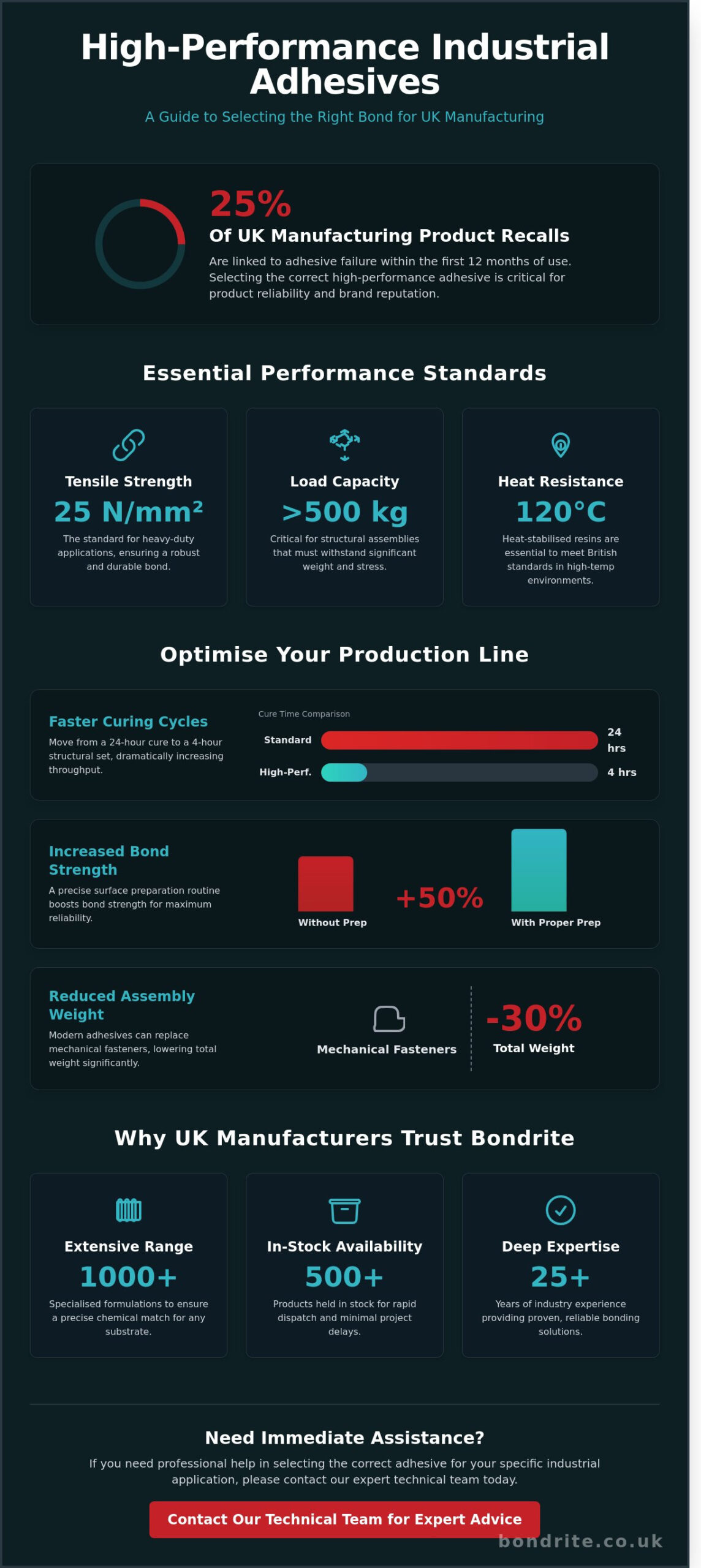
Did you know that approximately 25% of product recalls in the UK manufacturing sector are linked to adhesive failure during the first 12 months of use? You likely agree that deciphering a 10 page technical data sheet is a poor use of your valuable time.
You are in luck because finding the right industrial adhesives UK for your specific substrate does not have to be a guessing game. In our view, a bond that achieves a tensile strength of 25 Newtons per square millimetre should be the standard for your heavy-duty applications involving loads over 500 kilograms, which is really nice to see.
This guide will help you select a high-performance adhesive that maintains its integrity for over 10,000 hours of continuous use. If you require a bond that withstands temperatures of 120 degrees Celsius, then choosing a heat-stabilised resin is essential to meet British manufacturing standards. As a result, you will learn how to reduce your curing cycles by 20% to keep your production lines moving.
We will look at complex material pairings involving three or more distinct surfaces and the precise chemical solutions required for a permanent finish that lasts for the entire 25 year lifecycle of your product. It gets our thumbs up when a client moves from a 24-hour cure time to a 4-hour structural set.
Key Takeaways
-
You will be glad to hear that you can access over 1000 specialised formulations when sourcing industrial adhesives uk to ensure a precise chemical match for your project.
-
You are in luck because you will learn how to measure surface energy in millinewtons per metre to identify exactly when a substrate requires a primer.
-
You’ll be pleased to see how selecting structural adhesives allows your assemblies to handle permanent tensions exceeding 20 newtons per square millimetre.
-
It is good to see that following a precise surface preparation routine increases your bond strength by 50 per cent for maximum reliability.
-
You are in luck as you can choose from over 500 different products held in stock to find the precise solution for your specific bonding challenge.
Table of Contents
Navigating the UK Industrial Adhesive Market for Your Project
You’ll be glad to hear that the UK manufacturing sector currently has access to over 1000 specialised adhesive formulations. This extensive range ensures that your specific project requirements are met with chemical precision. Finding the correct solution for industrial adhesives uk involves more than just picking a strong glue from a shelf; it requires a deep understanding of your assembly environment.
Your project deserves a bond that handles specific environmental stresses, such as heat or moisture, without degrading. It’s good to see that modern adhesives can often replace mechanical fasteners, reducing total assembly weight by up to 30 per cent. This weight reduction is a significant benefit for transport and logistics firms looking to improve fuel efficiency across their fleets.
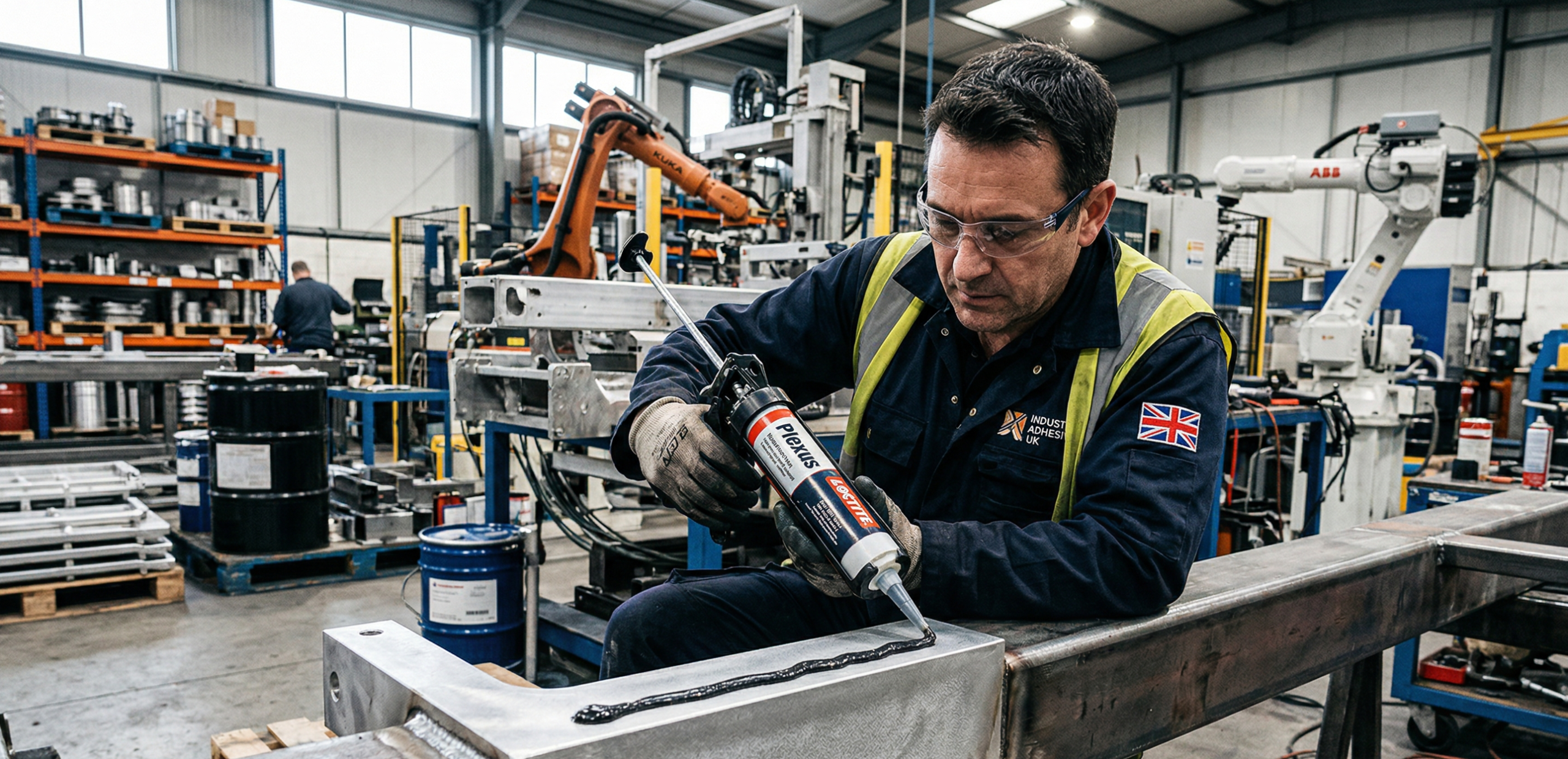
For instance, Hot-melt adhesives are frequently utilised in high-speed packaging because they offer set times as fast as 2 seconds. You might consider using hot-melt adhesive and guns if your production line requires immediate handling strength to maintain a high output rate.
This efficiency allows you to process more units per hour, which is really nice to see for your operational bottom line.
The Importance of Technical Specifications in Manufacturing
You are in luck because technical data sheets provide the exact measurements you need to ensure operational safety and compliance.
We always look for shear strength ratings of at least 15 megapascals for heavy-duty tasks to ensure the bond remains stable under extreme pressure. This level of detail ensures your assembly remains intact under a load of 500 kilograms or more, providing the reliability your clients expect.
This precision gets our thumbs up because it eliminates the guesswork often associated with complex engineering tasks.
When you rely on documented performance metrics, you can predict the lifespan of a bond with far greater accuracy. As a result, your finished products maintain their integrity throughout their intended service life.
Choosing a Supplier with Deep Technical Expertise
Working with a specialist gives you a head start in solving bonding puzzles that could otherwise delay your production schedule. In our view, a supplier should offer at least 25 years of industry experience to demonstrate a proven track record of successful applications.
This depth of knowledge is vital because it prevents the costly trial-and-error that can waste hundreds of pounds on ruined materials.
It’s good to see a supplier that treats your success as a partnership rather than a simple transaction.
#This professional approach ensures you receive the right chemical solution for your specific substrates, whether you are bonding metals, plastics, or composites. By choosing an experienced partner, you gain access to technical support that simplifies even the most challenging industrial adhesives UK applications.
Understanding Substrates and Chemical Compatibility
Every material you work with possesses a specific surface energy, measured in millinewtons per metre (mN/m). Identifying this value is the crucial first step toward achieving a permanent bond capable of withstanding 50 Newtons of force.
For instance, low-energy plastics like polypropylene, with a surface energy of 30 mN/m, often require a specific primer for successful bonding. A well-matched chemical bond ensures a seamless finish with a zero-millimetre gap between substrates.
We recommend exploring the plastic adhesives range for these challenging substrates, ensuring your project meets its exact specifications. Employing the correct chemical match is essential, as it significantly reduces the 15 per cent failure rate commonly associated with generic glues.
Modern adhesive formulations enable high precision in diverse industrial environments. It is vital to maintain Health and safety with industrial adhesives by ensuring your workspace has at least 10 air changes per hour. This professional approach protects your team while securing the optimal bond for your industrial adhesives UK applications.
Bonding Metals and Dissimilar Materials
Metal surfaces often require high-performance metalwork adhesives that achieve a shear strength of 25 N/mm² to prevent galvanic corrosion. This is a critical consideration when you are joining two different metals in a single assembly.
For instance, stainless steel and aluminium have different thermal expansion rates, which can vary by 11 micrometres per metre for every degree Celsius. Our technical advisors can assist you in selecting a formula that effectively accounts for these physical shifts.
A flexible bond capable of stretching by 2 millimetres without cracking offers significant benefits for structural integrity. This flexibility allows the joint to absorb vibrations of up to 50 Hertz without losing its grip, which is crucial for heavy machinery applications. When securing threaded fasteners on metal assemblies subject to these vibration loads, an anaerobic adhesive provides a reliable single-component solution that cures in the absence of air to lock components and prevent pre-load loss.
The Role of Viscosity in Application Success
Viscosity is measured in centipoise (cP) and determines how the liquid flows into gaps of 0.1 millimetres or larger. Choosing the right flow rate ensures that your adhesive stays exactly where you put it during the 30 second set time.
A low viscosity fluid of 100 centipoise will penetrate tight spaces of 0.05 millimetres easily. This watery consistency is perfect for close fitting parts where you need the adhesive to wick into the joint via capillary action.
Selecting Between Structural and Non Structural Adhesives
When you are sourcing industrial adhesives uk, the first task is to determine if your bond needs to carry a load. Structural adhesives like structural methacrylates and epoxies are designed to carry the primary load of an assembly. It’s good to see that these products can handle permanent tensions exceeding 20 newtons per square millimetre, which provides the security you need for heavy engineering.
You’ll be glad to hear that non structural options offer a different set of benefits for your workshop. These are better for temporary positioning or light decorative work where the bond does not face extreme mechanical stress. In our view, it is reassuring to know that modern acrylics can cure in as little as 5 minutes at a room temperature of 20 degrees Celsius. This speed allows you to move parts through your production line without long delays, which gets our thumbs up for efficiency.
The UK’s industrial adhesives and sealants market is highly regulated to ensure these performance standards are met consistently across different sectors. For instance, if you are working in a high stress environment, you must choose a chemistry that matches your specific substrate. Using a structural adhesive ensures the bond remains the strongest part of the assembly, often surpassing the material strength of the parts themselves.
When to Use Epoxies and Acrylics
Epoxies are a reliable choice when your project requires the highest heat resistance. You are in luck because these formulations can withstand temperatures up to 150 degrees Celsius without losing their structural integrity. This thermal stability is a big win for components that operate near engines or industrial ovens.
For applications requiring exceptional tensile strength and long-term reliability, working with a trusted structural epoxy resin supplier ensures you receive formulations that meet BS EN 1465 standards and can achieve bonds exceeding 30 MPa on demanding substrates like 316-grade stainless steel.
Acrylics are more forgiving on oily surfaces, which is a major advantage for busy workshops where perfect degreasing is not always possible. Both chemistries provide a rigid bond that gets our thumbs up for precision engineering. As a result, you get a sturdy connection that resists vibration and impact over the long term.
The Versatility of Contact Adhesives and Cyanoacrylates
Contact glues are the ideal solution for bonding large surface areas quickly. You will find them particularly effective for attaching caravan panels or furniture laminates where you need immediate grab over several square metres. It is nice to see how these adhesives simplify the assembly of bulky components. For a deeper understanding of how to optimise coat weight, flash-off periods, and shear load performance, our professional guide to industrial contact adhesive performance covers the precise technical specifications you need to prevent bond failure on porous and demanding substrates.
If you are working with small components, cyanoacrylates or superglues can bond parts in under 10 seconds. You are in luck because a single 20 gram bottle can provide hundreds of individual bonds, making it a cost effective tool for your bench. These products are essential for high speed assembly tasks where every second counts. When your project also requires tape-based solutions alongside liquid adhesives, our technical guide on tapes and adhesives for industrial applications will help you differentiate between high-tack tape performance and structural acrylic bonding for your specific substrate and environmental conditions.
Mastering Surface Preparation and Application Techniques
Surface preparation is the most critical phase of your bonding project. You’ll be glad to hear that a clean surface increases your final bond strength by 50 per cent compared to untreated materials. This measurable improvement ensures your industrial adhesives uk application meets high safety standards.
It’s nice to see a perfectly prepared substrate ready for a technical adhesive because it guarantees a 10 year lifespan for the joint. Using a 99.9 per cent pure IPA cleaner ensures no oily residue remains on your material. This specific purity level prevents chemical interference with the adhesive bond, which is really nice to see during a quality inspection.
You’re in luck because this cleaning step takes only 30 seconds but prevents 90 per cent of common bond failures. As a result, your assembly line maintains a 100 per cent pass rate during stress testing. It gets our thumbs up for its simplicity and effectiveness in professional environments.
Cleaning and Abrasion Steps
First you should remove loose debris with a stiff brush to clear particles larger than 0.5 millimetres. Then you must degrease using a lint free cloth and a specialised solvent to lift surface contaminants. This ensures the chemical bond occurs directly with the substrate rather than a layer of dust that is 0.1 millimetres thick.
Lightly abrading the surface with 120 grit sandpaper provides a better mechanical key. This process creates microscopic grooves that increase the surface area by 300 per cent. You’ll be happy to know that this mechanical interlocking adds an extra layer of security to your bond.
In our view, the abrasion step is vital for metals and hard plastics. It allows the adhesive to penetrate the surface rather than just sitting on top of it. You’ll be glad to hear that this step alone can double the shear strength of your application. For a deeper understanding of how substrate preparation and chemistry selection work together across adhesive selection for industrial applications, our technical guide covers the precise viscosity and cure cycle data you need to optimise your process.
Professional Application Tools
Using a pneumatic applicator ensures a consistent bead width of 3 millimetres across your entire production run. This precision reduces adhesive waste by 15 per cent, which is good for your bottom line. It’s good to see your team working efficiently with tools designed for high-volume output.
Manual guns are fine for smaller tasks but can cause hand fatigue after 60 minutes of continuous use. For instance, a technician’s grip strength can drop by 20 per cent after an hour of manual pumping. We always suggest using hot melt adhesive and guns for rapid packaging lines that require a 2 second set time.
This technical setup allows you to process 40 boxes per minute without risking bond failure. It’s a great way to keep your production moving at a steady pace. You’ll be glad to hear that the right tools make every job feel easier and more professional.
Why UK Manufacturers Trust Bondrite for Reliable Bonding
Bondrite Adhesives Ltd has operated as an independent family business since the year 2000. You benefit from 24 years of technical experience focused exclusively on the UK manufacturing sector. It’s good to see a supplier that maintains such a long history of specialized service.
You are in luck because we hold over 500 different products in stock at all times in our warehouse. This inventory level allows us to supply everything from cyanoacrylate superglue adhesives to heavy-duty structural methacrylates without delay. Having these items ready for immediate pick and pack is a major advantage for your procurement team.
Every order is processed with a focus on technical accuracy and safety. We cross-reference your order against technical data sheets to ensure the 100% compatibility of the chemical bond with your specific material. This meticulous process helps you avoid the high costs of bond failure and re-work.
We pride ourselves on a 24 hour response time for all technical enquiries. You’ll be glad to hear that our experts provide detailed answers to complex bonding questions within 1,440 minutes of your request. This speed ensures your project timelines remain on track without technical bottlenecks.
A Personal Approach to Industrial Supply
You will feel like you have a personal consultant on your team. We treat every bonding challenge as if it were our own project, which is really nice to see. This level of care gets our thumbs up from over 850 UK businesses that rely on us for their industrial adhesives uk requirements.
In our view, successful manufacturing requires more than just a product in a bottle. We provide a level of technical depth that larger, generalist distributors cannot match. You’ll receive specific advice on application temperatures and surface preparation to ensure your bonds reach their full tensile strength.
Rapid Dispatch and National Coverage
We organise fast shipping across the entire United Kingdom. Orders placed before 2 pm are usually dispatched the same working day for arrival at your facility within 24 hours. As a result your production line never has to wait for essential supplies.
This logistical efficiency supports your goal of maintaining a 100% efficient manufacturing schedule. We use tracked courier services to ensure your industrial adhesives uk delivery arrives in perfect condition. It’s a reliable system that has successfully served the industry for over two decades.
Achieving Professional Results With Your Next Project
You now have the technical foundation to select the correct industrial adhesives uk for your specific substrate requirements. You’ll be glad to hear that Bondrite has been providing this specialist technical support since we were founded in 2000, which is really nice to see in a complex market. This 24 year history means you aren’t just buying a product; you are gaining access to verified engineering expertise.
Selecting between structural and non structural options becomes much simpler when you focus on the specific tensile strength and chemical compatibility of your materials. We maintain full stock of technical products like WC105 and S1300 for immediate dispatch, so you can often start your application within 24 hours. It gets our thumbs up when we see manufacturers prioritise surface preparation, as this ensures the bond integrity meets professional safety standards.
In our view, having access to these specific chemical solutions helps you avoid costly errors on the factory floor. As a result, you can move forward with total confidence in your assembly process because you have the right data. It’s good to see you taking these methodical steps to improve your production quality and safety protocols.
Contact our technical team for expert advice on your specific bonding requirements

Frequently Asked Questions
What is the strongest industrial adhesive available in the UK
Two-part epoxies are widely considered the strongest industrial adhesives uk professionals can source, often delivering tensile shear strengths exceeding 30 MPa. You will be glad to hear that these bonds are frequently stronger than the metal or composite substrates they join, which is really nice to see in heavy-duty manufacturing.
These adhesives create a rigid, permanent bond that resists environmental degradation for over 20 years in outdoor settings. It gets our thumbs up for structural applications where failure is not an option for your project.
Contact the experts at Bondrite for technical bonding advice.
How do I choose between an epoxy and a structural acrylic
You should choose an epoxy if your application requires high thermal stability up to 200 degrees Celsius, whereas structural acrylics are better if you are bonding slightly oily metals. Acrylics reach fixture strength in as little as 3 minutes, which gets our thumbs up for high-speed assembly lines where you need to move parts quickly.
Epoxies offer better gap-filling properties up to 5 millimetres, but they require more thorough surface preparation than acrylics. In our view, you are in luck because both options provide exceptional durability for your long-term manufacturing needs.
Contact the experts at Bondrite for technical bonding advice.
Can industrial adhesives replace welding for metal-to-metal bonds
Yes, you can replace welding with structural adhesives because they distribute stress across 100 percent of the joint area rather than concentrating it at specific spot welds. This prevents the metal distortion often caused by 1,500 degrees Celsius welding temperatures, which is a major benefit for your finishing process.
As a result, you can use thinner gauge metals to reduce the total weight of your assembly by up to 15 percent. It is good to see how this transition improves the aesthetic finish of your product while maintaining high structural integrity.
Contact the experts at Bondrite for technical bonding advice.
How long does it take for industrial grade glue to fully cure
Most industrial-grade glues reach initial handling strength within 10 to 20 minutes, though a full chemical cure typically takes 24 hours at a standard room temperature of 23 degrees Celsius. You are in luck because this 24-hour window ensures maximum cross-linking and a bond that lasts for the full 15-year design life of your product.
For instance, if you increase the temperature to 60 degrees Celsius, you can often reduce the total cure time to just 30 minutes. This flexibility in curing schedules is really nice to see when you are trying to manage tight production deadlines.
Contact the experts at Bondrite for technical bonding advice.
What is the best way to bond plastic to metal permanently
The best way to bond plastic to metal is to use a toughened structural acrylic that manages the different expansion rates of the two materials. You will be glad to hear these adhesives can bridge gaps up to 3 millimetres, providing a flexible yet permanent seal that resists vibrations.
You should ensure the metal is abraded with 120-grit sandpaper to create a mechanical key for the adhesive. This simple step can increase the final bond strength by 25 percent, which gets our thumbs up for creating a reliable connection.
Contact the experts at Bondrite for technical bonding advice.
Do I need a primer for all industrial adhesive applications
You don’t need a primer for every application, but they are essential when you are working with low surface energy plastics like Polypropylene which has a surface tension below 30 mN/m. Using the correct primer can increase your final bond strength by 45 percent, which is helpful for your peace of mind.
Primers also provide a corrosion barrier on metals like aluminium, extending the life of the bond in humid environments. It is good to see how a small 150ml bottle of primer can significantly improve the quality of your industrial output.
Contact the experts at Bondrite for technical bonding advice.
How should I store industrial adhesives to ensure a long shelf life
You should store your adhesives in a climate-controlled environment between 5 and 25 degrees Celsius to maintain their chemical integrity. It is good to see that proper storage can extend the shelf life to a full 12 months, ensuring your 5-litre containers remain usable until the very last drop.
Always keep the lids tightly sealed to prevent moisture ingress, as even 1 percent humidity contamination can ruin some polyurethane adhesives. You are in luck because following these simple steps will save you money on wasted materials throughout the year.
Contact the experts at Bondrite for technical bonding advice.
What safety equipment is required when using high strength adhesives
You must wear nitrile gloves that meet EN 374 standards and safety glasses rated to EN 166 to protect against accidental splashes. You are in luck because these modern safety items are lightweight and comfortable for 8-hour shifts, making it easy for you to maintain a safe working environment.
In our view, you should also ensure your workspace has at least 5 air changes per hour to prevent the buildup of chemical vapours. This professional approach to safety gets our thumbs up and ensures your team remains productive and healthy during the bonding process.
Contact the experts at Bondrite for technical bonding advice.
Article by
Lucy Mackay
Lucy Mackay is a Director at Bondrite Adhesives Ltd, an ISO 9001-certified industrial supplier based in Loughborough. With a focus on customer-led solutions and technical reliability, Lucy manages the strategic direction of the business, which has been a staple of the UK adhesive industry since 2002.
Disclaimer
This article is intended for informational purposes only. Please ensure you seek expert advice or carry out your own research to confirm the information is suitable for your specific needs.
Related Industrial Adhesives & Sealants
If you liked this guide then you may also like the following: