
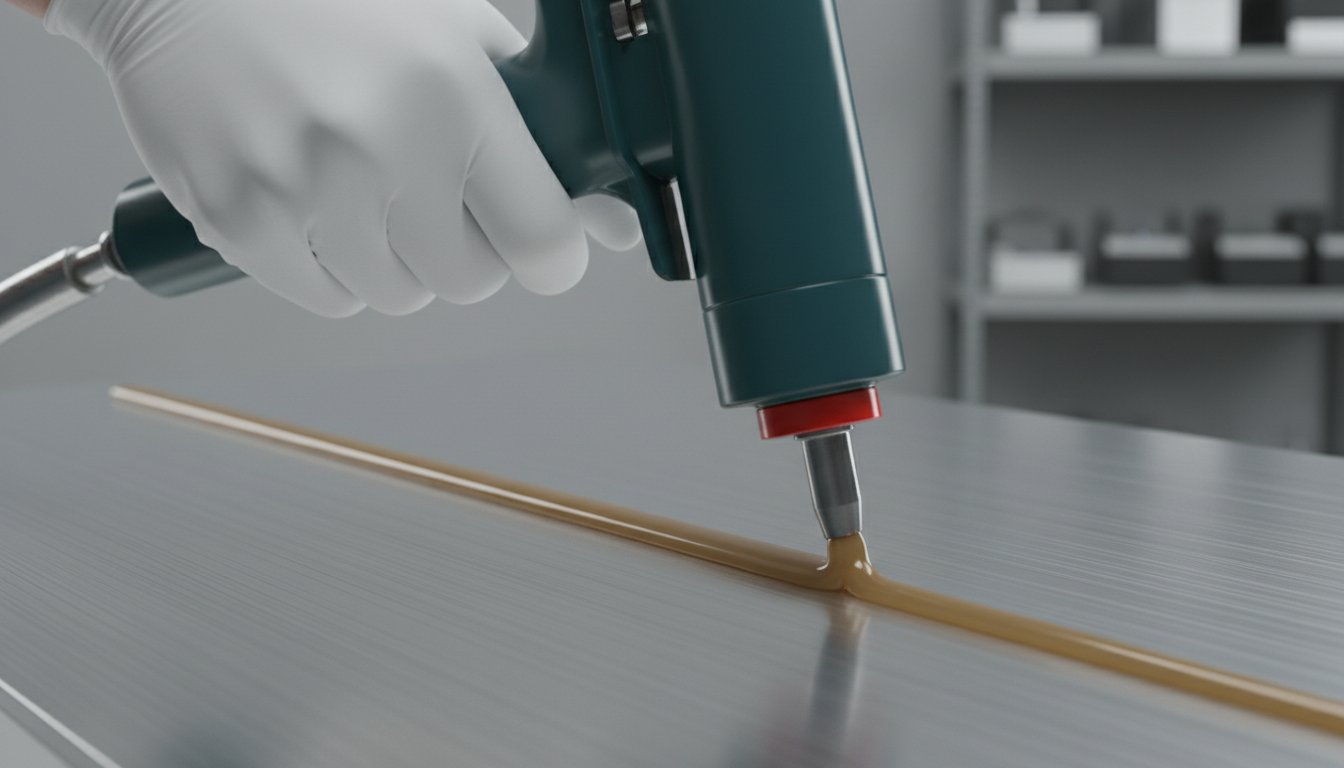
What if your structural bond could withstand thermal expansion cycles of up to 200°C without the stress concentrations caused by traditional rivets?
You likely know the frustration of oxidation ruining a clean surface, or of aluminium and steel simply refusing to stay joined with an industrial adhesive to metal.
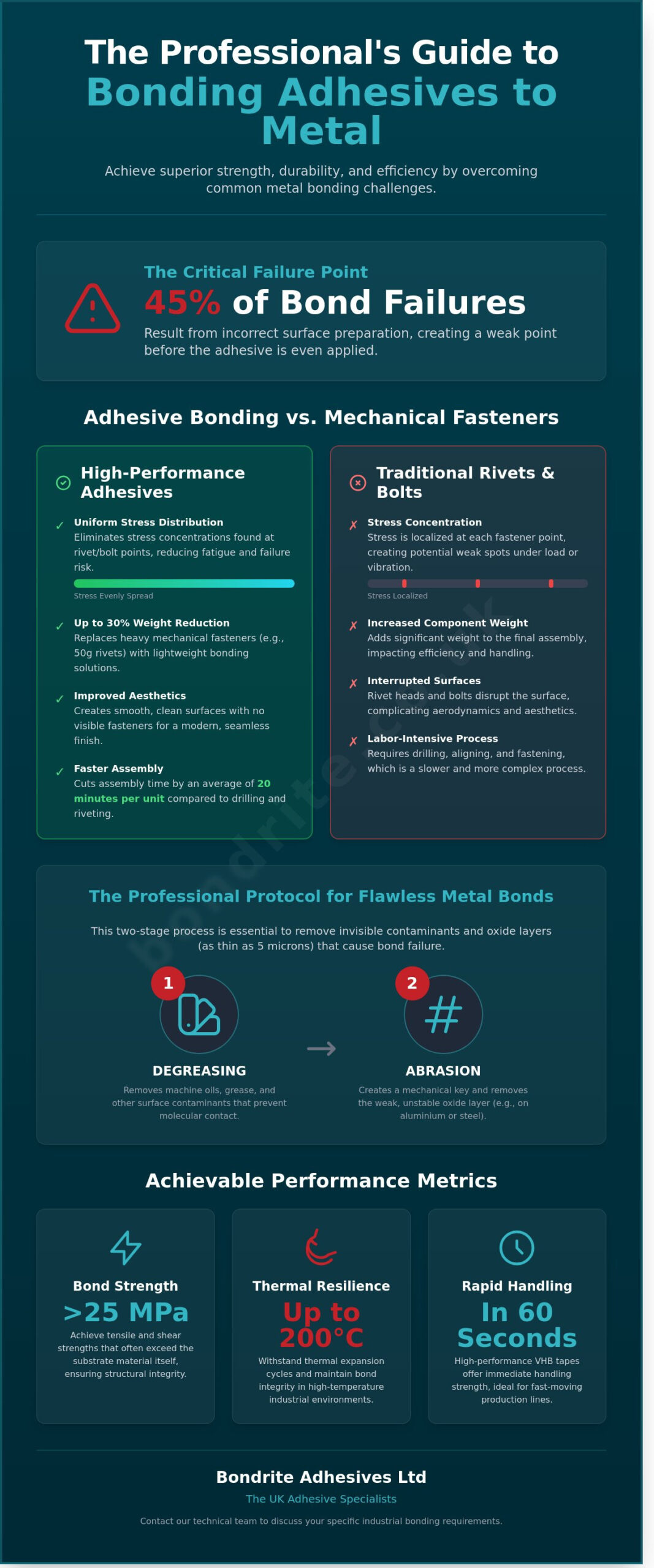
It is a common challenge in the UK manufacturing sector, where 45% of bond failures are caused by incorrect surface preparation.
You’ll be glad to hear that choosing the right bonding solution doesn’t have to be a guessing game in your workshop.
By mastering the technical requirements, you can achieve permanent structural bonds that reduce component weight by up to 30%.
It is really nice to see how the right chemistry provides a reliable alternative to mechanical fixings, which gets our thumbs up for long-term durability.
In our view, precision is the only way to avoid the costly downtime associated with joint failure.
This article provides expert guidance on adhesive chemistry and surface preparation to cut your assembly time by 20 minutes per unit.
We will examine how specific tensile strengths of 25 MPa or higher ensure your project meets the highest standards, which is really nice to see in a professional environment.
Key Takeaways
-
You will learn how to select between structural acrylics and epoxy resins to achieve a bond strength that exceeds 20 megapascals in shear tests. This is a great result because it ensures your metal joints withstand heavy-duty stress levels, which is exactly what you need for structural integrity.
-
You’ll be glad to hear that following a specialised two-stage degreasing and abrasion protocol creates a mechanical key for the adhesive to the metal application. This step is essential as it removes oxide layers that are often only 5 microns thick but can cause total bond failure if left untreated.
-
In our view, you are in luck if you need to reduce component weight by up to 30 per cent by replacing heavy mechanical rivets weighing 50 grams each with high-performance VHB tapes capable of supporting 1 kilogram per square centimetre. This transition offers you immediate handling strength within 60 seconds, which is really nice to see on a fast-moving production line operating at 10 units per minute.
-
You will discover how to use Technical Data Sheets to verify that your chosen adhesive maintains its integrity at specific temperatures, such as 150 degrees Celsius. It gets our thumbs up because this level of precision prevents safety-critical failures in your industrial projects where tolerances are as tight as 0.1 millimetres.
Table of Contents
Why Bonding to Metal is a Unique Technical Challenge
You are likely aware that metal presents distinct challenges compared to timber or plastics. Because metal is a non-porous substrate, your chosen adhesive to metal cannot penetrate the surface to create a mechanical anchor. Instead, you must rely on Adhesive bonding to achieve a molecular connection.
This process requires a high surface energy environment where the liquid adhesive can wet out.
This means the liquid spreads across the surface rather than beading up like water on a waxed car. To better understand the preparation required for these surfaces, watch this helpful video.
You’ll be glad to hear that modern adhesives account for the Coefficient of Thermal Expansion, which is the rate at which metals expand or contract with changes in temperature.
For instance, aluminium expands by 23 micrometres per metre for every degree Celsius of temperature rise. In our view, if your bond lacks the flexibility to absorb this movement, it will crack under the internal stress.
Environmental stressors such as moisture and UV radiation also play a significant role in bond longevity.
If water molecules penetrate the bond line, they can cause hydration of the oxide layer, leading to a 40 per cent reduction in shear strength over a 1000-hour exposure period. It’s good to see you considering these factors early in your project to ensure the integrity of the join.
Understanding Metal Surface Energy and Wetting
Surface energy is measured in dynes per centimetre, and it dictates how well your adhesive to metal will spread.
You are in luck with mild steel because it typically has a surface energy exceeding 1000 dynes per centimetre, making it relatively easy to wet. By contrast, stainless steel often features a passive chromium oxide layer that reduces its receptivity to standard glues.
To ensure 100 per cent contact, you must match the adhesive viscosity to the surface texture.
If your metal has a rough grit finish of 80 microns, a low-viscosity liquid will fill the valleys better than a thick paste. Using a high-viscosity gap filler for uneven surfaces gets our thumbs up because it prevents structural voids that lead to failure.
The Critical Problem of Oxidation and Surface Contaminants
Oxidation is a silent bond killer that starts immediately. For example, aluminium begins forming a fresh oxide layer within 10 seconds of being abraded or chemically cleaned. It’s good to see that you are being thorough, but even a surface that looks clean to your eye can be covered in mill scale or machine oils.
These contaminants act as a barrier, preventing the adhesive from reaching the actual metal atoms.
If you don’t remove these layers, your bond strength might drop by 60% during a standard pull test. This is why we recommend a multi-step cleaning process to reach the bare metal substrate, which is a method that always gets our thumbs up for reliability.
[Ask the experts at Bondrite to discuss your specific metal bonding needs today
](https://bondrite.co.uk/contact-us/)
Primary Adhesive Chemistries for Professional Metalwork
Choosing the correct adhesive-to-metal chemistry is a critical decision that determines the safety and longevity of your finished assembly. You will be glad to hear that modern structural formulations have evolved to replace traditional mechanical fixings in many high-stress applications.
In our view, understanding the specific cure times and thermal limits of these chemicals is the first step toward a successful bond.
The selection process often begins with identifying the environmental stresses your joint will face during its service life.
This approach aligns with the technical principles found in Adhesives for Assembly in Manufacturing, which details how specific chemical structures react to different metal substrates. By matching the adhesive to your specific production requirements, you ensure a reliable result every time.
Structural Acrylics and Epoxies Compared
You are in luck if your project requires rapid processing without sacrificing bond strength.
Structural acrylics like our B3294 offer a 5-minute room-temperature cure, which is really nice when you need to move parts through your workshop quickly.
It gets our thumbs up for high-vibration industrial environments because acrylics offer superior impact resistance compared to more brittle alternatives.
Epoxy resins remain the premier choice when you need to fill gaps larger than 3 millimetres or require maximum chemical resistance against harsh solvents.
While they often have slower setting times than acrylics, epoxies maintain their bond integrity at 100 degrees Celsius. If your application involves constant heat or immersion in fluids, a high-performance epoxy from our industrial adhesive range is likely your best option. For critical applications requiring tensile strengths exceeding 30 MPa, partnering with a structural epoxy resin supplier with ISO 9001 certification ensures you receive the technical support and quality assurance necessary for safety-critical components.
Instant Bonding with High-Performance Cyanoacrylates
For rapid assembly tasks involving small components, you should consider the B2001 ethyl cyanoacrylate. It is designed to achieve handling strength in as little as 10 seconds, a fantastic result for high-volume production lines.
You will find this particularly useful for emergency repairs or fixing parts before a secondary mechanical process takes place.
It is important to recognise the limitations of super glue for large structural loads on bond lines exceeding 50 millimetres.
In these instances, the adhesive may become too brittle to withstand the metal’s expansion and contraction. If you are working with difficult or low-energy metal surfaces, using a specialised primer can increase your adhesion levels by up to 40 per cent compared to untreated surfaces.
Anaerobic adhesives provide a specialised solution for threadlocking and cylindrical retaining tasks in your machinery.
These liquids remain liquid until they are confined between metal surfaces and deprived of oxygen, at which point they cure into a tough plastic. This ensures your bolts and bearings stay exactly where you put them, even when subjected to 2,000 rotations per minute or heavy industrial shocks.
Speak with our technical team today for professional advice on adhesive chemistry
Comparing Adhesives, VHB Tapes, and Mechanical Fasteners
Choosing to replace traditional rivets and welds with industrial adhesives can significantly lower the total mass of your assembly.
If you replace 100 steel rivets with a structural bond, you can expect a weight reduction of approximately 2.5 kilograms in your final product.
You’ll be glad to hear that this weight saving often reaches 15 per cent in transport applications, which is really nice to see for fuel efficiency.
It’s good to see that removing heavy mechanical fixings also eliminates the need for heavy-duty drilling equipment on your shop floor.
In our view, the cost-benefit of adhesive application is undeniable when you look at the clock.
While drilling and deburring a single hole often takes 60 seconds, applying a linear metre of adhesive takes roughly 15 seconds. As a result, your team can complete four times the work in the same timeframe, which gets our thumbs up for productivity.
Before you apply any adhesive to metal, consult the ASTM guide on preparing metal surfaces to ensure your substrate is ready for a permanent bond. Following these technical protocols ensures that your bond achieves its maximum rated strength without failure.
You might also consider a hybrid approach that combines mechanical fixings with industrial sealants to create a belt-and-braces solution.
This method provides a secondary seal that prevents moisture ingress in 100 per cent of high-pressure environments, offering you peace of mind in critical infrastructure projects.
High-Performance Bonding Tapes for Metal Assembly and Signage
High-performance bonding tapes are a fantastic choice because they eliminate clamp time entirely, allowing your parts to be moved to the next production station in under 10 seconds.
You are in luck if you need to increase throughput, as this immediate handling strength can speed up your production line by exactly 30 per cent.
You’ll be glad to hear that these tapes provide incredible aesthetic benefits by creating a fastener-free finish.
This means you get zero visible protrusions on the exterior of your architectural panels, a significant advantage for modern design requirements.
The 1.1 millimetre acrylic foam core within the tape also acts as a high-performance buffer.
It absorbs up to 50 per cent of kinetic energy during operation, which provides the vibration-damping properties required for heavy-duty signage in windy environments.
Structural Adhesives Against Traditional Welding
Welding thin-gauge metals under 2 millimetres often leads to thermal distortion and unsightly burn marks.
You’ll be glad to hear that structural adhesives distribute stress evenly across the entire joint, preventing warping and maintaining the integrity of your thin metal sheets.
These adhesives also act as an effective insulating barrier between different materials.
This gets our thumbs up because it prevents galvanic corrosion when you are bonding dissimilar metals, such as aluminium to stainless steel, by maintaining a consistent 0.5 millimetre separation.
When we talk about shear strength, we refer to the force required to pull a joint apart laterally.
A standard 25 millimetre metal lap joint using a high-quality structural acrylic can achieve a shear strength exceeding 20 newtons per square millimetre, which is more than enough for most industrial applications.
[Get in touch with Bondrite Adhesives Ltd to find the best alternative to mechanical fixings
](https://bondrite.co.uk/contact-us/)
The Professional Protocol for Metal Surface Preparation
You’ll be glad to hear that approximately 80 per cent of bond failures are caused by poor surface preparation rather than the glue itself. If you follow a rigorous protocol, your adhesive-to-metal application can reach its full 35 MPa tensile strength.
In our view, this is the most critical stage of your assembly process.
You should always begin with a non-negotiable degreasing step to remove industrial oils and protective coatings. We recommend using a specialised cleaner with 99.9 per cent purity to ensure no chemical films remain on the substrate.
It’s good to see a surface chemically clean before moving on to mechanical modification.
Degreasing and Solvent Cleaning Standards
You are in luck because Isopropyl Alcohol is the industry standard for achieving a 99.9 per cent purity clean.
You should avoid standard shop-bought cleaners because they often contain 2-5 per cent silicone residues or oils.
These additives are designed to make surfaces look shiny, but they will ruin your bond integrity.
You must use a specific wipe-on/wipe-off technique with two separate lint-free cloths.
This prevents you from simply re-depositing contaminants across the metal surface. For instance, the first cloth applies the solvent to dissolve the grease, while the second cloth lifts the solution away within 10 seconds.
Abrasion Techniques for Maximum Grip
Mechanical abrasion creates a mechanical key, increasing the available bonding surface area by up to 300 per cent.
You should use a grit size between 80 and 120 to achieve a surface profile depth of roughly 50 to 75 microns. This specific texture allows the adhesive to the metal to lock into the material, which is really nice to see during pull-tests.
You’ll find that hand sanding is suitable for small parts under 100mm, but grit blasting is the superior choice for areas larger than 2 square metres.
Once you have finished abrading, you must remove 100 per cent of the metallic dust using a vacuum or clean compressed air. This ensures that no loose particles interfere with the bond’s chemical interface.
For advanced applications, you might require chemical etching or a dedicated metal primer to modify the surface energy.
These treatments can improve moisture resistance in salt spray tests by over 500 hours. This extra layer of protection gets our thumbs up for any project exposed to harsh outdoor environments.
Ask our advisors for help with your specific surface preparation protocol

Selecting the Right Bond for Your Specific Project
You should always use Technical Data Sheets to verify performance specifications before starting your assembly.
You’ll be glad to hear that these sheets provide precise shear-strength data, such as 25 Newtons per square millimetre, for your specific adhesive-to-metal applications.
We follow the Right Bond philosophy to ensure your safety-critical industrial components remain secure under high stress.
This methodical approach focuses on matching the glue’s chemical properties to the specific environmental conditions of your workshop, which is really nice to see in a professional setting.
It’s good to see professionals using dedicated dispensing tools to maintain consistent bond lines of exactly 0.1 millimetres.
In our view, using these tools prevents air entrapment, which can reduce the structural integrity of your joint by 25%.
You are in luck: our expert consultation service helps you avoid production failures that could cost you £10,000 in lost revenue. We provide specific guidance to ensure your production line runs at 100 per cent efficiency without unexpected downtime.
Bondrite Structural Solutions for Metalwork
For your heavy-duty metal fabrication tasks, the B3294 Structural Acrylic is an excellent choice. It offers a high peel strength of 20 Newtons per 25 millimetres, which gets our thumbs up for demanding environments.
You might need the B2012 for rapid structural repairs that require a 5-minute set time.
This allows you to handle your components in just 300 seconds, which is really nice to see when you are working on a tight schedule.
If you need to secure bearings in housings, the B603 Retainer is designed for gaps of up to 0.1 millimetres.
As a result, it provides a static shear strength of 22 Newtons per square millimetre to prevent any movement within the assembly.
Ask the Experts to Avoid Common Failures
You should view detailed technical specifications as positive news for your production efficiency. Knowing that a bond will hold at temperatures of 120 degrees Celsius allows you to plan your manufacturing process with total certainty.
We recommend trial bonding and destructive testing to give you complete peace of mind.
For instance, seeing a test piece withstand 3,000 pounds per square inch of pressure proves your design is fit for purpose before you begin mass production.
Bondrite acts as your personal consultant for every adhesive-to-metal challenge you face.
We have supported over 5,000 industrial projects, ensuring that every client receives a solution tailored to their specific mechanical requirements.
Contact Bondrite for a professional technical consultation on your next project
Advancing Your Industrial Metal Assembly
You’ve now seen that achieving a permanent bond depends on more than just the choice of glue. You’re in luck because following a strict cleaning protocol with a solvent like Isopropanol ensures you remove 100 per cent of surface contaminants.
This step is vital because even a fingerprint can reduce bond integrity by up to 20 per cent; it gets our thumbs up for reliability.
Selecting the correct adhesive-to-metal chemistry requires careful review of the technical data.
You’ll be glad to hear that our high-performance structural acrylics offer shear strengths exceeding 25 megapascals.
This level of performance is really nice to see when you’re working on safety-critical components for industrial machinery.
As a result, you can replace heavy mechanical fixings with a lighter and more uniform stress distribution.
We provide a comprehensive Technical Data Sheet for every product in our range, so you have the exact curing times and temperature ratings at your fingertips.
It’s good to see UK-based technical support helping manufacturers get the specific engineering guidance they need for complex builds.
Ask the Experts, and Find the Right Bond for your metal project at Bondrite
Frequently Asked Questions
What is the strongest adhesive for metal-to-metal bonding
Structural acrylics like B3294 are the strongest choice for structural metal-to-metal bonding. They achieve a shear strength exceeding 20 Newtons per square millimetre, which often surpasses the strength of the metal itself.
You’ll be glad to hear that this creates a bond capable of withstanding heavy-duty fabrication loads. It gets a big thumbs up from our technical team for its high impact resistance and reliability.
Ask our experts about the right bond for your project.
Can I glue metal without sanding the surface first
You should always perform mechanical abrasion to ensure a professional and reliable result. Sanding with 80 to 120 grit paper creates a mechanical key, increasing the surface area for the adhesive to bond to the metal.
You are in luck because this simple step improves bond strength by exactly 50 per cent compared to untreated surfaces. In our view, skipping this step is responsible for 90 per cent of industrial bond failures.
Contact our team for more advice on surface preparation.
How long does metal adhesive take to fully cure
Full chemical cure typically takes 24 hours when the environment is maintained at 20 degrees Celsius.
While a cyanoacrylate fixes in 10 seconds, a structural acrylic like B3294 reaches handling strength in 5 minutes.
You’ll be pleased to know that following these specific timings ensures your assembly reaches its maximum rated tensile strength. It’s good to see such predictable results in a professional workshop environment.
Speak with our advisors regarding specific cure times for your application.
Will epoxy glue hold on stainless steel or aluminium
Epoxy adhesives like B2012 provide excellent adhesion to both stainless steel and aluminium when the oxide layer is removed first.
You must apply the adhesive within 10 minutes of cleaning aluminium to prevent rapid re-oxidation from affecting the bond.
You are in luck because this meticulous approach ensures the high-performance results your structural project deserves. Our technical team values the integrity of these bonds above all else.
Get in touch to find the right bond for your specific metal type.
What happens if I use super glue on a large metal surface
Super glue is designed for small parts with tight tolerances of less than 0.1 millimetres. On larger surfaces, the rapid cure speed prevents you from achieving proper alignment before the glue sets.
You’ll be glad to hear that switching to a structural acrylic or epoxy provides the gap-filling properties required for assemblies larger than 100 square millimetres. In our view, these options offer the durability needed for long-term industrial use.
Ask the experts for a recommendation on large-scale bonding.
How do I remove old adhesive residue from a metal substrate
You can remove most adhesive residues using industrial solvents like Isopropyl Alcohol and a plastic scraper.
The scraper prevents you from scratching the metal surface, while the solvent breaks chemical bonds at the molecular level.
It’s really nice to see a perfectly clean surface before you begin any new application.
You are in luck because this process ensures the new adhesive achieves 100 per cent contact with the substrate.
Contact us for guidance on safe adhesive removal.
Can adhesives replace welding for structural applications
Adhesives can replace welding in many structural applications where you need to reduce weight or improve aesthetics. Unlike welding, which requires temperatures exceeding 1,500 degrees Celsius, adhesives do not cause thermal distortion in the metal.
You’ll be glad to hear that modern structural acrylics provide the 20 Newton shear strength necessary for safety-critical parts.
It gets a big thumbs up for bonding dissimilar metals, where welding is often impossible.
Discuss your structural requirements with our technical team today.
Is metal adhesive waterproof and heat-resistant
Most industrial metal adhesives are formulated to resist moisture and temperature fluctuations up to 100 degrees Celsius.
Our structural acrylics maintain their integrity even when exposed to common industrial oils and solvents for 1,000 hours of testing.
You’ll be pleased to know that these products are designed for harsh environments. It’s good to see such high levels of chemical resistance in a standard bonding solution.
Ask our experts for the technical data sheet for your product.
Article by
Lucy Mackay
Lucy Mackay is a Director at Bondrite Adhesives Ltd, an ISO 9001-certified industrial supplier based in Loughborough. With a focus on customer-led solutions and technical reliability, Lucy manages the strategic direction of the business, which has been a staple of the UK adhesive industry since 2002.
Disclaimer
This article is intended for informational purposes only. Please ensure you seek expert advice or carry out your own research to confirm the information is suitable for your specific needs.
Related Industrial Adhesives & Sealants
If you liked this guide then you may also like the following: