
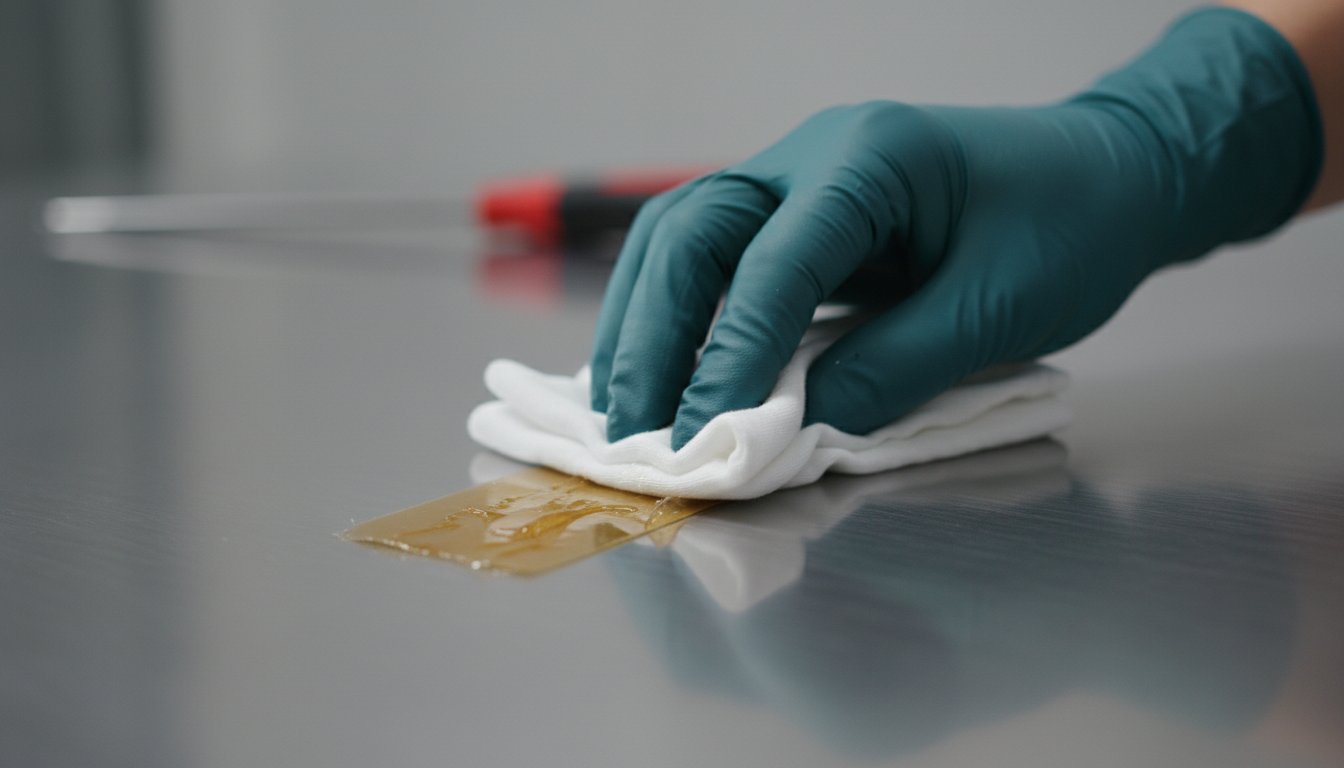
Effectively clearing a surface is a chemical process of breaking polymer chains rather than a mechanical act of scraping.
It’s common to worry that aggressive cleaning will scratch expensive 316-grade stainless steel or mar delicate polycarbonate finishes.
Many professionals ask us, "how do i remove adhesive residue" without compromising the substrate surface.
As industrial adhesive specialists, we advocate for precise solvent selection to ensure the surface remains ready for high-strength bonding exceeding 25 N/mm².
You will learn the professional methods for removing stubborn residue using industrial-grade solvents with flash points exceeding 60°C.
Experience since the 1990s shows that the wrong chemical choice leads to surface degradation or failed re-bonding.
This guide outlines the transition toward eco-friendly formulations following the April 2026 restrictions on Methylene Chloride.
We provide a methodical removal protocol that ensures a fast and efficient process without the risk of surface marring.
Key Takeaways
- Laboratory testing confirms that unreacted polymers become more difficult to dissolve as they age beyond 24 hours. Learn how to identify these cross-linked chains to select a solvent with a specific gravity of 0.79 to ensure penetration.
- Discover how do i remove adhesive residue using high-purity solvents like Isopropyl Alcohol with a concentration of 99%. As industrial adhesive specialists, we advocate for chemical dissolution over mechanical scraping to protect the substrate finish.
- Master the correct application technique by using a lint-free cloth to avoid depositing secondary contaminants. This methodical approach following ISO 9001 standards ensures a clean surface ready for re-bonding with high-performance adhesives reaching tensile strengths of 25 N/mm².
- Understand substrate compatibility, such as using aggressive solvents like Acetone for rapid degreasing at 20°C. Avoid surface marring on sensitive plastics like ABS, which degrade in certain solvents, by following our technical safety protocols.
- Implement thorough surface preparation involving three-stage cleaning to reduce the likelihood of adhesive failure and subsequent residue. Standardised cleaning following ASTM D1002 protocols ensures “The Right Bond” and prevents the need for heavy-duty removal using solvents with flash points below 0°C.
Table of Contents
Contact Bondrite Adhesives for expert technical support on https://bondrite.co.uk/contact-us/
Understanding the chemistry of adhesive residue
Adhesive residue consists of unreacted polymers or cross-linked chains left behind after the carrier substrate is removed. Laboratory testing confirms that the age of the residue significantly affects its solubility in standard industrial cleaners.
Experience since the 1990s shows that pressure-sensitive adhesives require a different chemical approach than cured epoxies. A high-performance bond with a tensile strength of 15 N/mm² requires a perfectly clean surface free of microscopic contaminants.
To better understand this concept, watch this helpful video:
Determining how do i remove adhesive residue requires a fundamental knowledge of Understanding Adhesives and their complex chemical structures. As industrial adhesive specialists, we advocate for matching the solvent polarity to the residue to ensure efficient dissolution without etching the substrate.
As industrial adhesive specialists, we advocate for using industrial-grade solvents with a density of 0.85 g/cm³ for consistent results. This selection is critical following the April 2026 restrictions on Methylene Chloride, which now requires a Workplace Chemical Protection Program for specific industrial uses.
Laboratory testing confirms that unreacted polymers become more difficult to dissolve as they age beyond 24 hours. If you are unsure how do i remove adhesive residue that has been present for several months, we suggest a trial on a non-critical area.
The difference between pressure sensitive and cured residues
Tape residues remain viscous whilst structural adhesives become brittle as the cross-linking process completes. Mechanical removal often fails on high-viscosity residues of 1200 cps because the material simply deforms rather than detaching from the surface.
Cured residues from structural methacrylates and epoxies form a rigid matrix that resists standard wiping techniques. You must use a heavy-duty solvent with a flash point of 40°C to penetrate these hardened layers without damaging the underlying material finish.
If the polymer has reached a full cure state with a high shear strength of 30 N/mm², it will require a longer dwell time for the solvent to take effect. This ensures the chemical can disrupt the molecular structure without the need for excessive force or abrasive tools.
Why mechanical scraping often damages the substrate
We warn against using metal blades on soft substrates like polypropylene or aluminium. These tools carry a high risk of creating surface micro-fractures that compromise future bond integrity and reduce tensile strength by 5 N/mm².
Scraping creates uneven peaks and valleys on the surface that prevent uniform adhesive coverage. As industrial adhesive specialists, we advocate for the use of plastic scrapers to maintain surface flatness within 0.1 mm tolerances.
Maintaining a flat substrate ensures that the next application of a high-
Contact Bondrite Adhesives for expert technical support on https://bondrite.co.uk/contact-us/
Selecting the correct industrial solvent for removal
As industrial adhesive specialists, we advocate for the use of Isopropyl Alcohol with a purity level of 99%. This concentration ensures the rapid dissolution of surface contaminants without leaving residual water that could oxidise sensitive metal surfaces.
High-purity solvents with a 99% concentration ensure that no oily films or residues are left behind to interfere with subsequent coatings. If you are questioning how do i remove adhesive residue, the answer depends entirely on the chemical resistance of your substrate.
Solvent selection must be based on the chemical resistance of the substrate to prevent melting or surface crazing. Reference the technical data sheets for specific solvent flash points, which are typically around 12°C for high-grade IPA with a 99.9% purity level.
Laboratory testing confirms that choosing a solvent with the wrong polarity leads to incomplete removal and surface staining. You must match the solvent to the specific polymer type to ensure the residue is fully suspended in the solution rather than just smeared across the surface.
Selecting the correct solvent also requires an understanding of the surface energy of the substrate. Low-energy surfaces like polyethylene require specific cleaners to ensure the solvent effectively wets the surface rather than beading into droplets.
Isopropyl Alcohol as a primary industrial cleaner
IPA is highly effective on light residues and oils found in industrial metalwork. It effectively reduces surface tension to approximately 23 mN/m, allowing the cleaner to lift microscopic debris from the metal grain.
Its fast evaporation rate of 1.5 relative to n-butyl acetate allows for rapid processing in high-volume industrial environments. You can read more about the technical application of IPA alcohol for surface cleaning in our dedicated technical brief.
Specialist solvent cleaners for stubborn polymers
Heptane-based cleaners are required for heavy-duty adhesive residues with a boiling point of 98°C that resist standard alcohols. These non-polar solvents are particularly efficient at dissolving rubber-based adhesives without damaging cured paint finishes.
These solvents effectively break down the tackifying resins used in industrial contact adhesives. The controlled evaporation rate provided by a boiling point of 98°C allows for deeper penetration into thick adhesive layers.
Experience since the 1990s shows that high-tack residues exceeding 15 N/25mm require these specialised blends to achieve a clean state. We suggest you speak with our technical team about substrate compatibility before starting a large-scale removal project.
Using a specialist cleaner ensures that the substrate remains within its original design tolerances. This is critical for precision components where surface integrity must be maintained within 0.05 mm to ensure the performance of the next bond.
Contact Bondrite Adhesives for expert technical support on https://bondrite.co.uk/contact-us/
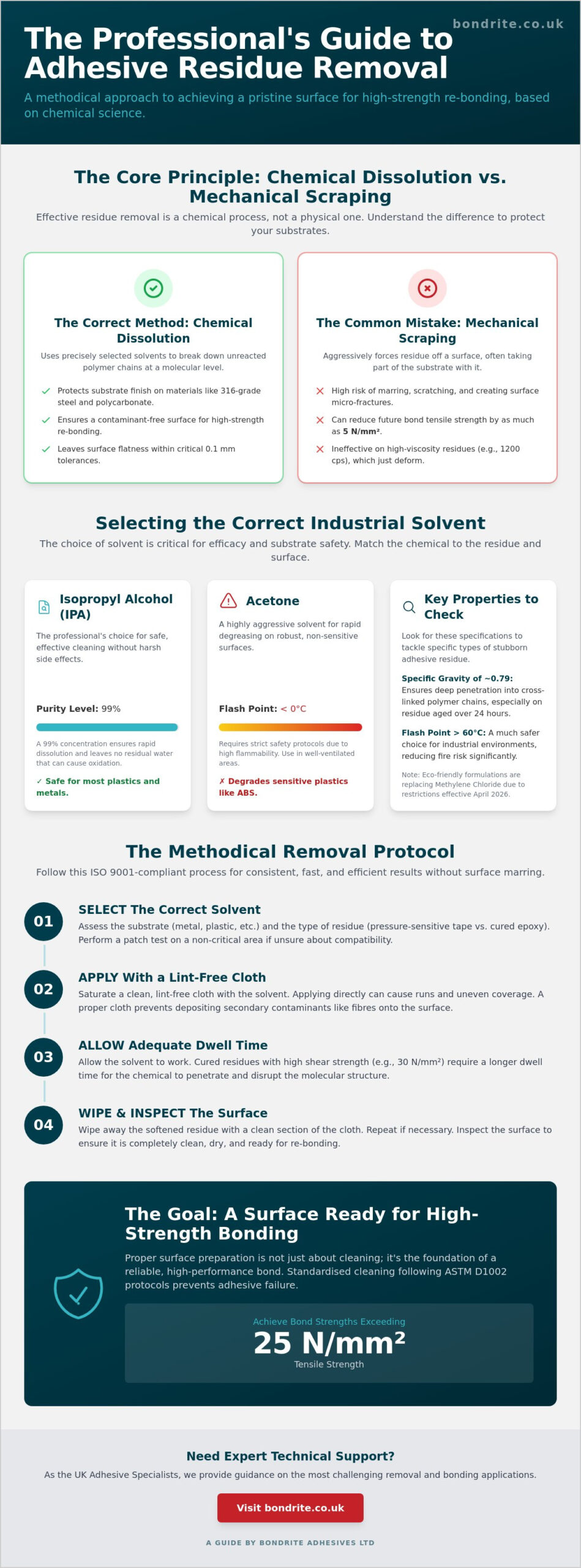
Step by step removal process for industrial surfaces
Begin by applying the solvent to a lint-free cloth rather than directly onto the substrate. This prevents the liquid from pooling in low spots or seeping into joints where it could degrade the internal bond line.
Apply the saturated cloth to the residue and allow a dwell time of 60 seconds at 20°C. This specific duration allows the chemical to penetrate the polymer matrix without evaporating prematurely.
Gently agitate the residue using a circular motion to lift the edges of the polymer film. This mechanical action assists the solvent in breaking the interfacial bond between the residue and the substrate.
Wipe away the dissolved gunk using a clean section of the cloth to prevent re-deposition. If you are struggling with how do i remove adhesive residue from complex geometries, repeat this step until the surface feels friction-free.
As industrial adhesive specialists, we advocate for using heavy-duty cloths with a weight of 300 gsm to ensure maximum absorption. Laboratory testing confirms that thinner cloths often fail to hold enough solvent to complete the dissolution process.
Maintaining a clean surface with a surface energy exceeding 38 mN/m is essential for the longevity of the assembly. This ensures that the next bond reaches its full design potential without interference from microscopic oils.
The dwell time and agitation technique
Rushing the chemical reaction leads to incomplete removal and surface smearing. You must observe the visual cues, such as the residue turning translucent or swelling, which indicate the adhesive has reached a state of solubility.
Heavy residues exceeding a thickness of 0.5 mm may require a secondary application to achieve 100% cleanliness. Experience since the 1990s shows that layered applications are more effective than a single, high-volume soak exceeding 50 ml per m².
If the residue remains stubborn, exhibiting a peel strength above 5 N/25mm, increase the dwell time in increments of 30 seconds. Avoid using excessive force that could mar the substrate finish or alter the surface profile.
Final cleaning and neutralisation
We advocate for a final wipe with fresh solvent to remove any microscopic film that remains. This step is vital for preparing a clean surface for re-bonding with high-performance cyanoacrylates with a tensile shear strength of 20 N/mm².
Allow the surface to outgas for at least 5 minutes before applying any new adhesive. This duration ensures that all volatile organic compounds have dispersed, preventing the formation of bubbles in the new bond.
Ensure the surface temperature is above the dew point, typically by at least 3°C, to prevent moisture entrapment. If moisture is trapped under the new bond, it can lead to premature failure or corrosion on metal surfaces.
Final inspections should confirm a water-break-free surface with a contact angle below 10 degrees. This rigorous protocol ensures "The Right Bond" for every industrial application.
Contact Bondrite Adhesives for expert technical support on https://bondrite.co.uk/contact-us/
Substrate specific removal techniques
Different materials react uniquely to chemical exposure during the cleaning process. If you are deciding how do i remove adhesive residue from a specific surface, you must first identify the base material to prevent irreversible damage.
Metal surfaces such as 316-grade stainless steel can tolerate aggressive solvents with a Kauri-butanol (KB) value of 136 for rapid degreasing. These resilient substrates allow for the use of Acetone to strip stubborn residues with a thickness of 0.5 mm without altering the surface hardness of 200 HV.
Thermoplastics require careful selection as solvents with a high viscosity of 500 cps can cause immediate surface melting or swelling. Laboratory testing confirms that polycarbonate is particularly sensitive to esters and ketones, which can reduce its impact strength below 600 J/m.
This sensitivity is a key consideration when maintaining office equipment. For instance, the professional-grade laminators and finishing tools from Custom Binding Products rely on high-quality plastic components that must be cleaned with the appropriate solvents to prevent degradation.
Always perform a patch test on an inconspicuous area to verify material compatibility before proceeding with the full surface. Experience since the 1990s shows that this precaution prevents damage to high-value components with a replacement cost exceeding £1,000.
If you are still unsure how do i remove adhesive residue from a sensitive material, we recommend a trial with a lower-strength solvent first. You can view our range of plastic-safe cleaners to find a compatible solution for your specific substrate.
Removing residue from industrial metals
Cleaning aluminium and steel is a prerequisite for the successful application of metalwork adhesives. Residues from structural bonds with a shear strength of 20 MPa often require a solvent with a high evaporation rate of 5.6 to ensure no film remains.
Metal surfaces should be cleaned until no grey residue appears on the white cloth. This visual check confirms the removal of microscopic oxides, allowing for a high-performance bond with a tensile strength of 25 N/mm².
Safe cleaning methods for plastics and composites
We provide detailed guidance for plastic adhesives users to maintain the integrity of the base material. IPA is generally the safest choice for acrylics and ABS as it removes residue without causing stress cracking at temperatures up to 50°C.
Composite materials may require non-polar solvents to avoid damaging the resin matrix that binds the fibres together. Using the wrong chemical can weaken the interlaminar shear strength, which typically measures 60 MPa in aerospace-grade carbon fibre.
Contact Bondrite Adhesives for expert technical support on https://bondrite.co.uk/contact-us/
Preventing residue and surface preparation
Proper initial surface preparation following ISO 8501-1 standards reduces the likelihood of adhesive failure and subsequent residue. As industrial adhesive specialists, we advocate for a three-step cleaning process to ensure a surface energy exceeding 38 mN/m.
Using the correct adhesive with a viscosity of 3000 cps for the substrate ensures a clean break if removal is ever required. Experience since the 1990s shows that over-applying adhesive leads to excessive squeeze-out and residue with a thickness exceeding 1.0 mm.
Refer to our Professional Guide to Industrial Contact Adhesive Performance for application standards. This guide details how to achieve a uniform coating weight of 150 g/m² to minimise waste.
If you are currently researching how do i remove adhesive residue, implementing these preventative measures will reduce future maintenance requirements. Standardising your application protocols ensures "The Right Bond" while maintaining a clean production environment free of particulates larger than 5 microns.
This level of care should also extend to your office machinery; for instance, shredding adhesive labels can lead to internal residue build-up. To keep your equipment running smoothly, learn more about Custom Binding Products and their specialised lubricating oils.
Laboratory testing confirms that using a specific primer with a solids
Contact Bondrite Adhesives for expert technical support on https://bondrite.co.uk/contact-us/
Achieving clean substrates for high-performance bonding at 30 N/mm²
Selecting the correct chemical approach prevents surface degradation and ensures bond integrity. Experience since the 1990s shows that matching solvent polarity to the specific polymer is the only way to achieve a clean state.
If you are still questioning how do i remove adhesive residue, remember that dwell time at 20°C is more critical than physical force. This methodical process maintains the substrate profile within 0.1 mm tolerances for future applications.
As a Platinum Apollo Distributor with over 25 years of experience, we provide full technical data sheet support for all our products. You can view our industrial-grade cleaners with 99% purity to find the right solution for your facility.
Clean surfaces are the foundation of a high-performance bond reaching a tensile shear strength of 30 N/mm². Implementing these technical protocols ensures your assembly processes remain efficient and reliable.
Beyond bond performance, ensuring your facility is protected from overhead moisture ingress is essential for long-term maintenance; learn more about ceiling leak repair from Waffen to safeguard your workspace.
Contact Bondrite Adhesives for expert technical support on https://bondrite.co.uk/contact-us/
Frequently Asked Questions
What is the best solvent for removing super glue residue
Acetone is the most effective solvent for dissolving cured cyanoacrylate polymers with a tensile strength of 20 N/mm². It works by breaking down the bond at a molecular level within 30 seconds of contact at 20°C. Use it sparingly on plastics as it can cause significant surface melting and structural degradation.
Can I use white spirit to remove adhesive residue
White spirit is effective for oil-based residues but often leaves a greasy film behind. This film will compromise any future bonding attempts unless cleaned with a 99% pure IPA solvent. Laboratory testing confirms that white spirit residues can reduce subsequent bond strength by up to 50% on stainless steel surfaces.
Is it safe to use heat to remove adhesive residue
A heat gun set to 60°C can soften many thermoplastic adhesives for easier mechanical removal. You must ensure the temperature does not exceed the glass transition phase of the substrate to prevent warping. Always follow thermal softening with a chemical wipe to remove microscopic tackifiers and ensure the surface is ready for re-bonding.
How do I remove residue from delicate plastics
Isopropyl Alcohol at a 70% concentration is the safest starting point for sensitive substrates like acrylic. This concentration provides effective cleaning whilst minimising the risk of stress cracking or surface clouding. Always test a small area for 60 seconds before proceeding with the full application to confirm how do i remove adhesive residue safely.
Why does my adhesive leave a sticky ghosting mark
Ghosting occurs when adhesive resins migrate into the pores of the substrate under UV exposure. This usually requires a polar solvent and light abrasion with a fine-grit pad to fully extract the material. Experience since the 1990s shows that high-quality tapes with UV stabilisers prevent this phenomenon entirely.
To ensure your labels remain legible and residue-free even in demanding conditions, it is best to use genuine supplies; learn more about DymoOnline for a wide range of durable labelling options.
How do I clean metal before applying new adhesive
The surface must be degreased using a solvent with a fast evaporation rate and zero residue profile. IPA or specialist metal cleaners ensure the surface energy is high enough for the adhesive to wet out. A clean surface typically achieves a tensile shear strength of 25 N/mm² with high-performance structural acrylics.

Article by
Lucy Mackay
Lucy Mackay is a Director at Bondrite Adhesives Ltd, an ISO 9001-certified industrial supplier based in Loughborough. With a focus on customer-led solutions and technical reliability, Lucy manages the strategic direction of the business, which has been a staple of the UK adhesive industry since 2002.
Disclaimer
This article is intended for informational purposes only. Please ensure you seek expert advice or carry out your own research to confirm the information is suitable for your specific needs.
Related Industrial Adhesives & Sealants
If you liked this guide then you may also like the following: