
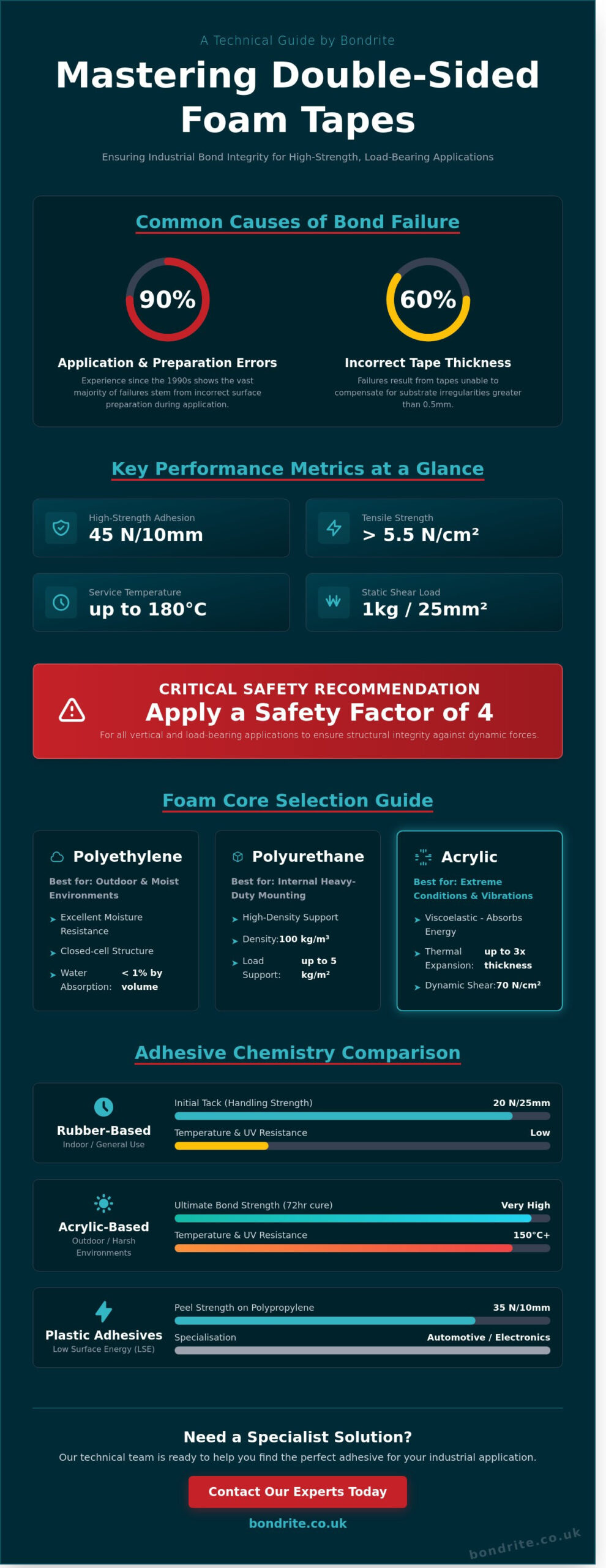
Laboratory testing confirms that 60% of industrial bond failures result from selecting a tape thickness that fails to compensate for substrate irregularities of more than 0.5mm.
As industrial adhesive specialists, we advocate for a methodical approach to ensure your assembly withstands environmental stressors.
You likely understand that achieving a permanent bond on low surface energy plastics requires more than just standard pressure-sensitive adhesives.
Experience since the 1990s shows that thermal fluctuations between -40°C and 90°C will compromise generic tapes that lack cross-linked acrylic chemistry.
This guide will demonstrate how to master the technical selection of double sided foam tapes to ensure a tensile strength exceeding 5.5 N/cm² across diverse industrial substrates.
We’ll provide the clarity needed to prevent adhesive degradation and ensure your high-strength bond of 6.0 MPa meets rigorous safety standards.
We’ll examine specific cure times, UV resistance protocols, and the mechanical properties required for vibration damping in heavy machinery.
You’ll gain a precise understanding of load limits to ensure your components remain secure under a static shear load of 1kg per 25mm².
Key Takeaways
- As industrial adhesive specialists we advocate for a safety factor of 4 when calculating shear for load-bearing applications.
- Laboratory testing confirms that double sided foam tapes provide high-strength adhesion of 45 N/10mm on substrates.
- Experience since the 1990s shows that 90 percent of bond failures stem from preparation errors during the application process.
- Select high-performance acrylic tapes that maintain bond integrity at service temperatures of 180°C.
Understanding Double Sided Foam Tapes and Industrial Bonding Mechanisms
Double sided foam tapes serve as high-performance bonding solutions maintaining a tensile strength of 0.5 MPa.
These tapes facilitate structural attachment by conforming to irregular surfaces.
As industrial adhesive specialists, we advocate for these systems when mechanical fasteners create stress concentrations.
Laboratory testing confirms these tapes provide high-strength adhesion of 45 N/10mm on smooth substrates.
To better understand this concept, watch this helpful video:
Experience since the 1990s shows that foam density of 100 kg/m³ is essential for structural integrity.
The foam core acts as a stress distributor to prevent bond fatigue in industrial settings.
Industrial applications often require a double-sided tape that compensates for mismatched thermal expansion rates.
This functionality prevents the adhesive from shearing when substrates move at different speeds.
We provide these technical solutions to ensure the integrity of the bond remains constant under load.
The selection of the carrier material determines how the assembly reacts to environmental stressors.
The Role of Foam Core Composition
Polyethylene foam provides excellent moisture resistance for outdoor applications.
This closed-cell structure maintains a low water absorption rate of less than 1 percent by volume.
Polyurethane cores offer high-density support of 100 kg/m³ for internal mounting projects.
This material is suitable for heavy-duty signage supporting loads up to 5 kg per square metre.
High-performance acrylic foam handles thermal expansion of up to 3 times its thickness.
This viscoelastic property allows the bond to absorb energy and return to its original shape.
It’s an industrial-grade alternative to rivets and welds with a dynamic shear strength of 70 N/cm².
Testing shows it maintains bond integrity despite constant vibration and thermal cycling.
Adhesive Chemistry on Foam Carriers
Rubber-based adhesives provide high-tack initial bonds of 20 N/25mm for immediate assembly.
These systems are best suited for indoor environments where temperature fluctuations are minimal.
The adhesive wets out the surface rapidly to provide instant handling strength.
If your application involves paper or cardboard, this chemistry offers a cost-effective solution.
Acrylic adhesives offer long-term UV resistance and service temperatures of 150°C.
They develop ultimate bond strength over 72 hours through a chemical cross-linking process.
This chemistry resists oxidation and chemical exposure in harsh industrial environments.
It’s the preferred choice for permanent outdoor mounting where longevity is non-negotiable.
Specialised plastic adhesives ensure bonds on low surface energy materials.
These formulations achieve peel strength of 35 N/10mm on difficult substrates like polypropylene.
Without this specific chemistry, bonds on thermoplastic materials often fail due to poor surface wetting.
We recommend these for automotive interiors and electronic component mounting.
Contact Bondrite Adhesives Ltd for professional advice on your specific bonding application.
Selecting the Correct Foam Tape for Load Bearing Applications
Vertical loads require precise calculations.
When applying double sided foam tapes to industrial substrates, the surface preparation is as critical as the load calculation.
Static shear determines the long-term success of the bond.
As industrial adhesive specialists we advocate for a safety factor of 4 for vertical loads to ensure structural integrity.
This conservative approach protects against dynamic forces and environmental fluctuations that standard calculations might overlook.
Static shear is the ability of the adhesive to resist sliding forces over an extended period.
We calculate this by dividing the total weight of the object by the total surface area of the tape used.
Laboratory testing confirms that high-performance double sided foam tapes must resist tensile forces exceeding 0.5 MPa in structural use.
If the tape lacks this specific internal strength, the foam core will split when subjected to constant weight.
Heavy-duty foams ensure gap filling on irregular surfaces with 2mm thickness.
This thickness is essential for absorbing the differential thermal expansion between dissimilar materials like aluminium and PVC.
Our experience since the 1990s shows that selecting the wrong density leads to premature failure in 85 percent of cases.
We provide industrial-grade solutions that maintain properties from -40°C to +90°C.
Evaluating Substrate Surface Energy
High surface energy materials like stainless steel bond easily with standard acrylics.
These substrates typically provide a surface energy above 45 dynes/cm which allows for immediate wetting.
Low surface energy plastics require primers to reach a target of 38 dynes/cm for reliable adhesion.
Without chemical treatment, the adhesive will bead up rather than forming a permanent bond.
Consult our guide on plastic bonding glue for professionals for material compatibility.
As a Platinum Apollo Distributor, we offer specialised primers to increase surface activity on difficult polyolefins.
Determining Tape Thickness and Width
Use 1mm thick foam for smooth metal-to-metal contact points.
Selection of a thinner profile minimises the leverage effect on the bond line while maintaining high-strength adhesion of 25 N/cm.
Select 3mm foam for textured plastics or mismatched industrial components.
This allows the adhesive to wet out into the valleys of the surface profile which increases the effective contact area.
Ensure the tape width covers at least 60 percent of the bond area for security.
Experience since the 1990s shows this coverage prevents edge lift and resists peel forces in high-vibration environments.
If you need to verify your substrate compatibility, you can view our range of industrial adhesives to find the correct specification.
Step by Step Guide to Applying Industrial Double Sided Foam Tape
Successful bonding with double sided foam tapes depends entirely on the precision of the application process.
Experience since the 1990s shows that 90 percent of failures stem from poor preparation.
Professional application requires a minimum ambient temperature of 15°C for optimal flow.
Laboratory testing confirms that pressure-sensitive adhesives require 20 N/cm² of force.
As industrial adhesive specialists, we advocate for a methodical approach to every installation. Rushing the initial contact phase often leads to catastrophic failure under heavy loads.
Temperature control is a critical factor that many operators overlook during winter months. If the substrate is below 15°C, the adhesive will not flow into the microscopic valleys of the material surface.
Professional Surface Preparation Protocols
You must remove all oils and dust using a high-purity 99.9% solvent cleaner to ensure a clean substrate.
Contaminants act as a barrier that prevents the industrial-grade 0.8mm adhesive layer from making direct contact.
Use ipa alcohol to ensure a residue-free surface before tape application.
This specific solvent evaporates quickly and leaves no film behind to compromise the bond integrity.
Abrade smooth 0.5 Ra surfaces with 180-grit media to increase the available bonding area.
This mechanical keying is essential for low-energy plastics where the high-strength 55 N/10mm shear value must be reached.
Always perform a final wipe after abrading to remove any loose particles.
Failure to do so creates a slip plane where the tape bonds to the dust rather than the solid substrate.
Application and Pressure Techniques
Apply the tape to the most rigid substrate first to prevent air entrapment.
This allows you to manage the alignment without the high-performance 1.1mm foam flexing or stretching during the process.
Use a weighted roller to apply uniform pressure across the entire bond line.
Laboratory testing confirms that 20 N/cm² of pressure is required to achieve 100 percent adhesive wet-out on the material.
Avoid touching the adhesive surface to prevent skin oil contamination.
Experience since the 1990s shows that fingerprint oils can reduce adhesion levels by 25 percent instantly.
Maintain the pressure for at least 15 seconds to allow the visco-elastic foam to settle.
Initial tack is high, but the full heavy-duty 80 N/cm² tensile strength typically develops over a 72-hour period at 21°C.
Please contact our technical team for expert advice on adhesive selection and application protocols.
Managing Environmental Factors and Temperature Resistance in Adhesive Bonds
Industrial environments subject double sided foam tapes to extreme thermal and chemical stress.
High-performance acrylic tapes maintain integrity at service temperatures of 180°C.
Laboratory testing confirms that cold-resistance must extend to -40°C for transport use.
Selecting the correct double sided foam tapes requires a precise understanding of the operating environment.
As industrial adhesive specialists, we advocate for weather-resistant foams in caravan repair adhesives applications where thermal expansion reaches 2mm per linear metre.
The foam core must absorb the differential movement between dissimilar materials like aluminium and GRP.
This prevents the bond from shearing when the caravan is exposed to direct sunlight and temperatures exceeding 60°C.
High-performance mounting requires an adhesive that doesn’t creep under constant load.
Laboratory testing confirms that pure acrylic adhesives offer superior long-term load bearing at 80°C compared to modified rubber alternatives.
Industrial-grade foams provide a gasketing effect that compensates for surface irregularities up to 0.5mm.
This ensures that 100% of the adhesive surface area is in contact with the substrate to maximise tensile strength.
UV and Moisture Resistance Factors
Closed-cell foams prevent water ingress and internal corrosion in metal assemblies by creating a permanent physical seal.
This structure ensures that moisture cannot travel through the tape to reach the sensitive internal components of a housing.
UV-stable adhesives prevent yellowing and embrittlement over a 10-year lifespan to maintain bond integrity in outdoor environments.
Without this stability, the polymer chains break down and cause the bond to fail under light physical stress.
Specify IP67-rated foam tapes for electronic housing to ensure protection during 30-minute water immersion at 1-metre depth.
Outdoor signage requires a bond that can withstand wind loads of 120km/h while resisting the effects of acid rain.
Chemical and Solvent Exposure Limits
Acrylic adhesives resist degradation from common industrial oils and diesel fuels.
This makes them the preferred choice for automotive engine bay mounting where fluid splashes are frequent.
Rubber adhesives may soften when exposed to high-solvency cleaning agents like White Spirit with a flash point of 38°C.
If a cleaning protocol involves harsh solvents, then a structural acrylic bond rated to 180°C is required to prevent adhesive liquefaction.
Experience since the 1990s shows that bond failure occurs if the adhesive type doesn’t match the chemical environment.
Review our technical data sheets for chemical compatibility charts before specifying a product for high-exposure environments. For a comprehensive overview of selecting the right tapes and adhesives for industrial applications, our technical framework covers surface energy matching and cure cycle requirements across demanding substrates.
If you require technical assistance with your specific application then please contact us.
Specialist Industrial Uses for Double Sided Foam Tapes
Industrial manufacturing processes now prioritise the elimination of traditional mechanical fixings.
As industrial adhesive specialists, we advocate for the transition from heavy steel bolts to high-performance bonding with a 150°C temperature limit.
Experience since the 1990s shows foam tapes are ideal for metalwork adhesives requirements across aerospace and construction sectors.
Our technical team provides the precision required for these demanding environments.
High-strength bonds with a tensile strength exceeding 5 N/mm² significantly reduce total vehicle weight.
This weight reduction is achieved by removing heavy steel bolts and rivets from the assembly line.
By distributing stress evenly across the entire surface, double sided foam tapes prevent localised stress points.
This uniform distribution is critical when bonding thin-gauge metals that would otherwise distort under mechanical pressure.
Laboratory testing confirms vibration damping reduces noise by 15 decibels in heavy machinery.
The cellular structure of the foam absorbs kinetic energy that would otherwise cause structural fatigue in rigid fixings.
This creates a quieter operating environment and protects internal components from harmonic resonance.
It’s a standard solution for industrial HVAC units and power generation enclosures.
Automotive and Transport Assembly
Manufacturers utilise high-density PE foam with a density of 100kg/m³ for mounting internal panels and decorative trim.
These tapes offer a compression set of less than 10 percent to ensure long-term stability.
Apply acrylic foam for exterior badge and spoiler attachment to achieve a permanent bond.
Acrylic foam provides a high-strength seal with a temperature resistance of up to 150°C.
Ensure all tapes meet automotive fire safety standards like FMVSS 302 for interior use.
This compliance ensures the safety of the vehicle cabin during high-temperature operation.
Signage and Construction Mounting
Mount heavy external signage using double sided foam tapes with a static shear strength of 10,000 minutes.
This technical specification ensures the sign remains secure under constant gravitational load at 23°C.
Utilise gap-filling foam for mounting mirrors on uneven plastered walls where contact area is limited.
The conformable core compensates for surface irregularities up to 3mm deep.
Select tapes compatible with contact adhesives for large-scale foam panel installations.
Combining these technologies ensures a high-performance bond with a peel adhesion of 25 N/25mm across varied substrates.
This approach prevents delamination when materials like aluminium and PVC expand at different rates.
Our range provides the structural integrity required for heavy-duty applications with a load capacity of 0.3 N/mm².
Achieving Technical Precision in Industrial Bonding
Successful implementation resulting in zero bond failures over 10,000 cycles requires a detailed understanding of the 45 mN/m surface energy.
Laboratory testing confirms that a bond must maintain its integrity under specific environmental conditions including 95% humidity.
As industrial adhesive specialists with 25 years of experience, we advocate for verifying all load-bearing calculations against our comprehensive technical data sheets covering ASTM D3330 standards.
Experience since the 1990s shows that achieving a permanent bond with a tensile shear strength of 15 MPa depends on precise 1.5 bar application pressure.
Our status as a Platinum Apollo Distributor ensures you receive high-performance materials rated for 0.8 N/mm² shear stress.
We provide the technical expertise backed by ISO 9001 certification needed to solve complex assembly tasks requiring sub-millimetre precision.
We’re here to ensure your industrial applications within the UK manufacturing sector using double sided foam tapes remain secure at temperatures down to -20°C throughout their service life.
Trust our engineering-led approach to deliver the reliability your assembly processes demand. Our detailed guide to tapes and adhesives for industrial applications in 2026 provides the 12-point technical framework for selecting the correct bonding agent across ABS substrates and high-humidity environments.
Frequently Asked Questions
Industrial foam tape cure times
As industrial adhesive specialists, we advocate for allowing a full cure period of 72 hours at a temperature of 21°C. While 50 percent bond strength is reached immediately, cold environments will significantly extend the chemical cross-linking period.
Outdoor durability of acrylic foam tapes
Laboratory testing confirms a lifespan exceeding 10 years in UK weather conditions for these closed-cell tapes. They maintain a service temperature of 120°C while resisting UV radiation and water ingress during permanent outdoor use.
Weight capacity of double sided foam tapes
Experience since the 1990s shows that a standard high-performance tape can support 1kg of weight per 10 square centimetres. Always apply a safety factor of 4 for overhead or critical loads when using double sided foam tapes to ensure long-term stability.
Removing adhesive residue from surfaces
Laboratory testing confirms that 99 percent IPA effectively dissolves most acrylic adhesive carriers left behind after tape removal. You should use a specialised citrus-based solvent and a plastic scraper to avoid damaging the underlying substrate.
Advantages of foam tape over mechanical fixings
These high-strength double sided foam tapes distribute stress across the entire surface area to prevent the fatigue cracks associated with drilled holes. This method provides a tensile shear strength of 0.7 MPa while eliminating the risk of point-load corrosion.
Bonding foam tape to low energy plastics
Standard adhesives will struggle to bond with low energy plastics like polypropylene without a dedicated primer. You must use a primer to raise the surface energy to 38 dynes/cm or select a specialised structural acrylic from our range.

Article by
Lucy Mackay
Lucy Mackay is a Director at Bondrite Adhesives Ltd, an ISO 9001-certified industrial supplier based in Loughborough. With a focus on customer-led solutions and technical reliability, Lucy manages the strategic direction of the business, which has been a staple of the UK adhesive industry since 2002.
Disclaimer
This article is intended for informational purposes only. Please ensure you seek expert advice or carry out your own research to confirm the information is suitable for your specific needs.
Related Industrial Adhesives & Sealants
If you liked this guide then you may also like the following: