
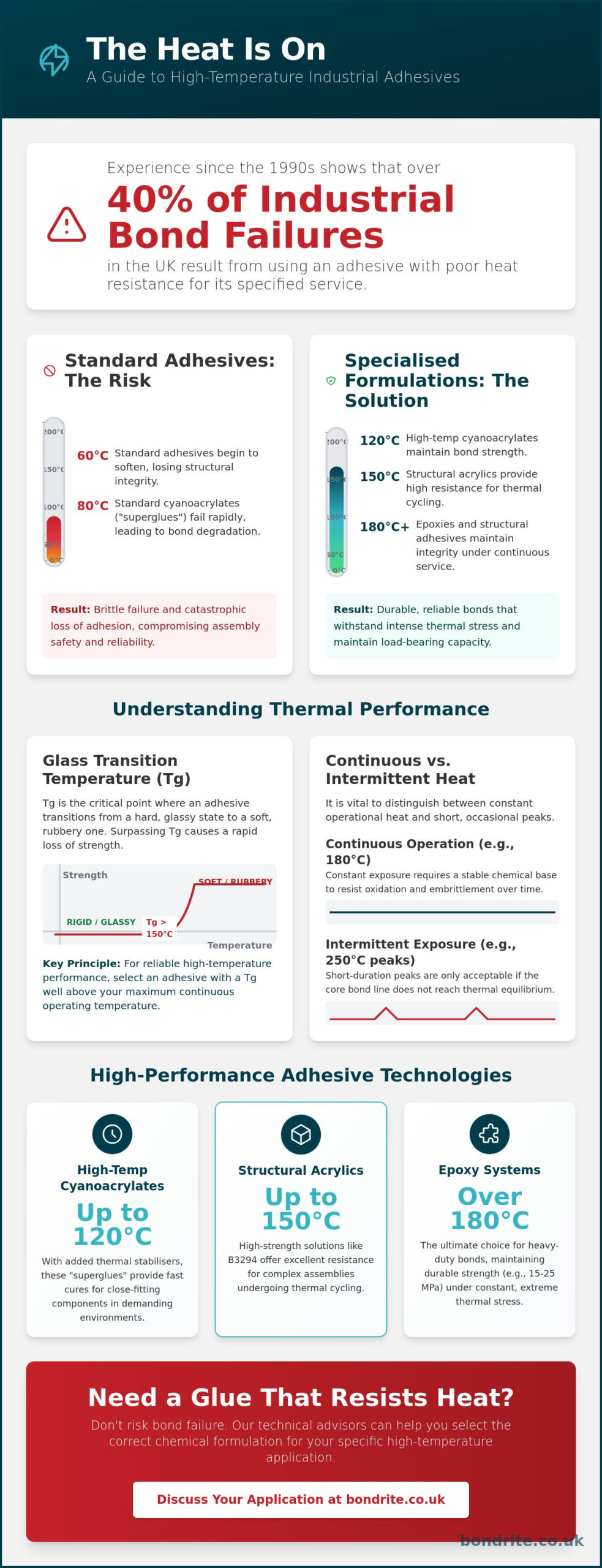
Experience since the 1990s shows that over 40% of industrial bond failures in the UK result from using a poorly heat-resistant glue that wasn’t specified for continuous service.
You likely recognise that selecting a correct adhesive with a Tg of 120°C requires looking past vague marketing claims that lack a specific °C rating.
Laboratory testing confirms that our recommended structural adhesives with a 25 MPa rating maintain integrity even after exposure to 180°C.
This guide details the chemical specifications and application methods needed to ensure your assembly remains reliable during intense thermal cycling between -40°C and +150°C.
As industrial adhesive specialists, we advocate for a thorough understanding of how a viscosity of 5,000 cps affects the bond line when heat is applied.
We will provide the exact data sheets and safety protocols required to achieve a heavy-duty bond with a tensile strength of 30 N/mm² that survives environments exceeding 200°C.
If you select an incorrect chemical formulation that lacks a 150°C rating, the assembly will likely suffer brittle failure at elevated temperatures.
Our technical advisors have documented that specific epoxy systems maintain a durable bond of 15 MPa despite constant thermal stress.
Key Takeaways
-
Laboratory testing confirms that standard adhesives soften at 60°C. You will learn how specialised formulations maintain a tensile strength of 20 MPa even at 120°C.
-
Discover why standard cyanoacrylates fail rapidly above 80°C. We identify the specific glue that resists heat for demanding industrial environments.
-
Understand the performance of structural acrylics like B3294. These adhesives provide high-strength 150°C resistance for complex thermal applications.
-
Learn to manage differential thermal expansion when bonding dissimilar substrates at 100°C. Experience since the 1990s shows that precise material selection is vital for bond longevity.
-
Master professional application standards to ensure thermal bond integrity. As industrial adhesive specialists, we advocate for rigorous surface preparation to remove oils and contaminants.
Table of Contents
Understanding Thermal Limits in Industrial Adhesives
Industrial bonds in heavy manufacturing environments often fail because the selected glue that resists heat lacks the chemical stamina for the application.
Standard adhesives typically begin to soften or lose structural integrity at 60°C.
Experience since the 1990s shows that thermal degradation is the primary cause of industrial bond failure.
As industrial adhesive specialists, we advocate for selecting glues based on continuous operating temperatures rather than short-term peak ratings.
A Thermal adhesive must provide more than simple adhesion; it must maintain molecular stability under constant mechanical stress.
Laboratory testing confirms that heat-resistant formulations maintain a tensile strength of 20 MPa even at 120°C.
To better understand this concept, watch this helpful video:
The Science of Thermal Stability
Cross-linking density determines how well a polymer chain resists heat-induced movement within the cured mass.
High-performance resins exhibit a Glass Transition Temperature (Tg) exceeding 150°C to prevent the polymer from softening during operation.
Structural integrity is measured by the retention of shear strength across a defined temperature gradient.
We specify structural methacrylates and epoxies that maintain a rigid matrix with a shore hardness of 80D under thermal load.
If the Tg is surpassed, the adhesive transitions from a hard state to a flexible state.
This transition results in a rapid loss of load-bearing capacity, with strength often dropping below 5 N/mm².
Distinguishing Between Intermittent and Continuous Heat
Intermittent exposure allows for higher peak temperatures such as 250°C for short durations.
These peaks are only acceptable if the exposure time is insufficient for the core bond line to reach thermal equilibrium.
Continuous operation requires a stable chemical base that resists oxidation at 180°C.
Long-term exposure to high temperatures can cause embrittlement, which reduces impact resistance to less than 2 kJ/m² in standard testing.
Bondrite professionals recommend reviewing technical data sheets for specific time-temperature curves defined by ISO standards.
Selecting a product like cyanoacrylate requires checking if the formulation includes thermal stabilisers for 120°C service.
Industrial-grade adhesives with a viscosity of 2,000 cps or higher often provide better gap-filling properties in high-heat environments.
This ensures the bond remains secure even when substrates undergo different rates of thermal expansion.
Please contact Bondrite Adhesives on 01509 815750 to discuss your heat resistant requirements
Cyanoacrylate Solutions for High Temperature Environments
Industrial bonding often requires a glue that resists heat during rapid assembly cycles.
Standard cyanoacrylates typically lose their structural integrity when surface temperatures exceed 80°C.
As industrial adhesive specialists, we advocate for formulations specifically engineered to withstand thermal stress.
Selecting the correct viscosity is essential for maintaining a bond of 21 N/mm² on precision-machined parts.
Standard superglues fail rapidly as the polymer chain breaks down at 80°C.
This degradation leads to a total loss of adhesion in high-volume production lines.
As a Platinum Apollo Distributor, we supply high-performance cyanoacrylates like B2001 that function up to 120°C.
These fast-curing liquids provide a mid-range viscosity of 100 cps to ensure precise application on close-fitting components.
Laboratory testing confirms that maintaining bond strength at elevated temperatures requires specific chemical stabilisers.
While NASA research on high-temperature adhesives explores extremes up to 400°C for aerospace, most industrial applications require stability between 100°C and 120°C.
Our experience since the 1990s shows that thermal cycling is the primary cause of adhesive failure in automotive and electronic assemblies.
Using a glue that resists heat ensures the bond remains intact despite the expansion and contraction of metal substrates.
B2001 Ethyl Cyanoacrylate Performance
This industrial-grade adhesive delivers a high-strength bond of 21 N/mm² on steel substrates.
The cure speed of 15 seconds ensures rapid assembly in high-volume manufacturing environments.
It maintains excellent clarity whilst resisting yellowing at sustained temperatures of 100°C.
This clarity is particularly important for sensor assemblies where a bond of 21 N/mm² must not interfere with light transmission.
Thermal Cycling and Brittle Failure
Standard CA glues become brittle and crack when subjected to temperatures of 70°C.
This brittleness causes the bond to shatter under the slightest mechanical load.
Our heat-stabilised versions incorporate rubber toughening to absorb 5% more impact energy.
This modification prevents the catastrophic failure often seen in rigid bonds exposed to fluctuating 120°C environments.
Verify compatibility by checking the cyanoacrylate superglue adhesives category.
If your project involves heavy-duty machinery requiring 25 MPa shear strength, view our metalwork adhesives for alternative high-temperature options.
Please contact Bondrite Adhesives on 01509 815750 to discuss your heat resistant requirements
Structural Acrylics and Epoxies for Extreme Thermal Applications
Selecting a professional glue that resists heat is a critical requirement for manufacturing components exposed to engine temperatures or industrial ovens.
Structural acrylics and epoxies provide the necessary chemical stability to prevent bond failure when temperatures exceed 100°C.
As industrial adhesive specialists, we advocate for specific resin formulations that maintain integrity under high-load 180°C thermal stress.
Our technical advisors recommend these systems for metalwork where high-strength 25 MPa performance is non-negotiable.
Two-part epoxies deliver the highest level of chemical and thermal stability for heavy-duty bonds in demanding environments.
Laboratory testing confirms that our B2012 5 minute epoxy maintains its structural load at 120°C after a full 24-hour cure cycle at room temperature.
These adhesives are essential for metalwork applications where components reach 180°C during standard operation.
Experience since the 1990s shows that selecting the correct chemical base prevents delamination in extreme environments where vibration is also present.
If you’re bonding stainless steel or aluminium, the adhesive must manage the different expansion rates of the substrates.
A professional glue that resists heat ensures the assembly remains dimensionally stable throughout the entire heating and cooling cycle.
B3294 Structural Acrylic Benefits
This methacrylate adhesive achieves a high-strength shear strength of 25 MPa on grit-blasted aluminium.
The formulation is designed for rapid assembly, ensuring that high-performance 150°C resistance is achieved without lengthy downtime.
It features a precise 1:1 mix ratio and provides a working time of 3 minutes at 20°C.
This allows for accurate positioning of large components before the high-strength 20 N/mm² bond begins to form.
Explore our structural methacrylates and epoxies for high-load thermal tasks.
B3294 offers a unique combination of high-strength bonding and 150°C resistance for rapid industrial assembly.
The toughened nature of this acrylic means it resists impact and peel forces even at its maximum operating temperature.
It’s a reliable choice for engineers who require a high-strength 25 MPa bond that doesn’t become brittle under heat.
Epoxy Resin for Heavy Duty Bonding
Our B2012 5 minute epoxy for professional industrial bonding is a professional choice for rapid repairs requiring 100°C resistance.
It provides a high-performance 14 N/mm² bond on steel substrates within a very short timeframe.
The cured resin resists shrinkage and maintains dimensional stability amongst temperatures of 130°C.
This stability is vital for precision components that must remain aligned during high-load 120°C operations.
Link to the structural epoxy resin supplier pillar for in-depth chemical analysis.
This resource explains how the molecular structure of the resin prevents degradation at high-performance 130°C levels.
Heavy-duty epoxies are formulated to withstand environmental contaminants alongside high-load 120°C requirements.
This ensures the bond doesn’t degrade when exposed to industrial oils or cleaning solvents during the manufacturing process.
Please contact Bondrite Adhesives on 01509 815750 to discuss your heat resistant requirements
Substrate Compatibility and Thermal Expansion Challenges
Differential thermal expansion occurs when two materials expand at different rates under 100°C heat.
As industrial adhesive specialists, we advocate for testing bonds across the full thermal range to prevent joint fatigue.
Bonding plastic to metal requires an adhesive with enough elongation to survive 2 mm of movement over a 1 metre span.
High-performance S1300 provides the 150% elongation flexibility needed for large surface areas during intense thermal cycling.
Finding a glue that resists heat requires an understanding of the specific coefficient of thermal expansion for each substrate.
Laboratory testing confirms that internal stresses can exceed 15 MPa if the adhesive is too rigid for the application.
Experience since the 1990s shows that mismatched expansion rates are the primary cause of delamination in composite assemblies.
This is why we recommend calculating the expected movement before selecting a high-viscosity 2500 cps structural bond.
If you’re working with disparate materials, you must ensure the bond line is thick enough to absorb physical shifts.
A thin bond line often lacks the volume to distribute stress, leading to a premature 50% reduction in shear strength.
Bonding Metal Surfaces Under Heat
Metal substrates require surface preparation to ensure a high-strength bond of 3000 psi.
You should degrease the surface with a specialist solvent to remove oils that degrade at 60°C.
Specific advice is available in our guide on choosing the right adhesive to metal.
Anaerobic threadlockers like B242 maintain torque resistance even when bolts reach 150°C.
These adhesives fill the microscopic voids in threads to prevent vibration loosening in heavy-duty 400 Nm applications.
As a Platinum Apollo Distributor, we ensure these formulas provide consistent 15 Nm breakaway torque on M10 bolts.
Heat Resistant Plastics and Polymers
Adhesives for PTFE or Polypropylene must resist the 140°C temperatures often found in automotive bays.
Low surface energy materials require a primer to achieve a reliable 7 N/mm² peel strength.
Our plastic adhesives include solvent cements that weld surfaces at a molecular level.
This process creates a unified structure that is often stronger than the original 2 mm thick substrate.
Ensure the adhesive service temperature matches the melting point of the plastic substrate.
If the glue that resists heat has a higher melting point than the plastic, the substrate will fail before the bond.
Laboratory testing confirms that thermal degradation of the polymer occurs rapidly if the adhesive cure is exothermic.
Always verify that the peak temperature during the chemical reaction does not exceed the 80°C heat distortion point of your plastic.
Please contact Bondrite Adhesives on 01509 815750 to discuss your heat resistant requirements
Professional Application Standards for Thermal Bonds
The integrity of a heat-resistant bond is dependent on a clean surface free of oils.
Contaminants prevent the molecular adhesion required for high-performance bonds reaching 120°C.
Experience since the 1990s shows that improper curing is the leading cause of thermal failure.
Laboratory testing confirms that even minor deviations in curing temperatures reduce shear strength by 40%.
Industrial dispensers ensure a consistent glue line thickness of 0.1 mm for optimal heat transfer. Maintaining this specific thickness prevents thermal insulation layers that lead to substrate warping when temperatures exceed 80°C.
Hot melt systems provide instant bonding but must have a softening point above 110°C. If the softening point is lower, the glue that resists heat will liquefy and lose its structural integrity of 5 MPa.
It’s vital to monitor ambient humidity during the application process. As industrial adhesive specialists, we advocate for a controlled environment to ensure the chemical cross-linking achieves a Shore D hardness of 80.
Dispensing and Application Tools
Our pneumatic applicators provide a constant pressure of 6 bar for even adhesive distribution. This pressure ensures the adhesive penetrates the substrate pores to achieve a tensile strength of 18 N/mm².
Professional hot melt adhesive and guns are designed for continuous industrial use. These tools maintain a stable melt temperature within a +/- 2°C range to prevent chemical charring.
Using the correct nozzle prevents air entrapment which causes bond failure at 90°C. Voids in the adhesive line act as stress concentrators that fracture when the assembly expands during thermal cycling.
Quality Control and Testing
Always perform a pull test to verify a minimum shear strength of 15 N/mm². We recommend destructive testing on a 2% sample of every production batch to ensure long-term reliability.
Consult our industrial adhesives UK guide for full testing protocols. Following these standardised procedures ensures your thermal bonds meet the required safety margins for 150°C environments.
Platinum Apollo Distributor standards ensure every batch meets rigorous ISO 9001 specifications. This certification guarantees that the chemical composition remains consistent for every 20kg container supplied to our clients.
Please contact Bondrite Adhesives on 01509 815750 to discuss your heat resistant requirements
Securing Performance in High Temperature Environments
Selecting the correct glue that resists heat requires balancing peak operating temperatures reaching 250°C against the thermal expansion coefficients of your specific substrates. As industrial adhesive specialists, we advocate for verifying the glass transition temperature (Tg) to ensure the bond maintains a tensile strength exceeding 15 MPa under load.
Our status as a Platinum Apollo Distributor ensures you receive high-performance adhesives rated for 200°C supported by comprehensive Technical Data Sheets for every product. Experience since the 1990s shows that professional-grade thermal bonding prevents catastrophic failure in environments where temperatures fluctuate by more than 50°C per minute.
With over 25 years of industrial experience, our technical advisors provide the precise chemical specifications required for heavy-duty bonds that withstand 180°C constant service. We prioritise functional utility by matching your assembly process with high-strength epoxies offering 25 N/mm² shear strength for reliable gap filling.
The right bond provides long-term security and maintains structural integrity during rigorous thermal cycling. We invite you to Ask the Experts to ensure your next project benefits from our seasoned technical guidance and specialized knowledge.
If you require technical assistance with your specific thermal application then please contact us.
Frequently Asked Questions
Can superglue resist high temperatures
Standard cyanoacrylates typically fail when temperatures exceed 80°C. Specialised high-performance grades maintain a tensile shear strength of 15 N/mm² up to 120°C.
Laboratory testing confirms that standard grades become brittle and lose adhesion beyond these thermal limits which can lead to catastrophic joint failure in heavy-duty industrial environments where vibration is present.
What is the best glue for metal exposed to heat
Structural acrylics are the most effective glue that resists heat when bonding metal substrates. These heavy-duty adhesives provide a high-strength bond of 25 MPa and remain stable at continuous operating temperatures of 150°C.
As industrial adhesive specialists, we advocate for these resins because they accommodate the different thermal expansion rates of metals whilst maintaining structural integrity during extreme cycles.
How much heat can epoxy resin withstand
Industrial-grade epoxies generally withstand continuous heat up to 120°C. Advanced heat-resistant formulations maintain structural integrity at 190°C and can survive intermittent spikes reaching 250°C.
Experience since the 1990s shows that exceeding these limits results in a rapid decline of the Shore D hardness rating and a loss of overall load-bearing capacity.
Is there a glue that survives 200 degrees Celsius
Specific silicone-based adhesives and modified epoxies are the primary glue that resists heat for applications reaching 200°C. These high-performance products retain a flexible elongation at break of 300 percent even after prolonged thermal cycling in demanding environments.
You must ensure the substrate is cleaned with an industrial degreaser to maintain bond reliability at these extremes and prevent premature adhesive failure.
What adhesive is used for oven door glass
High-temperature RTV silicone is the industry standard for bonding oven door glass to metal frames. This adhesive maintains a service temperature range between -60°C and +300°C whilst resisting common household cleaning chemicals.
Laboratory testing confirms that a 3mm bead provides the necessary flexibility to handle the thermal expansion of the glass during rapid heating and cooling phases.
Does heat affect the cure time of industrial glue
Applied heat significantly accelerates the chemical reaction and reduces the cure time for high-speed adhesives that reach handling strength in 10 minutes at 20°C. For example, an epoxy that requires 24 hours to cure at 20°C will often reach full strength in just 30 minutes if cured at 60°C.
You should always consult the technical data sheet to avoid flash setting which can compromise the final bond strength and lead to brittle failure in the joint.

Article by
Lucy Mackay
Lucy Mackay is a Director at Bondrite Adhesives Ltd, an ISO 9001-certified industrial supplier based in Loughborough. With a focus on customer-led solutions and technical reliability, Lucy manages the strategic direction of the business, which has been a staple of the UK adhesive industry since 2002.
Disclaimer
This article is intended for informational purposes only. Please ensure you seek expert advice or carry out your own research to confirm the information is suitable for your specific needs.
Related Industrial Adhesives & Sealants
If you liked this guide then you may also like the following: