
What if the heavy-duty bond holding a 350kg component in place relies on a technical understanding of what is glue made of rather than the animal-derived proteins used in 19th-century woodworking?
Experience since the 1990s shows that industrial manufacturing demands more than just a sticky substance with a low viscosity of 50 cps to achieve a tensile shear strength of 25 N/mm².
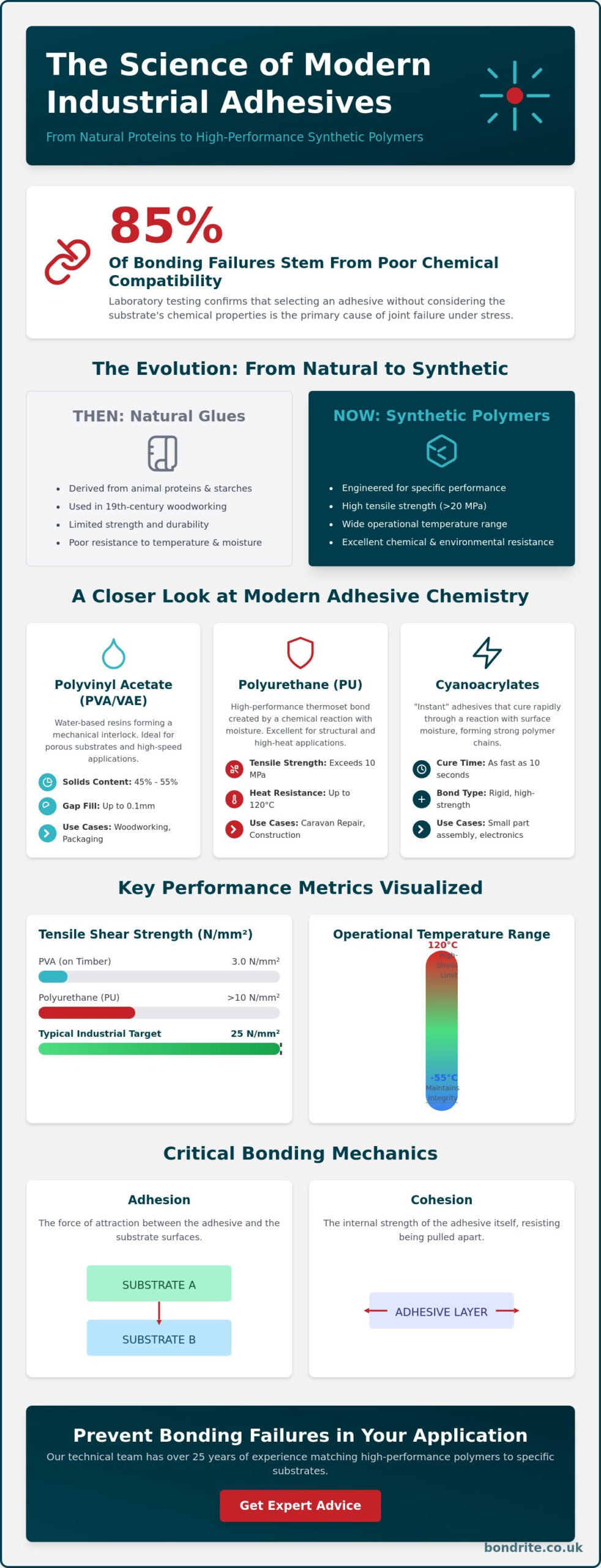
Laboratory testing confirms that 85% of bonding failures stem from poor chemical compatibility between the adhesive and the substrate.
As industrial adhesive specialists with over 25 years of experience, we advocate for a deeper knowledge of polymer science to prevent material failure during high-stress applications exceeding 120°C.
This guide provides a technical transition from natural proteins to high-performance synthetic polymers that maintain integrity at -55°C.
We’ll examine the specific roles of resins and cyanoacrylates with a 10-second cure time to ensure you select the correct chemical properties for your substrate.
Key Takeaways
- Understand the transition from proteins to synthetic 20 MPa polymers used in modern manufacturing.
- Identify what is glue made of by exploring how Polyvinyl Acetate (PVA) provides high-tack 0.1mm gap fill.
- Evaluate high-performance 10-second cure chemistry within Cyanoacrylates to understand rapid bonding.
- Laboratory testing confirms that differentiating between adhesion and cohesion ensures bonds meet required 25 N/mm² tensile strength.
- Experience since the 1990s shows that matching polymers to substrate materials manages high 23 x 10⁻⁶/K thermal expansion rates in aluminium.
Table of Contents
The Evolution of Bonding Agents from Natural to Synthetic
Glue is a bonding agent that transitions from a liquid to a solid to establish a mechanical or chemical link.
Understanding what is glue made of requires a look at both historical natural substances and modern chemical engineering.
As industrial adhesive specialists, we advocate for a technical approach to bonding that prioritises chemical integrity.
Industrial bonding requires a deep understanding of how these materials interact with different substrates.
Selecting the wrong base material can lead to catastrophic joint failure under mechanical stress.
To better understand the manufacturing process behind these substances, watch this helpful video:
Synthetic Polymers in Industrial Adhesives
Industrial synthetic polymers define the performance and durability of modern bonding agents.
Polyvinyl Acetate serves as the primary resin for the majority of water-based wood adhesives used in UK manufacturing.
Understanding what is glue made of requires a technical look at how these molecular chains form a permanent mechanical interlock.
As industrial adhesive specialists, we advocate for selecting polymers based on the specific environmental stresses of the application.
Polyvinyl Acetate and VAE Formulations
Polyvinyl Acetate (PVA) is a rubbery synthetic polymer produced through the polymerising of vinyl acetate monomers.
Typical industrial-grade PVA formulations maintain a solids content of approximately 45% to 55% to ensure consistent application and bond density.
Specific plasticisers are incorporated into these formulations to lower the glass transition temperature below 10°C.
For high-speed packaging applications, Vinyl Acetate Ethylene (VAE) provides increased flexibility and superior adhesion to coated boards.
Water-based adhesives rely on the controlled evaporation of the carrier fluid to set the polymer chain into a rigid state.
Experience since the 1990s shows that PVA and VAE adhesives achieve a shear strength of 3.0 N/mm² on standard timber substrates.
The science of sticking involves these polymers transitioning from a liquid dispersion to a solid matrix that resists creep under load.
The Chemistry of Polyurethane Adhesives
Polyurethane (PU) adhesives create a high-performance bond through the chemical reaction between an isocyanate and a polyol.
These adhesives react with ambient moisture or moisture within the substrate to form high-strength bonds exceeding 10 MPa in tensile shear tests.
Laboratory testing confirms that PU adhesives can withstand temperatures up to 120°C without experiencing structural failure or bond line softening.
This thermal stability makes them essential for heavy-duty industrial components that encounter significant heat cycling during operation.
When considering what is glue made of in a structural context, the isocyanate component is critical for creating a thermoset cross-link.
This chemical structure ensures the adhesive does not re-melt, providing a critical safety margin in load-bearing applications.
We frequently supply these formulations for caravan repair due to their high vibration resistance and ability to gap-fill uneven surfaces.
You should ensure that at least one substrate is porous to allow moisture to trigger the curing process effectively across the entire bond area.
The Chemistry of High Performance Bonding
Understanding what is glue made of requires an analysis of molecular cross-linking.
Industrial bonding performance depends on specific chemical triggers that transform liquid monomers into solid polymers.
Cyanoacrylate and Instant Adhesion
The primary ingredient in these formulations is ethyl cyanoacrylate monomer in its liquid state of 100 cps.
As industrial adhesive specialists, we advocate for precise application because cyanoacrylate superglue adhesives require moisture as a trigger.
Hydroxide ions present in surface moisture or atmospheric humidity initiate a rapid anionic polymerisation of 0.5 seconds.
This exothermic reaction allows the adhesive to reach handling strength in 5 to 30 seconds at room temperature.
Laboratory testing confirms that the absence of acidic stabilisers on a substrate surface allows the chain reaction to proceed.
This creates a thermoplastic resin that forms a high-strength bond of 20 MPa on rigid plastics.
Structural Acrylics and Methacrylates
Structural acrylics utilise methyl methacrylate (MMA) monomers to create high-strength bonds exceeding 25 N/mm² in tensile shear.
These formulations are engineered for high impact resistance of 15 kJ/m² and maintain integrity even under heavy vibration.
Experience since the 1990s shows MMA adhesives offer superior peel strength on metals like aluminium.
Laboratory testing confirms that these methacrylates provide a durable bond that resists environmental degradation for over 25 years.
The chemistry involves a toughening agent that prevents crack propagation within the adhesive layer.
This results in a heavy-duty bond capable of withstanding 3,000 psi in transport and marine manufacturing.
Two Part Epoxy Systems
Epoxies function through a two-part chemistry consisting of a resin and a hardener (catalyst).
Engineers frequently ask what is glue made of when specifying adhesives for high-stress environments requiring a heat resistance of 120°C.
The resin usually contains epoxide groups while the hardener uses amine or polyamide compounds.
This allows for work times ranging from 5 minutes to several hours depending on the specific industrial requirement.
Laboratory testing confirms that epoxies provide excellent chemical resistance to solvents and hydraulic fluids.
They create a low-shrinkage bond of less than 1% volume change that ensures dimensional stability in precision engineering applications.
Mechanics of Adhesion and Cohesion
To understand what is glue made of, we must examine the molecular mechanics that govern the bond.
Adhesion is the physical force that binds the adhesive to the substrate surface.
Cohesion represents the internal strength of the adhesive itself after curing.
Laboratory testing confirms that a bond fails when the stress exceeds either the adhesive or cohesive strength.
Choosing the correct industrial applications depends on whether the bond is mechanical or chemical. Mechanical bonding relies on the adhesive flowing into surface irregularities to create a physical lock once it sets.
Chemical bonding involves molecular attraction or fusion between the adhesive and the substrate. Experience since the 1990s shows that chemical bonds provide superior resistance to environmental stress and high-strength performance reaching 25 MPa in tensile shear tests.
Surface Energy and Substrate Wetting
Surface energy determines whether a liquid adhesive will spread across or bead up on a material.
Low surface energy plastics like polypropylene often sit below 30 mN/m and require specific primers or
[plastic adhesives
](https://bondrite.co.uk/product-category/adhesives-by-use/plastic-adhesives/)to ensure successful wetting.
Surfactants are integrated into formulations to reduce surface tension below 30 mN/m. This allows the liquid to achieve intimate molecular contact by overcoming the resistance of the substrate surface.
Proper surface preparation is required to maximise the molecular contact area. As industrial adhesive specialists, we advocate for degreasing and abrading surfaces to increase surface energy above 40 mN/m for optimal results.
The Role of Solvents and Carriers
Solvents like MEK or Acetone are used to dissolve polymers for easier application.
These carriers evaporate to leave behind a high-strength solid bond reaching 15 MPa in shear tests.
Solvent cements create a weld effect where the adhesive dissolves the substrate surface. This process fuses the two materials into a single piece rather than just sitting on top of the surface.
WC105 solvent cement creates a monolithic bond by fusing acrylic components together. This results in a clear joint that maintains structural integrity with a 24-hour full cure time at 20°C.
When considering what is glue made of, the carrier system is just as vital as the base polymer. These solvents ensure the adhesive maintains a low viscosity of 500 cps for deep penetration into tight joints.
Selecting Adhesives based on Chemical Composition
Selecting the correct bonding agent requires a technical understanding of what is glue made of and how it interacts with specific surfaces.
Matching the base polymer to the substrate ensures long term performance.
As industrial adhesive specialists, we advocate for checking the Technical Data Sheet (TDS) to verify chemical resistance against solvents like acetone or petrol.
This document provides essential data on viscosity measured in cps and Shore hardness ratings.
Matching Polymers to Substrates
Structural epoxies provide high gap-filling properties of up to 5mm for rigid assemblies.
These formulations achieve shear strengths exceeding 20MPa on prepared steel surfaces.
We recommend contact adhesives for flexible materials such as rubber or foam to maintain bond elasticity.
These solvent-borne systems allow for immediate handling strength while accommodating material movement.
Cyanoacrylates provide rapid fixture times of under 30 seconds for small surface areas.
For pre-screened professional options, engineers should consult our adhesives by use category.
Applications involving high thermal expansion require specialised metalwork adhesives to prevent bond line fracture.
Experience since the 1990s shows that mismatched expansion coefficients lead to delamination during temperature cycles.
Anaerobic adhesives serve as the primary choice for metal fasteners where oxygen exclusion triggers a 15-minute fixture time.
These resins polymerise into a hard thermoset plastic that resists vibration and prevents corrosion.
Checking the TDS ensures the adhesive withstands exposure to industrial fluids like hydraulic oil or coolant.
As a leading UK Adhesive Distributor, we provide detailed data on chemical immersion tests conducted over 1,000 hours.
Environmental Resistance and Durability
Chemical additives provide UV resistance and thermal stability for outdoor applications.
Laboratory testing confirms that specific methacrylates maintain bond strength of 15MPa at temperatures as low as -40°C.
Silicone sealants offer high-performance elongation properties exceeding 400% for expansion joints.
This flexibility prevents failure when substrates shift due to seasonal heat fluctuations.
Industrial-grade acrylics offer high impact resistance of 25J to protect the bond against mechanical shock.
These reactive systems cure quickly at room temperature to provide a durable, permanent connection.
Please contact our technical team for expert advice on adhesive selection
Achieving Technical Precision in Industrial Bonding
Understanding what is glue made of allows engineers to predict how synthetic polymers will react under heavy-duty loads exceeding 20 N/mm².
Experience since the 1990s shows that matching the resin base to your specific substrate is the only way to ensure long-term structural integrity.
As industrial adhesive specialists, we advocate for selecting high-performance structural acrylics that maintain a stable viscosity of 50,000 cps for gap-filling applications.
Laboratory testing confirms that high-strength epoxies provide superior resistance to chemical exposure when cured at 20°C for 24 hours.
Our status as a Platinum Apollo Distributor ensures you receive technical support backed by over 25 years of industrial experience.
Selecting the correct chemical composition ensures your assembly remains secure under extreme conditions like continuous operation at 150°C.
It doesn’t matter if you’re bonding metals or composites; the chemistry always dictates the final result.
We look forward to helping you identify the most effective bonding solution for your next project.

Article by
Lucy Mackay
Lucy Mackay is a Director at Bondrite Adhesives Ltd, an ISO 9001-certified industrial supplier based in Loughborough. With a focus on customer-led solutions and technical reliability, Lucy manages the strategic direction of the business, which has been a staple of the UK adhesive industry since 2002.
Disclaimer
This article is intended for informational purposes only. Please ensure you seek expert advice or carry out your own research to confirm the information is suitable for your specific needs.
Related Industrial Adhesives & Sealants
If you liked this guide then you may also like the following: