
Could a chemical bond actually outperform a steel bolt in a heavy-duty industrial assembly? For many engineers, the traditional reliability of rivets and welds is difficult to move away from, despite the clear drawbacks of point-loading and substrate damage. However, selecting a high-performance adhesive to replace mechanical fasteners is often the most technically sound decision for modern manufacturing. You’ve likely dealt with the frustration of stress cracks forming around drill holes or the inevitable onset of galvanic corrosion where dissimilar metals meet. These failures don’t just affect aesthetics; they compromise the long-term safety and structural integrity of the assembly.
By moving to structural bonding, you can achieve a sleek, seamless finish whilst significantly reducing assembly time by eliminating drilling and secondary finishing steps. This article explains how structural adhesives provide superior stress distribution and durability compared to traditional fixings. We will explore the specific material properties of methacrylates and epoxies, and how these solutions ensure a longer service life for your industrial components through improved load-bearing capabilities.
Key Takeaways
- Understand how transitioning to uniform stress distribution prevents the fatigue cracking typically associated with point-loading rivets and bolts.
- Learn why choosing a high performance adhesive to replace mechanical fasteners provides a superior seal against moisture whilst improving the overall aesthetics of the product.
- Identify the technical criteria for choosing between structural acrylics and epoxies based on material compatibility and thermal requirements.
- Gain insights into the essential surface preparation and joint design protocols that guarantee a reliable chemical bond in heavy duty industrial environments.
- Discover how to reduce production costs by removing labour intensive drilling and finishing processes from your manufacturing workflow.
p>For technical guidance on selecting the correct bonding solution for your specific application, please get in touch with our expert team.
Why Professionals Choose Adhesive to Replace Mechanical Fasteners
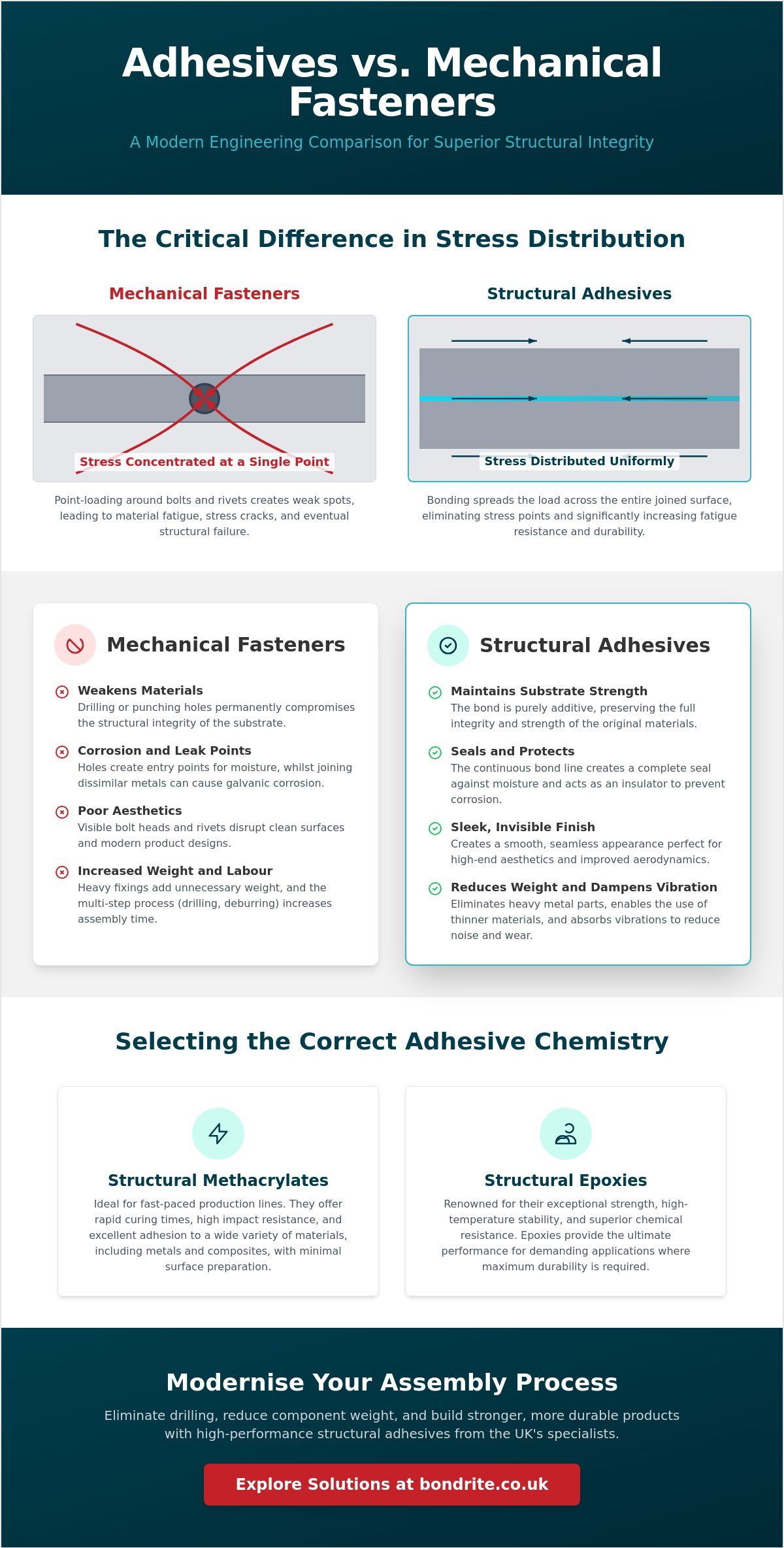
Structural bonding is a permanent joining method engineered for load bearing applications where mechanical integrity is paramount. Using an adhesive bonding strategy allows engineers to distribute stress across the entire surface area of a joint. This contrasts sharply with traditional methods like riveting or bolting, which rely on point-loading. When you choose a high performance adhesive to replace mechanical fasteners, you eliminate the concentrated stress points that often lead to material fatigue and eventual failure. This uniform distribution ensures that the bond line remains stable even under significant shear or tensile forces.
To see how high performance bonding works in a practical setting without the need for traditional fixings, watch this demonstration:
In the British manufacturing and transport sectors, there is a clear shift towards lightweighting to improve fuel efficiency and payload capacity. This transition has made metalwork adhesives and caravan repair adhesives essential tools for modern assembly. By removing heavy steel bolts and replacing them with high strength chemical bonds, manufacturers can reduce overall component weight without sacrificing structural performance. This is particularly beneficial when joining dissimilar materials, such as aluminium to composites, where traditional welding is often impossible or technically complex.
The limitations of traditional mechanical fixings
Mechanical fixings require the removal of material through drilling or punching. This process inherently weakens the substrate and creates permanent leak points that must be addressed with secondary sealants. Beyond structural concerns, visible bolt heads or rivets often compromise the sleek, modern aesthetics required in high end product design. The cumulative labour costs of drilling, deburring, and sealing each individual fixing point can quickly escalate. These manual steps often become a bottleneck in production lines, making traditional methods less efficient for high volume manufacturing operations.
Defining the structural adhesive advantage
Structural adhesives are high strength chemical bonds designed to carry significant loads whilst maintaining the integrity of the joined materials. Selecting a high performance adhesive to replace mechanical fasteners allows for the use of thinner, lighter materials because the bond does not require the thickness needed to support a thread or a rivet head. These structural methacrylates and epoxies also provide excellent vibration dampening. This reduces noise and protects the assembly from the harmonically induced stresses that frequently cause mechanical fasteners to loosen or shear over time. By choosing a chemical bond, you ensure a more durable and reliable result.
If you require technical assistance with your assembly process, you can speak with our engineering consultants for tailored advice.
Structural Advantages of Bonding over Traditional Fixing Methods
The transition to using an adhesive to replace mechanical fasteners offers significant improvements in fatigue resistance. Mechanical assemblies are prone to failure at the points where holes are drilled, as these areas act as stress concentrators. Over time, vibration and cyclic loading cause microscopic cracks to form around rivets and bolts. In contrast, a bonded joint spreads these loads across the entire surface area. This results in a more robust assembly that can withstand higher levels of stress over a longer operational life. Furthermore, many structural methacrylates and epoxies provide a dual function by sealing and bonding simultaneously. This eliminates the need for separate gaskets or secondary silicone applications, protecting the internal components from moisture ingress.
In the caravan and specialist vehicle industries, the move away from visible fixings has transformed both aerodynamics and aesthetics. Removing hundreds of rivets from the exterior of a vehicle reduces drag and creates a perfectly smooth, modern finish. This isn’t just about looks; it’s about production efficiency. Eliminating the requirement for precision drilling and the subsequent deburring of holes allows for a much faster assembly line. Workers can apply the adhesive and join the components in a single, streamlined process. If you’re looking to optimise your manufacturing flow, our caravan repair adhesives and industrial bonding agents provide the necessary performance without the complexity of traditional hardware.
Eliminating galvanic corrosion between dissimilar metals
A major technical challenge in modern manufacturing is the joining of dissimilar metals, such as aluminium panels to steel frames. When these metals touch in the presence of moisture, an electrochemical reaction occurs, leading to galvanic corrosion. Adhesives act as a permanent dielectric barrier, physically separating the two metals and preventing this reaction. This is particularly vital in transport manufacturing where exposure to road salt and rain is constant. By using a chemical bond, you prevent the internal rust that often forms around bolt holes, significantly reducing long term maintenance costs and preserving the structural integrity of the frame.
Superior stress distribution and fatigue life
The use of an adhesive to replace mechanical fasteners is a viable alternative to traditional joining methods because it prevents the ‘unzipping’ effect. In a riveted joint, if one fastener fails, the load on the remaining fasteners increases, often leading to a rapid, sequential failure of the entire line. A continuous bond line does not have this single point of failure. Additionally, the inherent flexibility of certain structural adhesives allows the joint to absorb thermal expansion and contraction. This is essential when bonding materials with different thermal coefficients, as it prevents the warping or buckling that occurs when rigid mechanical fixings restrain natural material movement. For specific advice on joint design, please contact our technical support team.
For technical advice on choosing the most suitable bonding agent for your manufacturing process, please consult with our technical specialists.
Selecting the Correct Adhesive Chemistry for Industrial Assemblies
Selecting the appropriate adhesive to replace mechanical fasteners requires a precise understanding of the chemical interaction between the bond and the substrate. Unlike a universal bolt, different adhesive chemistries offer specific mechanical properties tailored to environmental conditions and material types. A detailed comparison of Adhesives vs. Mechanical Fasteners in industrial settings confirms that the success of the bond depends on choosing a resin that matches the thermal and chemical demands of the application. If the adhesive chemistry is not correctly aligned with the substrate, the assembly may suffer from poor adhesion or long term bond degradation under load.
Structural Acrylics and Methacrylates for Metalwork
Structural acrylics, particularly methacrylates, are often the primary choice for heavy duty metal bonding. One of the most significant technical advantages of methacrylates is their ability to cut through thin layers of surface oil, which is common in metal fabrication. This reduces the intensity of the cleaning process whilst maintaining exceptional shear strength. B3294 Structural Acrylic Adhesive provides high peel resistance, making it ideal for assemblies subjected to impact or shock. If you are working with aluminium or steel, our range of metalwork adhesives provides the necessary structural integrity for permanent joining.
Epoxy Resins for Maximum Durability
Epoxy resins are engineered for maximum durability in the most demanding environments. These systems are characterised by their high heat resistance and superior chemical stability, often outperforming mechanical fixings in corrosive or high temperature settings. Two part epoxy systems are particularly effective for gap filling on irregular surfaces where a tight mechanical fit is impossible. You can view our full technical range of structural methacrylates and epoxies to find a solution that meets your specific environmental requirements and safety standards.
Fast Set Cyanoacrylates for Production Efficiency
For high speed production lines where smaller components require immediate handling strength, cyanoacrylates are an efficient solution. These fast set adhesives provide rapid bonding for plastics and rubbers, allowing for a streamlined assembly process without the wait times associated with traditional curing. Whilst highly effective for smaller parts, it’s important to remember that superglues have limitations in large scale structural load bearing joints where high impact resistance is required. For these applications, our cyanoacrylate superglue adhesives should be used in conjunction with a careful assessment of the joint geometry to ensure long term reliability.
To ensure your production line is correctly configured for structural bonding, speak with our technical advisors.
Best Practice for Transitioning from Mechanical Fasteners to Adhesives
Transitioning to a high performance adhesive to replace mechanical fasteners requires a fundamental shift in assembly logic. Unlike bolts, which provide clamping force at specific points, adhesives rely on surface area and chemical affinity. Success is predicated on a methodical approach to surface preparation and a joint design that plays to the strengths of the adhesive. You must also account for production variables such as open times, which is the period you have to join parts before the adhesive begins to skin, and fixture times, the duration required before the assembly can be moved without support. If you don’t account for these timings, you risk disturbing the bond during its critical curing phase. Testing and validation protocols, such as lap shear tests according to BS EN 1465:2009, are essential to verify that the bond meets your safety and performance standards before you commit to full scale production. Testing is essential.
Surface Preparation and Cleaning Protocols
Surface preparation is the single most critical factor in bond reliability. Any presence of grease, oil, or oxidation acts as a release agent, preventing the adhesive from reaching the substrate. Professionals use high quality solvent cleaners to degrease surfaces, often followed by mechanical abrasion to increase the surface energy and provide a physical key for the bond. Failing to follow these steps is the primary cause of bond failure, whilst even minor contamination can compromise integrity. Precision is non negotiable here. For a deeper analysis of these failure points, read our expert guide on Why Your Adhesive Failed.
Joint Design for Adhesive Success
Designing a joint for bonding is fundamentally different from designing for a bolt or rivet. You should always aim for lap joints rather than butt joints. In a lap joint, the adhesive is subjected to shear stress, which is where it performs most reliably. A butt joint, however, often places the adhesive under tensile or cleavage stress, which can lead to premature failure. Maximising the surface area of the overlap will directly increase the overall strength of the bond. Clever engineering design should always seek to minimise peel and cleavage forces by ensuring that loads are distributed evenly across the bond line. This might involve tapering the edges of the substrate or using a joggle joint to ensure the bond line remains in shear. If you need assistance designing a joint for a specific load, contact our technical support specialists for a professional consultation.
For a detailed analysis of how structural bonding can improve your specific production line, please contact our technical specialists.
High Performance Industrial Adhesives for British Manufacturing
Switching to a high performance adhesive to replace mechanical fasteners delivers significant long term cost savings by streamlining complex production workflows. You eliminate the capital expenditure associated with precision drilling machinery and the ongoing labour costs of manual fastener installation. In British manufacturing, where efficiency is a key competitive advantage, these gains in assembly speed and material reduction contribute to a more sustainable bottom line. Modern structural bonding is no longer a speculative alternative. It’s a proven industrial standard that offers quiet reliability in the most demanding environments. By choosing to use an adhesive to replace mechanical fasteners, you’re investing in a joining method that enhances the structural integrity of your product whilst reducing its overall weight.
The transition to chemical bonding requires a partner who understands the nuances of material science and industrial safety. Bondrite provides the technical clarity needed to make this transition with confidence. We ensure that your chosen solution meets all necessary performance specifications, providing the sturdy, no-nonsense dependability that engineers require. Our commitment to transparency means you receive honest advice on whether a specific chemistry is suitable for your substrate, ensuring the safety and longevity of your finished assembly.
Technical Support and Product Selection
Expert consultation is vital before committing to a significant production change. Bondrite provides comprehensive technical data sheets and safety documentation to ensure every application complies with current UK REACH standards and diisocyanate training requirements. We also offer professional dispensing equipment, including pneumatic applicators and high quality glue guns, to ensure consistent bead application and eliminate material waste. This technical partnership ensures that your assembly process is repeatable, precise, and fully optimised for high volume manufacturing. We prioritise the correctness of the application above all else.
The Future of Assembly in the UK
The next generation of aerospace and electric vehicle production depends on the weight savings provided by advanced chemical bonds. Structural adhesives allow for more sustainable product designs by reducing the total part count and enabling the use of thinner, high strength materials that mechanical fixings would otherwise damage. These innovations are essential for meeting the strict performance and environmental standards of modern industry. To understand the full technical breadth of these materials, we encourage you to review our Industrial Adhesives UK guide. Choosing the right specialist partner ensures your manufacturing process remains at the forefront of industrial innovation and technical excellence.
To discuss your specific assembly requirements with a technical advisor, please get in touch with our team.
Optimising Your Industrial Assembly with Structural Bonding
Transitioning to a high performance adhesive to replace mechanical fasteners provides a measurable improvement in both the structural integrity and aesthetic finish of your components. By moving away from point-loaded fixings, you eliminate the risk of stress cracking and the long term maintenance issues caused by galvanic corrosion. We’ve explored how the correct application of methacrylates and epoxies can streamline production whilst reducing overall component weight. This shift in assembly methodology ensures that your products meet the highest standards of durability and safety.
As a specialist UK supplier since 2000, Bondrite offers the expert technical support and extensive product range required for high performance industrial applications. We provide the technical data and professional guidance necessary to ensure your bonding process is safe, reliable, and efficient. Our team is dedicated to helping you achieve precision in every joint, from initial design through to final production. For expert advice on choosing the right adhesive for your assembly, please contact our technical team today. We look forward to supporting your next manufacturing project.
Frequently Asked Questions
Is an adhesive really as strong as a bolt?
A structural adhesive can provide equivalent or superior joint integrity to a bolt by distributing the load across the entire bond area. Whilst a bolt offers high strength at a single point, it also creates a stress concentrator that can lead to material fatigue. Using an adhesive to replace mechanical fasteners ensures that the stress is uniform, often resulting in a joint that is more durable under cyclic loading than one held by traditional hardware.
What are the main benefits of replacing rivets with structural adhesives?
Replacing rivets with adhesives eliminates the need for hundreds of drill holes that inherently weaken the substrate. This transition provides a perfectly smooth exterior finish, which is essential for aerodynamics in the transport and aerospace sectors. Additionally, adhesives act as a permanent sealant against moisture and debris, removing the requirement for secondary gaskets. This dual functionality simplifies the assembly process and reduces the total weight of the finished product.
Can adhesives bond dissimilar materials like plastic to metal?
Structural adhesives are specifically engineered to join dissimilar materials such as aluminium, steel, and various industrial plastics. This is often difficult or impossible with mechanical fixings due to the risk of galvanic corrosion or material distortion. By using a chemical bond, you create a dielectric barrier between the materials. This prevents electrochemical reactions and allows the assembly to accommodate differing rates of thermal expansion without compromising the bond line.
How long does it take for a structural adhesive to cure?
Curing times vary significantly depending on the specific chemical composition and environmental temperature. Methacrylates typically reach handling strength within 10 to 20 minutes, whilst full chemical cure usually occurs within 24 hours at room temperature. If you require faster production cycles, heat can sometimes be applied to accelerate the process. Always refer to the technical data sheet for precise fixture and cure timings for your specific application and substrate.
Do I need special equipment to apply industrial adhesives?
Professional application requires the use of dedicated dispensing equipment to ensure consistent mixing and bead placement. This typically includes manual or pneumatic adhesive applicators designed for two part cartridges. Static mixing nozzles are also essential to ensure the resin and activator are combined in the correct ratio before reaching the surface. Using the proper tools prevents material waste and guarantees that the adhesive performs according to its stated technical specifications.
How do I prepare a metal surface for structural bonding?
Effective surface preparation involves a methodical process of cleaning, degreasing, and mechanical abrasion. You must first remove all traces of oil, grease, and dust using a high quality solvent cleaner. Abrading the surface with a fine grit sandpaper or a wire brush then increases the surface area and provides a physical key for the bond. Finally, a second cleaning step removes any remaining debris to ensure a pristine bonding surface for the resin.
What happens if the adhesive joint is exposed to high temperatures?
High temperatures can cause some adhesives to soften, which may reduce their shear strength if the temperature exceeds the design limit. However, structural epoxies are specifically designed to maintain their integrity in high heat environments, often withstanding temperatures exceeding 120 degrees Celsius. If your assembly will be exposed to extreme heat, you must select a chemistry with a high glass transition temperature. This ensures the bond remains rigid and carries its load safely.
Can I use adhesives for outdoor applications with high UV exposure?
Many industrial adhesives are formulated with high resistance to UV radiation and environmental weathering. Silicone sealants and certain high performance polyurethanes are particularly effective for outdoor use as they remain flexible and do not become brittle when exposed to sunlight. When selecting an adhesive to replace mechanical fasteners in an outdoor setting, verify that the product has been tested for long term environmental stability to prevent bond degradation and moisture ingress.

Article by
Lucy Mackay
Lucy Mackay is a Director at Bondrite Adhesives Ltd, an ISO 9001-certified industrial supplier based in Loughborough. With a focus on customer-led solutions and technical reliability, Lucy manages the strategic direction of the business, which has been a staple of the UK adhesive industry since 2002.
Disclaimer
This article is intended for informational purposes only. Please ensure you seek expert advice or carry out your own research to confirm the information is suitable for your specific needs.
Related Industrial Adhesives & Sealants
If you liked this guide then you may also like the following: