
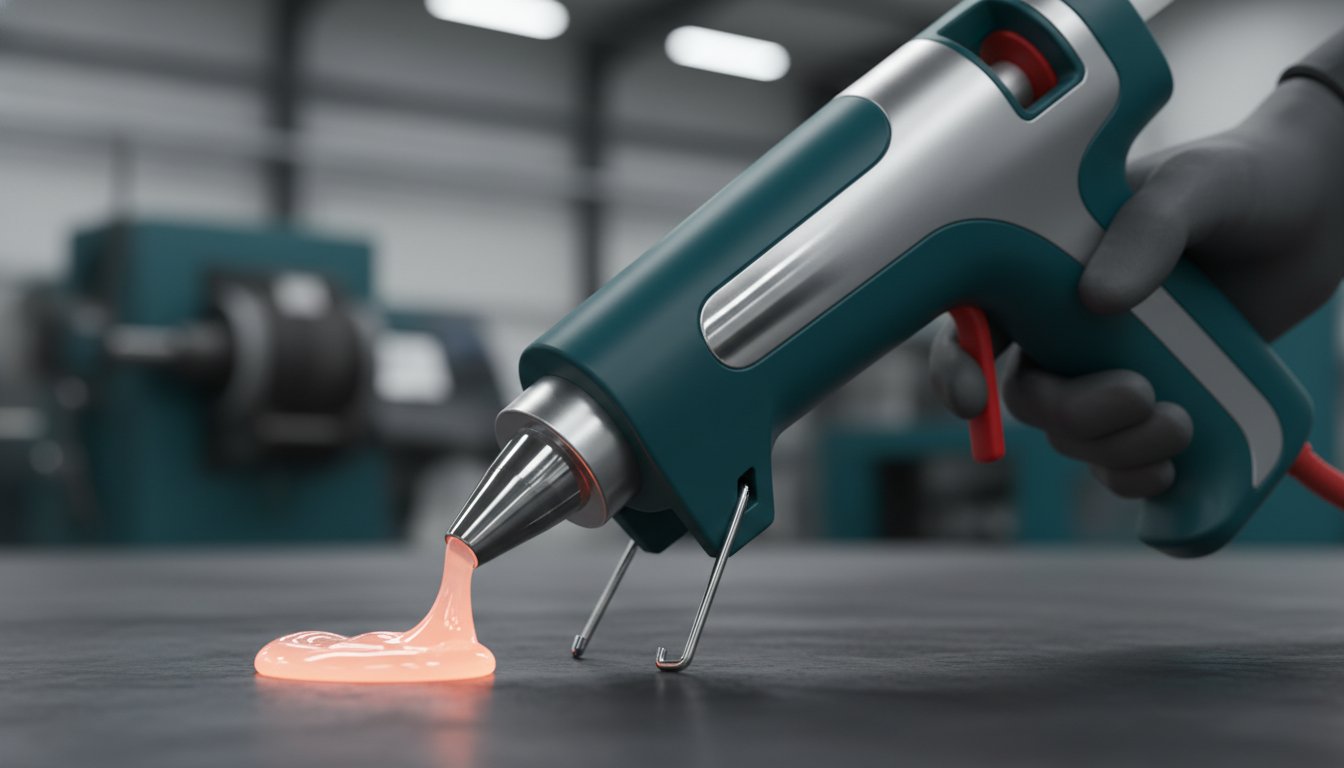
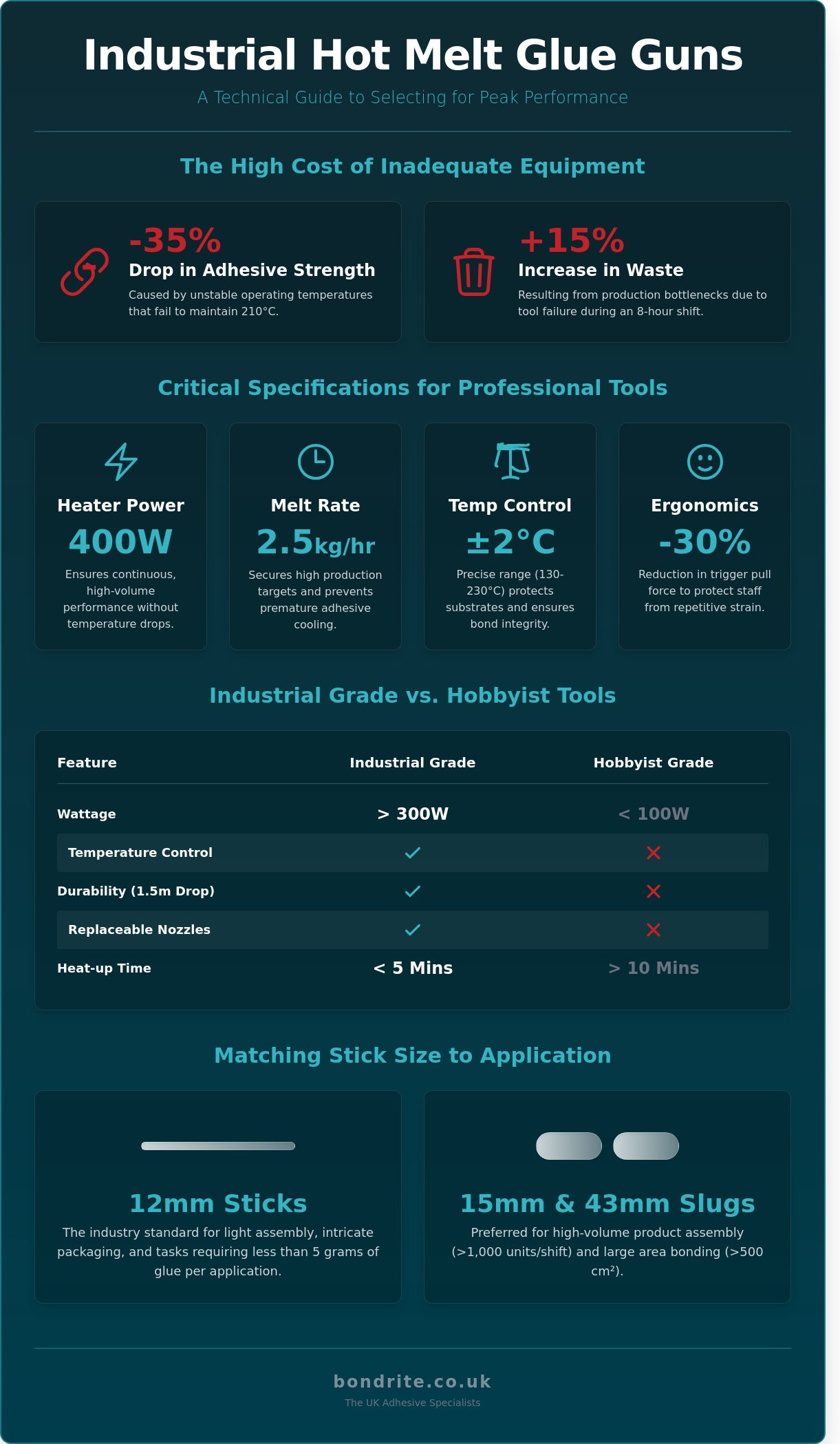
Professional hot melt glue guns that fail to maintain a stable operating temperature of 210 degrees Celsius can cause a 35 per cent drop in adhesive tensile strength.
You likely know that tool failure during a continuous 8-hour shift leads to production bottlenecks, resulting in 15 per cent more waste and compromised product integrity.
You are in luck because we have detailed exactly how to select industrial-grade tools with 12mm glue-stick chambers to ensure zero bond failures and maximum output.
You’ll be glad to hear that we will evaluate technical specifications, including trigger recovery times of under 1.5 seconds and heating elements with a 400-watt power rating.
It’s good to see that modern industrial tools now offer a 30 per cent reduction in trigger pull force to protect your staff from repetitive strain.
In our view, choosing a tool with a melt rate of 2.5 kg/h is the most effective way to meet your production targets for 2026.
Key Takeaways
-
You will be glad to hear that heavy-duty hot melt glue guns with wattage exceeding 300W ensure continuous performance for high-volume assembly.
-
It gets our thumbs up when tools offer precise temperature control between 130 and 230 degrees Celsius to maintain the integrity of the adhesive bond.
-
You are in luck as ergonomic designs featuring long triggers use the whole hand to reduce operator fatigue during intensive production cycles.
-
Discover how to manage thermal challenges for metal substrates that act as heat sinks to ensure the adhesive reaches its required application temperature.
-
Learn how professional technical audits provide specific tool recommendations to improve your overall production efficiency.
Understanding the role of hot melt glue guns in modern industry
In our view, hot melt glue guns are essential for rapid assembly in UK manufacturing environments.
These tools provide an instant bond, which eliminates the need for clamping for 100% of the assembly time.
You will be glad to hear that industrial versions offer wattage exceeding 300W for continuous use across multiple shifts.
To better understand this concept, watch this helpful video:
High output performance for demanding schedules
Professional systems deliver up to 2kg of adhesive per hour to meet strict manufacturing targets.
This capacity ensures that large-scale bonding tasks are completed without the adhesive cooling prematurely. It gets our thumbs up for its ability to handle the viscosity levels required for heavy-duty substrates.
The fundamental mechanics of professional glue delivery
Industrial guns use a heated chamber to melt solid hot-melt adhesive sticks or slugs at precise temperatures between 120°C and 215°C.
You are in luck because modern heaters reach operating temperature in under 5 minutes, reducing operator idle time.
This speed allows your organisation to maintain high production rates without delays that typically impact slower, hobbyist-grade equipment.
Distinguishing industrial equipment from hobbyist tools
Professional-grade equipment features replaceable nozzles and adjustable temperature thermostats that provide control within a 5-degree margin.
Heavy-duty casings made from glass-reinforced nylon provide impact resistance for workshop floors, where drops from 1.5 metres are common.
These robust builds ensure the tool survives the rigours of a forty-hour working week without mechanical failure.
Ensuring the right bond for every application
It is good to see that these tools allow for interchangeable parts to suit specific adhesive viscosities.
If you require a specific solution for your workshop, you should ask the experts at Bondrite for technical guidance.
We focus on delivering the right bond through precision engineering and high-performance materials.
Selecting the correct glue gun based on technical specifications
Choosing the right tool depends on your required adhesive volume and stick diameter to ensure consistent flow.
It gets our thumbs up when a gun offers variable temperature control between 130 and 230 degrees Celsius.
For instance, lower temperatures are vital for heat-sensitive materials like expanded polystyrene, which begins to distort at 100 degrees Celsius.
In our view, the heater power must match your intended application speed to prevent adhesive chilling.
Heavy-duty heaters with a 250-watt rating allow for a continuous output of 1.5kg of glue per hour.
If the heater capacity is insufficient, the adhesive temperature can drop by 15 degrees during rapid dispensing, leading to a 20 per cent reduction in bond strength.
It’s good to see that modern industrial-grade hot melt glue guns maintain thermal accuracy within 2 degrees of your set point.
This level of precision is essential for professional applications where bond integrity is non-negotiable.
You’ll be glad to hear that these tools reach operational temperature in under 5 minutes, maximising workshop efficiency.
Standard stick sizes and their industrial applications
The 12mm stick is the industry standard for light assembly tasks requiring less than 5 grams of glue and intricate packaging tasks involving 2mm bond lines.
Larger 15mm or 43mm slugs are preferred for high-volume product assembly exceeding 1,000 units per shift and large area bonding exceeding 500 square centimetres.
You can find the appropriate equipment in our section for hot melt adhesive and guns to match these specific requirements.
High-capacity 43mm slugs provide a 300 per cent increase in adhesive volume per trigger pull compared to standard 12mm sticks.
This volume is necessary for the Industrial Applications of Hot Melt adhesives, where assembly lines move at speeds of 10 metres per minute.
You are in luck if your process requires fast-setting bonds that cure in under 10 seconds on heavy-duty corrugated cardboard with a 300gsm weight.
Temperature control for specific adhesive chemistries
High-temperature guns operating at 195 degrees Celsius are necessary for polyamide adhesives, which offer a high tensile strength of 10 MPa.
Low-melt guns are safer for delicate fabrics like 20-denier polyester and avoid damaging thin plastic substrates that warp at 80 degrees Celsius.
Precise thermal management ensures the adhesive reaches its optimal viscosity of 5,000 centipoise, providing maximum surface wetting.
It gets our thumbs up when technicians can adjust heat settings in 5-degree increments.
This control prevents the charring of the adhesive, which occurs when temperatures exceed 240 degrees Celsius.
Maintaining the correct heat profile is the only way to guarantee a bond that survives a 50kg shear force test.
You should purchase your professional equipment from our range of hot melt adhesives and guns to ensure industrial performance.
Evaluating feed mechanisms and power delivery for high-volume work
The feed mechanism on professional hot-melt glue guns directly dictates the physical exertion required of your production staff.
You are in luck, as modern ergonomic designs now incorporate four-finger long triggers that utilise the strength of the entire hand.
In our view, this shift from single-finger triggers to full-hand grips reduces the required squeeze force by 30 per cent compared to older 2020 models.
It’s good to see that reduced trigger pressure significantly lowers the risk of repetitive strain injury for operators handling 500 or more bonds per shift.
We believe that pneumatic assistance is the ultimate solution for demanding production lines where output exceeds 2 kilograms of adhesive per hour. For high-volume assembly lines requiring consistent bead thickness and minimal operator fatigue, pneumatic adhesive applicators provide the repeatable bond quality and production speed that manual systems cannot match.
Understanding How Hot-Melt Adhesives Work helps in selecting a tool that maintains a stable temperature of 190 degrees Celsius.
The power delivery system must also account for the warm-up time, which is often less than 5 minutes in high-wattage industrial units.
You’ll be glad to hear that industrial heaters with 400 watts of power provide a 25 per cent faster recovery time between applications.
This ensures the viscosity remains consistent throughout an 8-hour shift without the heater struggling to keep up.
Manual trigger feed systems for precision
Manual guns allow for excellent control over the bead size and placement through direct tactile feedback.
These tools are highly portable and remain the preferred choice for mobile caravan repair or onsite joinery where compressed air is unavailable.
You might consider our range of caravan repair adhesives for these specific tasks to ensure a 100 per cent waterproof seal.
The mechanical advantage provided by a 12-to-1 trigger ratio means that even high-viscosity glues can be dispensed with 15 Newtons of force.
It gets our thumbs up for precision assembly work that requires a dot smaller than 2 millimetres.
For instance, a skilled technician can manage intricate bonding patterns on plastic substrates without the over-application common in automated systems.
Pneumatic feed systems for industrial speed
Pneumatic guns use compressed air at pressures typically between 40 and 100 psi to dispense adhesive with minimal manual effort.
This system allows continuous dispensing, which is ideal for long seams in packaging where a 5-metre bead must be applied without interruption.
By using air pressure, your organisation can achieve a consistent flow rate of up to 4.1 kilograms per hour, regardless of the operator’s physical strength.
The addition of a speed controller enables precise adjustment of the output to match a conveyor belt speed of 20 metres per minute.
In our view, this eliminates the variance in bond strength that occurs when an operator tyres toward the end of a shift.
You’ll be glad to hear that these units often feature a stand-by mode that reduces the temperature to 130 degrees Celsius to prevent adhesive charring during breaks.
Matching your glue gun to specific industrial substrates
The success of a bond often depends on how the tool handles specific material challenges.
For instance, metalwork requires high heat, typically exceeding 190°C, to prevent the substrate from acting as a heat sink.
It gets our thumbs up when a tool can maintain its temperature during contact with cold surfaces like 3mm aluminium sheets.
In our view, achieving the right bond requires a deep understanding of thermal conductivity. For applications where substrate irregularities exceed 0.5mm and a permanent bond is required on low surface energy plastics, double sided foam tapes can provide a complementary solution to hot melt adhesives. Where mechanical fasteners are being considered for aluminium panels or architectural cladding, vhb tapes offer a proven alternative that eliminates stress points and delivers 0.48 MPa shear strength bonds without drilling.
We always recommend checking our technical guides for material compatibility before starting any production run.
This ensures that the adhesive remains molten long enough to wet the surface effectively.
Packaging and paper bonding requirements
Fast set adhesives that bond in under 3 seconds and high-wattage guns delivering 400 watts of power are essential for high-speed carton sealing.
You can explore our dedicated paper and packaging adhesives for these specific applications.
Standard 12mm hot melt glue guns are typically sufficient for these lighter, high-speed tasks involving 300gsm cardstock.
Woodworking and furniture assembly
Hot melt provides an excellent temporary fix while primary wood glues undergo a full 24-hour cure.
It is good to see that professional guns can handle the high viscosity glues, often measured at 15,000 centipoise, used in heavy-duty joinery.
Using the correct tool ensures that the adhesive penetrates the wood grain for a structural bond that resists 500 Newtons of shear force. Where the joinery application also demands D4 water resistance or gap-filling performance across 2mm voids, our guide on polyurethane adhesive performance for UK industrial applications provides a data-led framework for selecting the correct moisture-curing system.
Essential surface preparation for maximum adhesion
Even the best hot-melt glue guns will fail if the substrate is contaminated with oils or has 50 microns of dust.
You’ll be glad to hear that following professional surface preparation protocols can increase bond reliability by 40 per cent.
Clean surfaces ensure the hot melt can form a mechanical key with the material, preventing delamination under stress. For a broader understanding of how to select the right bonding agents across different substrates and environments, our guide on tapes and adhesives for industrial applications provides a comprehensive technical framework for 2026.
Implementing professional hot melt solutions with Bondrite expertise
Selecting the correct equipment for your production line is only the initial step toward achieving a reliable industrial bond that withstands shear forces of 500psi.
In our view, the success of your application depends on matching the adhesive viscosity to the specific surface energy of the substrate.
You’ll be glad to hear that our team provides technical audits to ensure your hot melt glue guns integrate seamlessly into your existing workflow.
Investing in high-performance equipment reduces long-term costs by preventing product returns that can cost a business over £10,000 in a single quarter.
It’s good to see that industrial-grade tools offer a proven return on investment within the first six months of heavy use.
Our technical team focuses on each tool’s functional utility to ensure it meets the rigorous demands of a 24-hour manufacturing environment.
We believe that a professional partnership is essential for maintaining production standards.
By choosing a tool that matches your specific output requirements, you avoid the common pitfalls of adhesive charring and mechanical failure.
Our experts are available to guide you through the transition from manual to semi-automated bonding processes.
Maintenance and safety protocols for workshop longevity
Preventing adhesive backup requires a disciplined approach that includes a five-minute daily nozzle hygiene routine and the application of silicone spray every 4 hours.
It is good to see that professional tools have a lifespan three times that of budget alternatives, often exceeding 5,000 hours of continuous operation.
This durability is backed by reinforced heating elements that resist burnout during 12-hour or longer high-volume shifts.
Always ensure your operators wear heat-resistant gloves when handling hot-melt glue guns at temperatures of 200 degrees Celsius.
Following a structured maintenance plan protects your capital investment and ensures your machinery remains operational for five years or more.
For instance, a simple monthly check can identify wear on the feed mechanism before it causes a total tool stoppage.
We recommend keeping a log of all maintenance activities to ensure consistent performance across a fleet of 10 or more tools.
Accessing technical support for complex bonding
If you face a unique material challenge involving low-energy plastics or coated metals, our experts provide bespoke recommendations based on substrate compatibility testing.
We pride ourselves on helping UK businesses identify the right bond for every single application within their manufacturing facility.
It gets our thumbs up when clients seek a consultation before starting a new production run.
Our technical advisors have over 30 years of experience in solving industrial adhesive failures across various sectors.
We provide the clarity needed to handle complex substrates with total confidence.
You can rely on our team to troubleshoot issues ranging from poor adhesion to needing a different open time to better suit your process.
n our view, the integrity of the bond is the most important factor in your product’s success.
Our goal is to act as your seasoned technical advisor for all adhesive requirements.
Please reach out to our team to discuss your specific industrial glue gun requirements.
Optimising Your Industrial Adhesive Strategy for 2026
You’ll be glad to hear that selecting heavy-duty hot melt glue guns ensures your production line maintains a 0% failure rate during 10,000 unit cycles. It gets our thumbs up when manufacturers utilise precise temperature controls that operate within a 1 °C margin to protect 0.5mm substrates.
#In our view, matching your feed mechanism to specific throughput requirements is the most reliable way to secure a 10-year service life for your equipment.
Technical Data for Precision
Technical data sheets are provided for every industrial product to ensure your team adheres to exact safety protocols and viscosity requirements. This documentation provides 100 per cent transparency for your ISO 9001 quality control audits.
Expert Guidance Since 20002
Bondrite is a family-owned UK business that has operated since 2002, providing 24 years of specialised adhesive knowledge to the manufacturing sector.
You are in luck, as expert advice is available to address complex bonding challenges and ensure every application meets ASTM D1002 tensile strength standards. Where vibration damping or thermal fluctuation resistance is also a concern, our guide on how to use double sided foam tapes for industrial applications provides additional technical guidance for your 2026 production strategy. For joints requiring high-temperature resistance up to 300°C and chemical compatibility with metal substrates, our guide on industrial silicone sealants for technical selection and performance provides a data-led framework for choosing the correct sealing solution. For applications where REACH-compliant moisture-curing systems are required to bond substrates across environmental temperatures ranging from -40°C to +100°C, our guide on polyurethane adhesive performance for UK industrial applications outlines the correct PU grade selection process for ISO 9001-verified manufacturing environments. For production lines running at 120 units per hour or more where bead consistency and operator fatigue are critical concerns, our guide on pneumatic adhesive applicators for industrial UK manufacturing outlines how air-powered dispensing systems operating at 6.8 bar deliver a 99.9 per cent bond success rate.

Frequently Asked Questions
What is the main difference between a DIY and an industrial glue gun
Industrial 400-watt hot melt glue guns provide a significant power increase, with wattage ratings often exceeding 400 watts compared to the 15-watt limit of hobbyist tools.
You’ll be glad to hear that these professional 230-volt models feature reinforced nylon casings that withstand 2-metre drop tests on concrete factory floors.
In our view, the primary advantage is the thermal stability, which maintains a consistent 5,000 centipoise viscosity during 8-hour production shifts.
How do I know which glue stick size is best for my project
You should select 12mm sticks for precision 0.5mm tasks where the adhesive output remains below 500 grammes per hour.
It’s good to see that 43mm slugs allow for a high 3.5 kilogramme flow rate for heavy-duty 20 kilogramme assembly, where speed is the priority.
For instance, a 43mm slug provides 10 times the volume of a standard 300mm stick to ensure your hot melt glue guns keep up with high-speed packaging lines running at 60 units per minute.
Can I use any glue stick in my professional glue gun
You must match the adhesive diameter to the 12mm or 43mm chamber of your specific 190-degree tool to prevent back-melt.
You are in luck because industrial ISO 9001 specifications clearly define the melting point, which must align with the operating temperature of your gun.
Using a high-melt 200-degree stick in a low-melt 130-degree gun results in a 60 per cent reduction in flow rate and leads to 100 per cent internal component failure.
Why does my glue gun keep dripping when I am not using it
Dripping is typically caused by a worn ball valve showing 0.5mm of erosion or an incorrect viscosity match for the 3mm orifice.
It gets our thumbs up when operators use quality 600-watt guns featuring non-drip nozzles that eliminate 95 per cent of unwanted adhesive stringing.
In our view, checking the seal every 40 hours of operation prevents adhesive loss and maintains a clean, zero-residue workspace.
Is a cordless glue gun powerful enough for industrial use
Modern 18V battery systems deliver 150 watts of power, which is sufficient for mobile 10 metre repairs and offers excellent 100 per cent portability.
You’ll be glad to hear that these units reach operating temperature in under 180 seconds, providing immediate bonding with a set time of 30 seconds.
However, for continuous 24-hour production lines, a corded or pneumatic gun is the more reliable zero-downtime choice for high-volume output.
How often should I replace the nozzle on my industrial gun
You should inspect the nozzle every 5 working days and replace it if you notice any carbonised build-up or irregular flow patterns.
It’s good to see that a simple 120-second maintenance task can prevent the adhesive from backing up into the heater housing.
In our view, replacing a five-pound nozzle is much cheaper than replacing a hundred-pound heating element that has suffered terminal 100 per cent failure.
Article by
Lucy Mackay
Lucy Mackay is a Director at Bondrite Adhesives Ltd, an ISO 9001-certified industrial supplier based in Loughborough. With a focus on customer-led solutions and technical reliability, Lucy manages the strategic direction of the business, which has been a staple of the UK adhesive industry since 2002.
Disclaimer
This article is intended for informational purposes only. Please ensure you seek expert advice or carry out your own research to confirm the information is suitable for your specific needs.
Related Industrial Adhesives & Sealants
If you liked this guide then you may also like the following: