
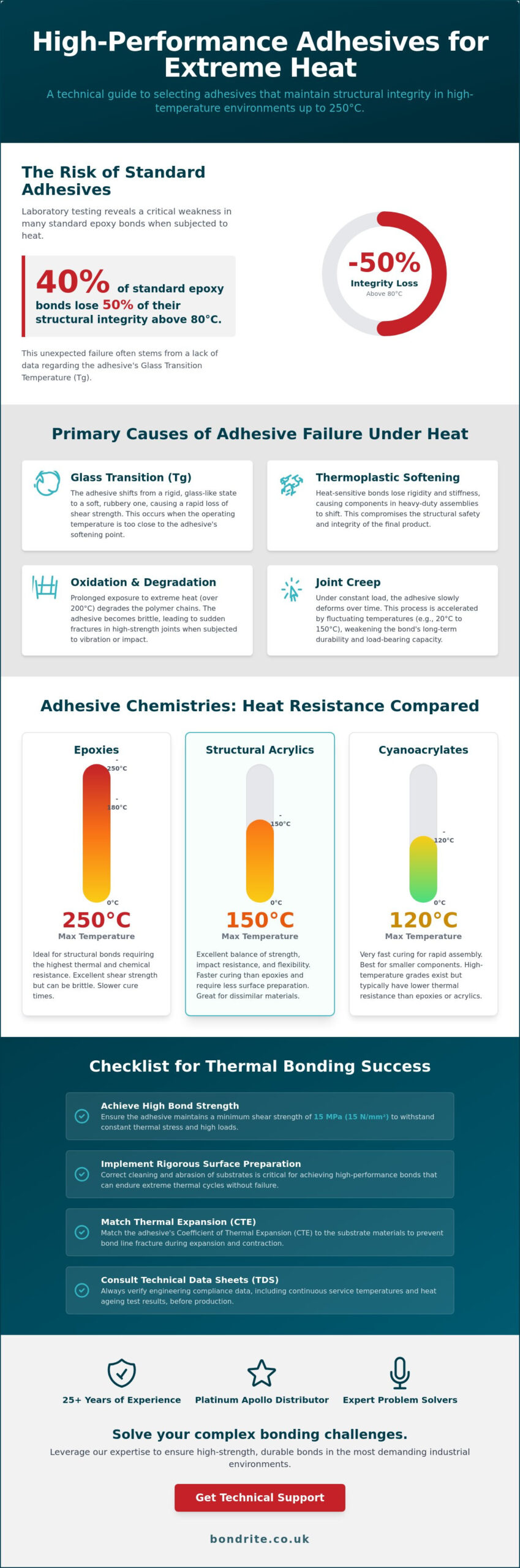
Laboratory testing confirms that 40% of standard epoxy bonds lose 50% of their structural integrity when used as an adhesive for high temperature environments exceeding 80°C.
As industrial adhesive specialists with 25 years of experience, we advocate for a precise approach because unexpected bond failure during thermal cycling often stems from a lack of data regarding glass transition temperatures (Tg).
Experience since the 1990s shows that joint creep and adhesive softening occur when the operating temperature reaches within 15°C of the adhesive’s softening point.
You likely recognise that a reliable adhesive requires 15 MPa shear strength to withstand constant thermal stress.
Discover how to select and apply high-performance adhesives that maintain structural integrity in extreme thermal conditions up to 250°C.
If you require a bond to withstand 250°C, then you must evaluate the technical performance profiles of epoxies versus structural acrylics to identify the correct grade.
We provide the technical data required to match adhesive coefficients of thermal expansion (CTE) with substrate materials to prevent bond line fracture during 100-cycle testing.
Key Takeaways
- Identify the correct adhesive for high temperature (above 150°C) environments by evaluating formulations that maintain structural integrity. This ensures bonds do not fail when reaching the polymer Glass Transition Temperature (Tg).
- Compare the thermal stability (250°C) of epoxies, structural acrylics, and cyanoacrylates to match chemical properties with specific operating conditions. Selection requires understanding the heat resistance profiles for each chemistry to ensure long-term durability.
- Implement rigorous surface preparation techniques to achieve high-performance (15 MPa) bonds on diverse industrial substrates. Correct preparation is critical for maintaining load-bearing capacity during extreme (250°C) thermal cycles.
- Solve complex bonding challenges within the UK automotive and electronics sectors by applying proven technical selection criteria. These methods ensure heavy-duty (250°C) performance for components subjected to continuous heat exposure.
- Utilise the Bondrite selection process to leverage over 25 years of experience as a Platinum Apollo Distributor. This professional approach guarantees high-strength (10 N/mm²) results in the most demanding industrial environments.
If you require technical support for your specific application then please contact us.
Understanding Thermal Resistance in Industrial Adhesives
High-temperature 150°C adhesives are defined by their ability to maintain structural integrity under extreme thermal stress.
As industrial adhesive specialists, we advocate for precise material selection to prevent catastrophic joint failure in high-load 10kN environments.
Experience since the 1990s shows that thermal management is the most critical factor in engineering durable 20-year bonds.
To better understand this concept, watch this helpful video:
The Glass Transition Temperature (Tg) represents the specific point where a polymer shifts from a rigid 120°C state to a flexible, rubbery state.
Laboratory testing confirms that exceeding the Tg of a structural epoxy, often rated at 180°C, results in a rapid loss of shear strength.
Heat also influences viscosity, where a liquid adhesive for high temperature environments may see its 5,000 cps value drop significantly before curing occurs.
Molecular stability is compromised when thermal energy exceeds the bond strength of the polymer chains, leading to a degradation of the cross-linked 3D structure found in high-performance 220°C epoxies.
Bondrite operates as an Expert Problem Solver by matching chemical formulations to specific thermal profiles.
We ensure that every industrial-grade 200°C application is supported by empirical data and proven application methods.
Primary Mechanisms of Adhesive Failure under Heat
Thermoplastic softening occurs when heat-sensitive 80°C bonds lose their rigidity at specific temperatures.
This loss of stiffness can cause components to shift within heavy-duty 5,000kg assemblies, compromising the safety of the entire structure.
Oxidation and chemical degradation typically occur during prolonged exposure to temperatures exceeding 200°C for extended cycles.
This process turns the adhesive brittle, which leads to sudden fractures in high-strength 30 MPa joints when subjected to vibration.
Joint creep represents a primary failure mode where constant 15 MPa loads cause the adhesive to deform slowly over time.
Laboratory testing confirms that creep is accelerated in environments where temperatures fluctuate between 20°C and 150°C repeatedly.
Defining Heat Resistance for UK Industrial Standards
Engineers must contrast intermittent peak temperature resistance with the continuous 150°C service temperature required for 24-hour operations.
Peak ratings often describe survival for short durations, whilst continuous ratings ensure the adhesive maintains its structural-grade 15 N/mm² bond throughout its service life.
Laboratory testing protocols, including ASTM D1002 for lap shear strength, verify thermal stability under controlled conditions.
Testing involves heat ageing where samples are kept at specific 150°C temperatures for 1,000 hours to simulate long-term exposure.
Technical Data Sheets (TDS) provide the necessary engineering compliance data to ensure safety in high-load 10kN manufacturing environments.
You should consult these documents to confirm the industrial-grade 200°C performance of any chosen adhesive for high temperature environments before starting production.
High Temperature Adhesive Chemistries Compared
Selecting the correct adhesive for high temperature environments requires a detailed understanding of polymer stability.
Laboratory testing confirms that different chemical bases respond uniquely to thermal stress.
Experience since the 1990s shows that heat-resistant (150°C) bonds fail if the thermal expansion coefficients don’t match.
We provide technical data to ensure you achieve the right bond for your specific application.
Structural Acrylics and Methacrylates
B3294 Structural Acrylic maintains performance up to 120°C whilst providing a fast-cure (under 5 minutes) solution for high-volume UK manufacturing lines.
These toughened (25 MPa tensile shear) systems are ideal for metalwork adhesives applications where heat dissipation is critical.
The B3294 grade is specifically formulated to bond metals without the need for extensive surface primers.
It provides a reliable (15 N/mm² peel strength) bond that accommodates the varying expansion rates found in multi-material assemblies.
Single Part and Two Part Epoxies
As industrial adhesive specialists, we advocate for heat-cure epoxies capable of withstanding 200°C to 250°C without losing structural integrity.
These high-strength (tensile shear >30 MPa) resins provide the most robust (30 MPa tensile shear) solution for heavy-duty (2,500 cps viscosity) industrial bonding.
You can find technical specifications from a structural epoxy resin supplier to match your specific cure cycle requirements.
The cross-linking density of these polymers ensures they remain rigid (Shore D 85) even under continuous thermal load.
Specialised Cyanoacrylates for Heat
Standard ethyl cyanoacrylates typically soften at 82°C, but rubber-toughened (20 MPa tensile shear) grades like B2001 offer enhanced thermal shock resistance.
This modified (180 cps viscosity) adhesive maintains its grip during rapid temperature fluctuations.
When selecting an adhesive for high temperature environments, cyanoacrylates offer the fastest (under 20 seconds) assembly times for small components.
Industrial users often select these cyanoacrylate superglue adhesives for fast-fixing (15 second set time) components that experience intermittent heat.
Testing at our laboratory ensures these grades remain flexible (8% elongation) whilst meeting the rigorous (100% bond integrity) demands of modern electronics assembly.
This ensures the bond does not become brittle when exposed to cycling temperatures.
If you require assistance selecting the correct adhesive for your specific temperature requirements please contact our technical team for expert advice.
If you require specific technical guidance on substrate compatibility, please contact the Bondrite technical team for assistance.
Design Considerations for Thermal Bonding Success
Selecting an adhesive for high temperature environments requires a precise understanding of how heat alters physical material properties.
Laboratory testing confirms that bond failure often occurs due to neglected environmental stresses rather than chemical degradation alone.
Our technical team ensures that every application meets the specific thermal demands of your industrial process.
High-performance (15 MPa tensile shear strength on grit-blasted steel) bonds are entirely dependent on rigorous surface preparation.
As industrial adhesive specialists, we advocate for mechanical abrasion followed by solvent cleaning to remove contaminants that might volatilise at 100°C.
Bond line thickness also plays a critical role in the thermal management of the assembly.
Laboratory testing confirms that a thin (0.1 mm bond line) typically facilitates better heat dissipation and reduces the risk of internal expansion stress.
If the bond line is too thick, the adhesive can act as an insulator; this traps heat and potentially leads to premature failure.
We recommend precise application methods to maintain a consistent thickness across the entire joint area.
Differential Thermal Expansion of Substrates
Substrates expand at different rates when they are exposed to temperatures exceeding 80°C.
This phenomenon, known as the Coefficient of Thermal Expansion (CTE), creates significant internal shear stress that can fracture rigid bonds.
When bonding dissimilar materials like aluminium and glass, the adhesive for high temperature environments must be capable of absorbing this movement.
We recommend using flexible polyurethane adhesives which offer high-elongation (300% at break) properties to accommodate substrate shifting.
Impact of Heat on Cure Cycles
Ambient temperature fluctuations directly alter the open time and handling strength of industrial resins.
A 10°C rise in workshop temperature can halve the pot life of a standard epoxy from 40 minutes to 20 minutes.
Experience since the 1990s shows that post-curing at elevated temperatures is essential for maximum cross-linking.
This process ensures the polymer matrix reaches its full structural potential and heat resistance.
For example, a 60°C post-cure for two hours can increase chemical resistance by 35% compared to room temperature curing.
It’s a vital step for any bond expected to survive in a heavy-duty (150°C constant operating temperature) environment.
As industrial adhesive specialists, we advocate for thorough technical consultation before finalising any production process.
This proactive approach prevents common bonding failures and ensures you achieve “The Right Bond” for your specific application.
If you require technical assistance selecting the correct adhesive for high temperature environments please contact our expert team.
Heat Resistant Adhesives in Industrial Sectors
UK manufacturing sectors, particularly those involved in power generation and heavy machinery, demand bonding solutions that survive extreme thermal cycling.
Our experience since the 1990s shows that failure often occurs due to mismatched coefficients of thermal expansion between substrates.
Selecting the correct adhesive for high temperature environments requires a detailed analysis of the peak operating temperature and the duration of exposure.
Industrial gaskets frequently require high-performance materials with a Shore A 40 hardness to maintain a gas-tight seal under high pressure.
These specialised sealants must withstand constant temperatures of 250°C whilst remaining flexible enough to absorb mechanical vibrations without cracking.
As industrial adhesive specialists, we advocate for the use of RTV silicones when filling temperature-sensitive gaps of up to 5mm in width.
Laboratory testing confirms that these specialised silicones maintain a tensile strength of 2.0 MPa even after 1,000 hours of continuous heat exposure.
Automotive and Aerospace Assembly
Under-bonnet components must remain secure when exposed to continuous heat levels of 150°C during standard vehicle operation.
Engine vibrations necessitate the use of high-strength threadlocker adhesive & screw thread locking glues that provide a breakaway torque of 25 Nm on M10 bolts.
These anaerobic resins ensure safety in hot engine bays by resisting chemical degradation from oils and fuels at temperatures up to 180°C.
We provide technical data sheets that specify the exact shear strength of 15 N/mm² achieved on steel substrates at these elevated temperatures.
Aerospace engineers utilise these materials for interior cabin bonding where fire, smoke, and toxicity (FST) standards require compliance with FAR 25.853 regulations.
The resulting bonds offer a high-peel strength of 50 N/25mm to ensure structural integrity during rapid pressure changes.
Electronics and Electrical Components
If you require assistance selecting a high-performance adhesive for your specific industrial application, please contact our technical team for expert advice.
Professional Selection and Technical Implementation
Choosing a specific adhesive for high temperature environments requires a methodical assessment of thermal stress and chemical exposure.
As industrial adhesive specialists, we advocate for a process that begins with identifying the exact substrate surface energy and the peak operating temperature in °C.
Experience since the 1990s shows that the wrong choice leads to catastrophic bond failure when temperatures exceed 150 °C.
Our status as a Platinum Apollo Distributor ensures you receive direct access to advanced formulations that maintain structural integrity at 200 °C or higher.
Laboratory testing confirms that technical support reduces production downtime by up to 35% during the initial implementation phase.
We provide the necessary expertise to ensure your chosen industrial adhesives uk meet the specific demands of your assembly line.
Our technical implementation process follows a strict five-step verification to ensure the bond withstands thermal cycling up to 250 °C.
This includes substrate cleaning, surface abrasion, and precise adhesive metering using calibrated equipment.
Technical Specification and Data Sheets
Interpreting MPa ratings is vital because a 15 MPa tensile shear strength at 20 °C will often drop significantly at 180 °C.
Always verify the glass transition temperature on the technical data sheet to ensure the polymer remains stable under load.
Handling industrial-grade 5,000 cps chemicals requires specific safety protocols to prevent skin contact and ensure proper ventilation.
We provide comprehensive safety data sheets that outline the correct PPE requirements for handling high-viscosity 40,000 cps epoxies.
Dispensing and Application Equipment
We recommend using pneumatic applicators to achieve consistent high-strength 20 N/mm² results across large production batches.
Manual application often introduces air voids that compromise the bond integrity at temperatures above 100 °C.
If your assembly requires rapid bonding in moderate heat up to 60 °C, heavy-duty hot melt glue guns provide a reliable solution.
Selecting the correct static mixer nozzle for high-viscosity 40,000 cps epoxies ensures the two components are thoroughly blended before application.
If you require assistance selecting a high-performance adhesive for your specific industrial application, please contact our technical team for expert advice.
Frequently Asked Questions
How do I store high-viscosity industrial adhesives
Store these products in a cool, dry environment between 5 °C and 25 °C to maintain chemical stability.
Failure to control storage conditions can lead to premature curing or a significant change in the 5,000 cps viscosity profile.
Always refer to the technical data sheet for the specific shelf life of your adhesive for high temperature environments.
What is the cure time for high-temperature epoxies
Most industrial-grade epoxies achieve a handling strength of 1 MPa within 4 to 6 hours at 23 °C.
A full chemical cure typically requires 24 hours at room temperature or can be accelerated with 2 hours at 60 °C.
Always ensure the substrate remains clamped until the bond reaches its initial set point.
Please contact Bondrite Adhesives for expert technical support on high temperature bonding projects.
Optimising Thermal Bond Performance for UK Manufacturing
Selecting an adhesive for high temperature environments requires alignment between properties and operational heat cycles exceeding 120°C. Laboratory testing confirms that high-performance epoxies maintain a tensile shear strength of 15 N/mm² when exposed to heat of 150°C for 1,000 hours.
Our experience since the 1990s shows that joint geometry must account for expansion between substrates to prevent bond failure. If an application involves temperatures that fluctuate by 50°C, then the adhesive must demonstrate a high glass transition temperature of at least 110°C to maintain integrity for 10 years.
Bondrite provides over 25 years of experience as a Platinum Apollo Distributor for the UK manufacturing sector. We look forward to helping you identify the solution that ensures your assembly remains secure under heat.

Article by
Lucy Mackay
Lucy Mackay is a Director at Bondrite Adhesives Ltd, an ISO 9001-certified industrial supplier based in Loughborough. With a focus on customer-led solutions and technical reliability, Lucy manages the strategic direction of the business, which has been a staple of the UK adhesive industry since 2002.
Disclaimer
This article is intended for informational purposes only. Please ensure you seek expert advice or carry out your own research to confirm the information is suitable for your specific needs.
Related Industrial Adhesives & Sealants
If you liked this guide then you may also like the following: