
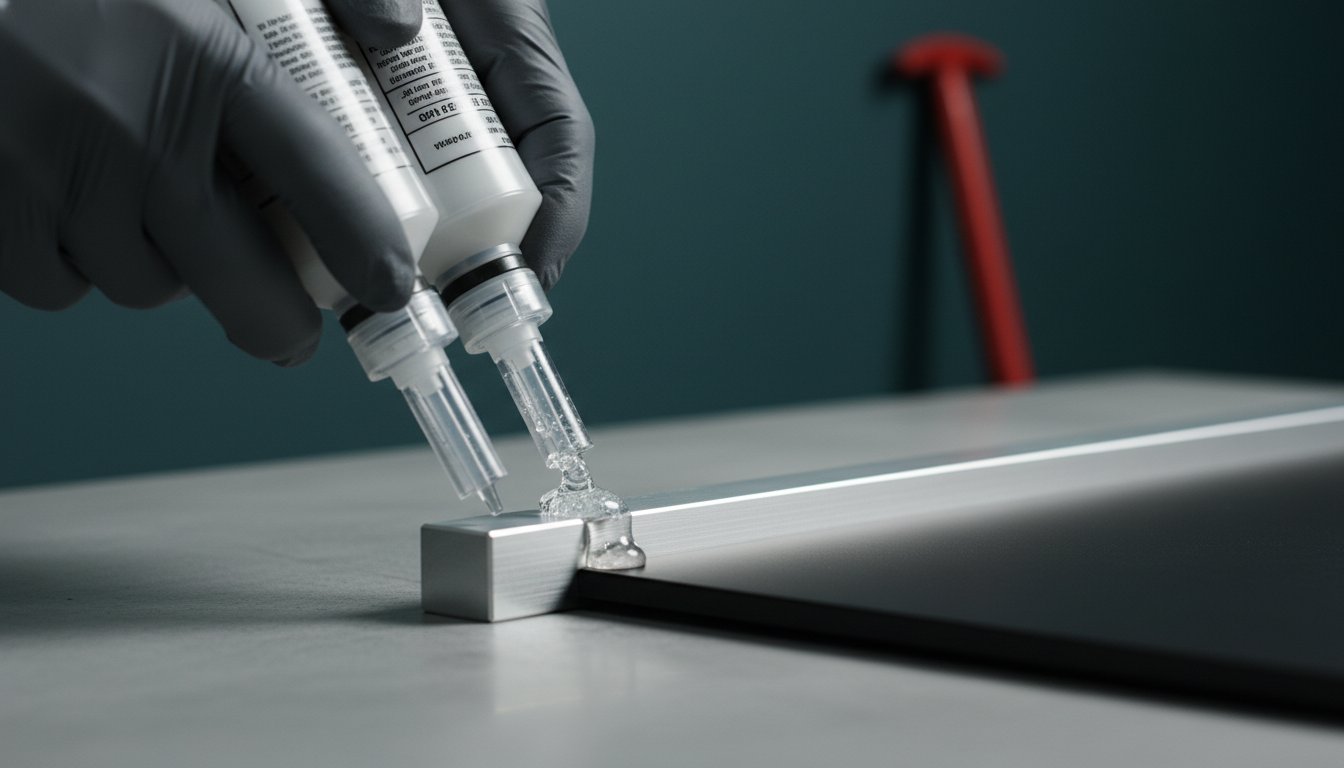
Is the productivity of your workshop being compromised by the curing schedule of your adhesives? You’re likely aware that whilst structural integrity is the priority, excessive downtime waiting for handling strength can stall an entire production line. With the global fast-curing epoxy adhesive market projected to exceed a valuation of $15 billion by 2026, more professionals are turning to rapid-cure systems to maintain throughput. Understanding the specific 5 minute epoxy adhesive uses available to your team allows you to integrate these high-performance systems without sacrificing the long-term reliability of the bond.
We agree that the pressure to deliver results quickly often conflicts with the technical demands of surface preparation and chemical cross-linking. This article provides the technical clarity needed to utilise rapid-curing adhesives to improve workshop efficiency and achieve high-strength bonds across diverse industrial substrates. We will examine precise mixing protocols, compatibility with complex plastics and metals, and the technical limitations you must respect to prevent premature joint failure.
Key Takeaways
- Learn how to optimise high volume production cycles by identifying professional 5 minute epoxy adhesive uses for jigging and rapid assembly.
- Understand the fundamental chemistry of resin and hardener interactions to determine when a rapid cure system is technically superior to slow set alternatives.
- Identify compatible substrates, such as aluminium, steel, and various timber types, to ensure bond reliability across diverse industrial materials.
- Master the critical role of surface preparation and precise dispensing tools in achieving maximum structural strength and bond longevity.
- Evaluate the trade-offs between accelerated cure speeds and ultimate peel strength to select the correct adhesive for specific mechanical loads.
If you require technical assistance regarding high-strength bonding or specific material compatibility, please reach out to our team of specialists for professional guidance.
Understanding the characteristics of 5 minute epoxy adhesives
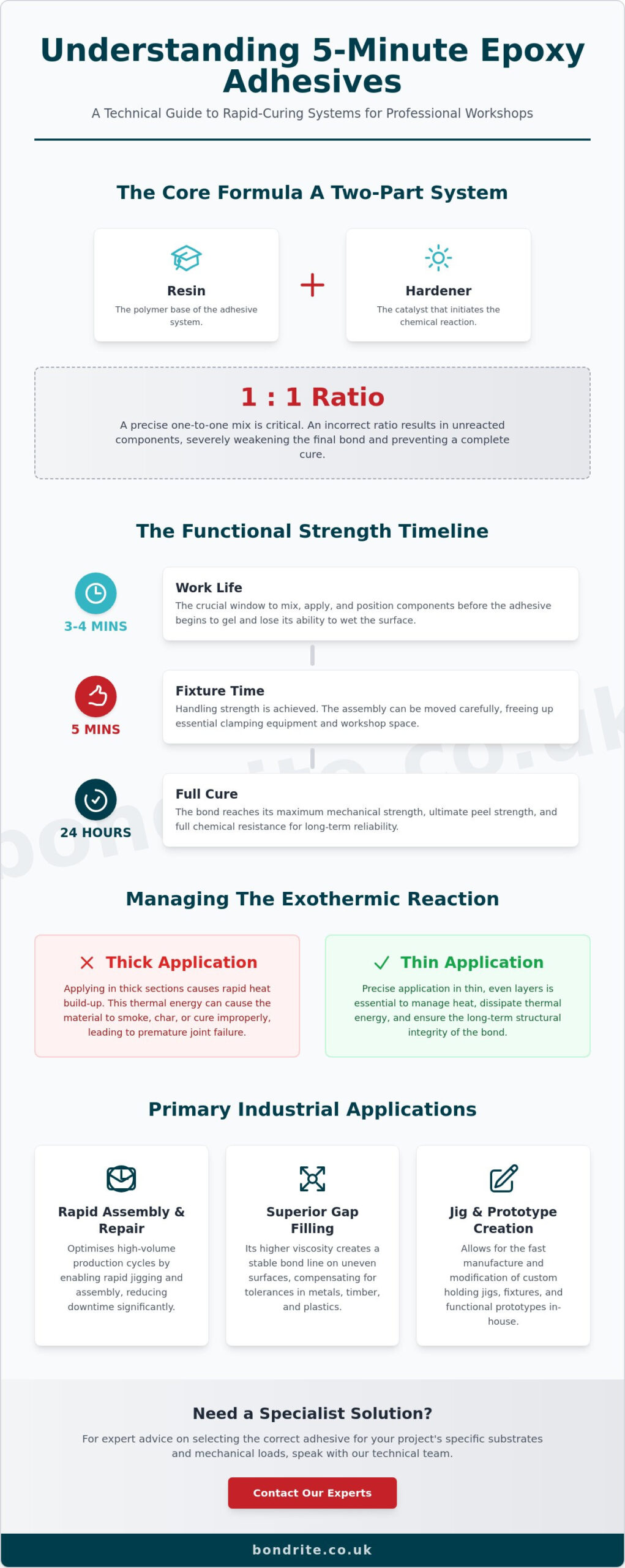
A 5 minute epoxy is a rapid-curing two-part polymer system designed for high-efficiency industrial environments where speed is a functional requirement. It consists of a resin and a hardener that, when combined in a precise 1 to 1 ratio, initiate a controlled chemical reaction. This balance is critical; an incorrect ratio results in unreacted components that severely weaken the final bond and may lead to a tacky, incomplete cure. Professionals must understand what epoxy adhesives are at a molecular level to appreciate why the mixing stage is so vital. Within the first few minutes, the mixture transitions from a low-viscosity liquid to a gel state, indicating the start of the cross-linking process. This transition is the point at which the adhesive loses its ability to wet the surface, making immediate application paramount for achieving a high-strength bond.
Identifying appropriate 5 minute epoxy adhesive uses depends on understanding how the material behaves under different environmental conditions and mechanical stresses. In a professional workshop, the ability to rapidly fix components in place can significantly reduce the need for extensive clamping equipment and floor space. To better understand how these systems compare to other rapid bonding agents and how they perform in real-world scenarios, watch this technical overview:
Chemical composition and the polymerisation process
The rapid cure cycle is achieved through highly reactive hardeners that facilitate the quick formation of molecular chains. Unlike 24 hour resins, these systems are formulated for immediate handling strength. This speed triggers a significant exothermic reaction where heat is a byproduct. If applied in thick sections, this thermal energy can build up rapidly, potentially causing the material to smoke or char. Precise application in thin layers is essential to manage this heat and ensure bond integrity.
Physical properties and functional strength timelines
Distinguishing between work life, fixture time, and full cure is necessary for industrial success. The work life usually lasts only three to four minutes at room temperature. Fixture time is reached at the five-minute mark, allowing assembly movement. Whilst handling strength is achieved quickly, full chemical resistance and maximum mechanical properties typically require a full 24 hour period to reach a completely stable state.
If you require technical advice on selecting the most appropriate adhesive for your specific workshop environment, you can speak with our technical advisors to ensure your application meets safety and performance standards.
Essential workshop and industrial uses for rapid set epoxies
High volume production lines operate on tight schedules where every minute of inactivity represents a loss in throughput. In these settings, 5 minute epoxy adhesive uses extend beyond simple repairs. They act as a critical bridge between instant-bond cyanoacrylates and slow-curing structural systems. One primary advantage is the ability to fill gaps in uneven industrial surfaces. Unlike thinner liquids, the high viscosity of these systems allows them to:
- Compensate for tolerances in cast metal components
- Provide a stable interface for rough-sawn timber
- Create a unified bond line on textured plastics
This ensures that components can be bonded with full surface contact, which is vital for maintaining the structural integrity of the assembly. By using a rapid set system, you’re able to move parts to the next stage of the manufacturing process without waiting for overnight curing cycles.
Jig manufacture and rapid prototyping
In metalwork applications and woodworking, creating custom holding tools is a frequent requirement. Rapid epoxies allow technicians to secure components in place while building complex assemblies, effectively serving as a temporary or permanent fixture. This is particularly useful where parts must be held at precise angles before permanent mechanical fastening. For rapid prototyping, the five minute fixture time enables immediate testing of physical models. Engineers can iterate designs without the 24 hour delays typical of standard resins, significantly compressing the development cycle.
Maintenance and emergency industrial repairs
Beyond the assembly line, these adhesives are indispensable for plant maintenance. In the paper and packaging industry, rapid repairs to equipment housing or non-pressurised fluid lines prevent costly downtime. The material is also highly effective for caravan repair applications, specifically for securing internal fixtures where vibrations often loosen mechanical screws. By sealing small leaks or securing loose fittings in woodworking environments, maintenance teams achieve a durable fix that resists moisture and moderate chemical exposure. If you’re unsure which grade of epoxy is required for your repair, consult our technical support team for a tailored recommendation.
If you have concerns regarding the bonding of dissimilar materials or require a technical datasheet for a specific substrate, please get in touch with our specialist team for professional support.
Material compatibility and substrate performance
Substrate selection dictates the ultimate success of any industrial bond. Whilst 5 minute epoxy adhesive uses are vast, the chemical nature of the surface determines the adhesion level achieved. For example, porous materials like softwoods allow for deeper resin penetration, creating a robust mechanical lock. Hardwoods, whilst still compatible, require a more textured surface to ensure the rapid-set resin can anchor effectively before the five minute work life expires. If the surface is too smooth, the polymer chains cannot grip the fibres, leading to premature joint failure under load.
Ceramics and glass represent another area where these adhesives excel in commercial settings. In shopfitting or precision assembly, the clear finish of professional grade epoxies ensures a clean aesthetic on transparent or glazed surfaces. However, for glass exposed to extreme temperature cycles, the difference in thermal expansion coefficients between the epoxy and the substrate must be considered. Failure to account for this can lead to stress fractures within the glass itself as the adhesive expands at a different rate to the substrate.
Bonding metals and alloys
Metals such as aluminium and steel provide excellent structural results when the surface is properly prepared. Achieving high shear strength relies on removing the oxide layer through mechanical abrasion. In metalwork applications where traditional welding is not feasible due to heat sensitivity or material thickness, epoxy provides a reliable alternative. A technical advantage of using epoxy between dissimilar metals is the prevention of galvanic corrosion. The cured polymer acts as an insulating barrier that stops the electrochemical reaction between the two alloys, preserving the integrity of the joint in humid environments.
Plastics and composite materials
Compatibility with plastics is more selective and requires precise identification of the polymer. High-energy plastics like ABS and Polycarbonate bond well with standard epoxies. However, low surface energy materials such as Polypropylene or Polyethylene are notoriously difficult to bond. These often require specialised plastic adhesives or surface primers to achieve any level of adhesion. In the marine and transport sectors, the rapid cure of 5 minute systems is ideal for bonding fiberglass and GRP components. This provides a rigid, impact-resistant joint that handles the vibrations of transit without the risk of debonding.
To discuss specific application protocols or to source high-performance dispensing equipment, please contact our technical department for expert assistance.
Professional application methods for achieving maximum strength
Achieving the peak mechanical properties of a bond requires more than just a correct mix ratio. Surface preparation is the most critical factor in ensuring bond longevity. If the substrate is contaminated with oils, moisture, or oxidation, the adhesive will fail at the interface regardless of its internal strength. For professional 5 minute epoxy adhesive uses, you must also manage the thermal energy generated during the cure. Because the polymerisation happens so rapidly, the chemical reaction is highly exothermic. Applying the adhesive in thick sections or large volumes leads to excessive heat buildup. This thermal spike can cause the material to char or even smoke, which compromises the structural integrity of the cured resin and may damage sensitive substrates.
Temperature plays a decisive role in the behaviour of the 5 minute window. Standard cure times are typically calculated at an ambient temperature of 20 degrees Celsius. If your workshop is significantly warmer, the chemical reaction accelerates, reducing your work life. Conversely, in colder conditions, the resin becomes more viscous and the cure time extends. You must account for these variables when planning your assembly sequence to avoid the material gelling before the parts are correctly positioned. Using structural epoxies effectively involves maintaining a controlled environment where possible to ensure consistent results.
Surface preparation and cleaning protocols
Begin by using a high-quality solvent cleaner to remove all traces of grease and industrial oils. Once the surface is chemically clean, mechanical abrasion is necessary to increase the surface area for bonding. For metals, sandblasting or heavy-grit sandpaper is recommended to create a mechanical key. You must ensure the environment is entirely dust-free before application. Even a microscopic layer of residue creates a barrier that prevents the epoxy from wetting the surface, leading to an immediate reduction in bond strength.
Mixing and dispensing techniques
Whilst manual mixing on a board is common for small tasks, industrial projects benefit from static mixing nozzles. These nozzles ensure a perfectly homogenous 1 to 1 ratio and significantly reduce the introduction of air bubbles. Air pockets within the bond line act as stress concentrators that can lead to crack propagation under load. You must organise your workflow so that all parts are ready for assembly before the resin is dispensed. Given the short pot life, there is no time for adjustments once the mixing process has started. To ensure your application remains within safe thermal limits and achieves maximum adhesion, speak with our technical specialists about your specific project requirements.
To discuss specific application protocols or to source high-performance dispensing equipment, please contact our technical department for expert assistance.
Selecting the correct epoxy for your specific project
Selecting the appropriate adhesive involves balancing assembly speed with the required mechanical performance of the final joint. Whilst 5 minute epoxy adhesive uses are ideal for rapid fixturing and high throughput, they’re not a universal solution for every industrial challenge. If your project requires a longer open time for complex part alignment or maximum impact resistance, a 30 minute or 24 hour system is technically superior. Rapid systems generally exhibit a higher cross-link density which can lead to a more brittle bond. If the assembly is subject to high peel forces or significant vibration, the shorter cure time might compromise the long-term durability compared to a toughened, slow-cure resin.
For professional requirements where rapid handling strength is non-negotiable, B2012 5 Minute Epoxy serves as a reliable standard. This system is formulated to provide consistent performance across various substrates, provided the technical limitations of the rapid cure cycle are respected. You must always consult the technical data sheets before proceeding with bulk application. These documents provide critical information on shear strength, service temperature ranges, and chemical resistance that guide your engineering decisions. Testing the adhesive on a small scale helps you understand how the material behaves under your specific workshop conditions, such as humidity and ambient temperature.
Rapid epoxy versus structural methacrylates
Both epoxies and structural methacrylates offer excellent gap-filling capabilities, yet they behave differently under mechanical stress. You should consider structural methacrylates and epoxies when your application demands higher impact resistance or the ability to bond through slight surface contamination. Methacrylates often provide better peel strength on certain plastics, though they have a much more distinct odour and different handling characteristics compared to the relatively low-odour profile of 5 minute epoxies. If your assembly requires a degree of flexibility to handle thermal expansion, a structural methacrylate might be the more resilient choice.
The Bondrite approach to technical support
Choosing an adhesive is a technical decision that benefits from expert verification to avoid costly failures. Speaking with a structural epoxy resin supplier allows you to access bespoke advice tailored to your specific manufacturing environment. We help engineers identify potential points of failure, such as thermal expansion mismatch or improper surface energy, before they affect production. We encourage the use of sample testing within your specific industrial conditions to ensure the adhesive performs to your required safety and durability standards. Our team is available to help you interpret technical data and select the most efficient dispensing tools for your workflow.
If you require technical assistance with your adhesive application please contact our expert team for professional guidance.
Optimising industrial throughput with rapid cure systems
Mastering these 5 minute epoxy adhesive uses allows your workshop to maintain high production speeds without compromising on the integrity of the bond. Success is dependent on meticulous surface preparation and a thorough understanding of the exothermic reaction during the cure. By utilising professional grade systems and adhering to precise mixing protocols, you ensure that every assembly meets the required safety and performance standards.
Bondrite Adhesives Ltd has operated as a specialist industrial adhesive supplier since 2000, providing UK based technical support to help engineers navigate complex bonding challenges. Our extensive range of B2012 5 Minute Epoxy and structural resins is backed by decades of technical expertise. If you require technical assistance with your adhesive application please contact our expert team for professional guidance. Implementing these technical solutions correctly will significantly improve your operational efficiency and bond reliability. We look forward to supporting your next assembly project.
Frequently Asked Questions
Can 5 minute epoxy be used for structural repairs on heavy machinery?
No, rapid cure epoxies are not recommended for primary structural repairs on heavy machinery. They’re formulated for speed and handling strength, which often results in a more brittle joint than slow-curing structural resins. For machinery subject to intense vibration or heavy loads, you should select a toughened structural adhesive that offers higher impact resistance and elongation properties. This ensures the bond can withstand the mechanical stresses without cracking.
What is the best way to remove 5 minute epoxy if I make a mistake?
Uncured epoxy should be removed using a solvent like acetone, whilst cured material requires mechanical removal or heat. If the resin is still liquid, wipe it away with a solvent-soaked cloth. Once it’s fully cured, you must apply heat to soften the bond before scraping it off. Be careful not to damage the substrate during this process. Mechanical sanding is also an option for removing stubborn residue from metal or timber surfaces.
Does 5 minute epoxy work on all types of plastic?
Epoxy adhesives don’t work on all plastics, particularly those with low surface energy like polypropylene or polyethylene. Professional 5 minute epoxy adhesive uses are generally limited to high surface energy materials such as ABS, polycarbonate, and PVC. If you’re working with difficult plastics, you’ll need a specialised primer or a different adhesive chemistry to achieve a functional bond. Always identify the specific polymer before selecting your adhesive to prevent bond failure.
How does temperature affect the setting time of rapid cure adhesives?
Temperature acts as a catalyst that either accelerates or decelerates the chemical reaction. High temperatures in the workshop will shorten the pot life and fixture time significantly. Conversely, cold conditions increase the viscosity and slow the curing process, which might prevent the adhesive from reaching full strength. It’s best to apply these adhesives at a controlled room temperature of approximately 20 degrees Celsius to ensure the performance matches the technical data sheet specifications.
Is 5 minute epoxy waterproof and suitable for outdoor use?
Rapid cure epoxies are water-resistant but aren’t typically rated for permanent submersion or high UV exposure. Whilst they’ll withstand occasional moisture, prolonged outdoor use can cause the resin to yellow and become brittle over time. If your application is exposed to the elements, we recommend applying a protective coating or using a UV-stable sealant. For maritime or sub-surface projects, a specialised waterproof epoxy or polyurethane system is usually a more reliable technical choice.
Can I use 5 minute epoxy to fill large gaps in timber or metal?
You can use rapid set epoxy to fill gaps, as it’s a non-shrinking material that maintains its volume during cure. This makes it ideal for 5 minute epoxy adhesive uses involving uneven timber or cast metal components. However, you must manage the exothermic heat generated during the reaction. If you’re filling a very large void, the heat buildup can cause the material to char. Apply the resin in thinner layers if the gap is exceptionally deep.

Article by
Lucy Mackay
Lucy Mackay is a Director at Bondrite Adhesives Ltd, an ISO 9001-certified industrial supplier based in Loughborough. With a focus on customer-led solutions and technical reliability, Lucy manages the strategic direction of the business, which has been a staple of the UK adhesive industry since 2002.
Disclaimer
This article is intended for informational purposes only. Please ensure you seek expert advice or carry out your own research to confirm the information is suitable for your specific needs.
Related Industrial Adhesives & Sealants
If you liked this guide then you may also like the following: