
With the global industrial adhesives market projected to reach a value of $61.8 billion in 2026, even a minor error in your resin calculator inputs can lead to substantial financial leakage across large-scale projects. You likely understand that precision is the foundation of any successful bonding operation, yet variables like substrate absorption and new EU formaldehyde emission limits, set at 0.062 mg/m³ as of August 2026, make estimation increasingly difficult. Running out of material mid-application or over-ordering due to inaccurate data isn’t just an inconvenience; it’s a failure of technical planning that directly impacts your bottom line.
This guide provides the technical framework you need to master professional estimation methodology. By following these steps, you’ll gain the confidence to calculate exact quantities for complex industrial shapes and diverse material properties. We will examine the specific formulas for various geometries, explain how to calibrate for material wastage, and detail the adjustments necessary for modern, low-VOC resin systems required by 2026 EPA regulations. Mastering these variables ensures your procurement is as precise as your engineering standards.
Key Takeaways
- Learn how to define the exact cubic volume of a cavity to prevent the high costs associated with material wastage and project delays.
- Identify the primary geometric shapes of your bonding or potting area to ensure your resin calculator inputs are technically accurate.
- Factor in surface porosity and mechanical wastage variables to bridge the gap between theoretical volume and actual resin consumption.
- Understand the density variations between epoxy, polyurethane, and structural acrylic resins to adjust your volume requirements with precision.
- Gain the technical confidence to order the correct quantity of industrial adhesives whilst adhering to the latest 2026 environmental and safety standards.
If you require technical assistance with your material requirements, you can speak with our advisors to ensure your project specifications are met with precision.
Why Precision Matters for Industrial Resin Applications
Resin calculation is the technical process of determining the cubic volume of a cavity or bond line. In industrial environments, this isn’t a mere estimation; it’s a critical engineering step. If you use a resin calculator without understanding the underlying physics, you risk significant operational failures. High performance structural methacrylates and epoxies represent a substantial capital investment. Over ordering these materials leads to unnecessary expenditure and hazardous waste management issues that can impact your project’s sustainability goals.
Under ordering is often more damaging to the final result. If a pour is interrupted because material runs out, the first layer may begin to cure before the second arrives. This creates a cold joint. A cold joint is a structural weakness where the two layers fail to fuse chemically, potentially leading to delamination under stress. To avoid this, you must understand specific gravity. This value represents the ratio of the material’s density compared to water. It’s the essential bridge between the space you need to fill and the amount of product you need to buy. Many industrial epoxy resins have a specific gravity greater than 1.1, meaning they’re significantly heavier than water.
To better understand how these calculations work in practice, watch this helpful video on determining resin requirements.
The Difference Between Volume and Weight
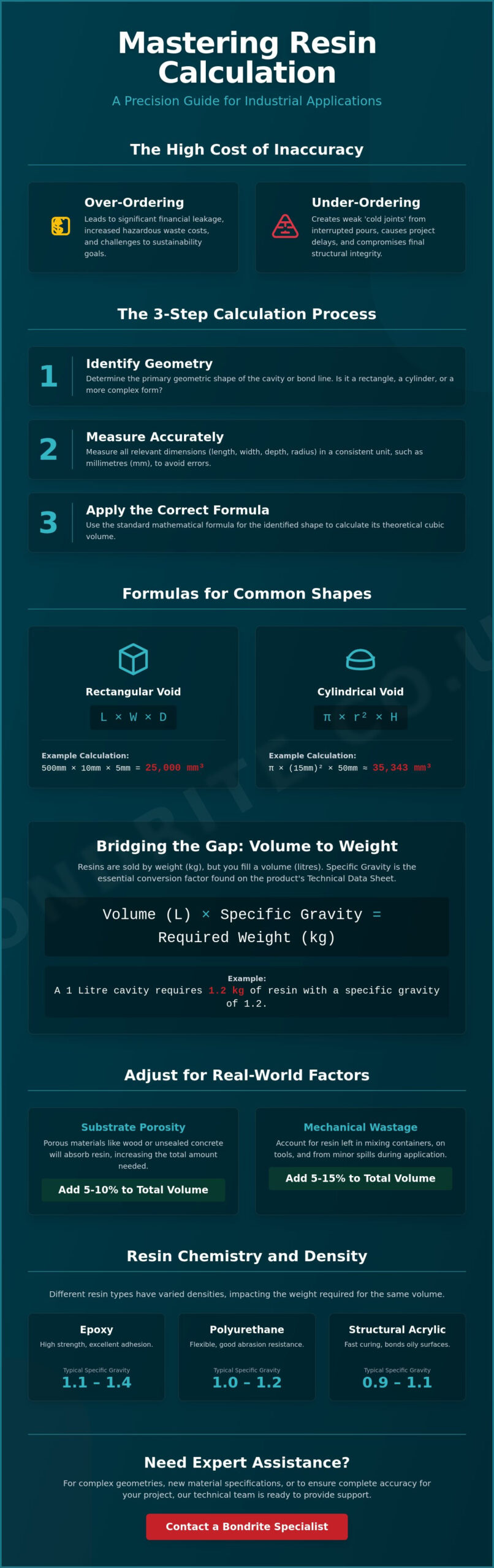
Suppliers typically sell resins by weight, yet your application requirement is defined by the volume of the void. You cannot assume one litre equals one kilogram. If the density is 1.2 g/cm³, a one litre cavity requires 1.2kg of material. Density affects the final quantity required because heavier resins provide less coverage per kilogram than lighter alternatives. To convert litres to kilograms, multiply the required volume in litres by the specific gravity listed on the technical data sheet. This step ensures your procurement matches the physical reality of the project site and prevents mid-project shortages.
Consequences of Inaccurate Material Estimates
Inaccurate estimates cause more than just financial loss. Interrupted pours compromise the integrity of the bond, leading to weaknesses that might not be visible until the component is under load. Logistically, emergency procurement for missing material is difficult in the current climate due to global shipping disruptions. These delays can stall entire production lines for days, leading to missed deadlines. Disposing of excess cured resin is also increasingly expensive because of stringent environmental waste regulations. Using a resin calculator correctly prevents these avoidable overheads and maintains the integrity of your industrial bonds.
For precise guidance on complex bonding geometries, you should consult with our technical team before finalising your material order.
Step by Step Guide to Calculating Resin Volume
To achieve an accurate result, you must first identify the primary geometric shape of the bond or potting area. Industrial projects often involve standardised channels or voids, but complex assemblies may require more detailed analysis. Measure all dimensions in consistent units, preferably millimetres or centimetres, to avoid conversion errors during the calculation phase. Once you have these figures, you can apply the specific mathematical formula required for your geometry to find the base cubic volume.
Calculating for Rectangular and Square Voids
The standard formula for a rectangular void is length multiplied by width multiplied by depth. If you are filling a bonding channel that is 500mm long, 10mm wide, and 5mm deep, the calculation is 500 x 10 x 5, which equals 25,000 cubic millimetres. In cases where the depth varies across a single area, you must calculate the average depth or divide the area into separate zones with uniform depths. This ensures your resin calculator inputs reflect the actual physical space of the assembly.
Formulas for Cylindrical or Circular Applications
Cylindrical voids are common in anchor bolting or electronic potting, where polyurethane adhesives are often selected for their insulation properties. The formula required is the radius squared, multiplied by pi (3.14159), and then multiplied by the depth. A frequent error in industrial maths is using the diameter instead of the radius. If a hole has a 20mm diameter, the radius is 10mm. For a 100mm deep hole, the calculation would be 10 x 10 x 3.14159 x 100, resulting in 31,415.9 cubic millimetres.
Estimating Volume for Irregular Industrial Shapes
Complex industrial components rarely follow perfect geometric lines. To estimate volume effectively, break the shape into smaller, manageable sections like rectangles and cylinders, then sum the volumes. For pre-existing cavities where geometry is too complex for manual measurement, use the displacement method. If the void is waterproof, you can perform a water test by filling it with a measured amount of liquid to find the exact volume. This empirical data provides the most reliable input for your resin calculator when theoretical models are insufficient.
After determining the total cubic volume in millimetres, convert this to millilitres by dividing by 1,000. For larger projects where volume is measured in cubic centimetres, the value is already equivalent to millilitres. If you are unsure about the specific requirements for your substrate, contact our technical specialists for a formal consultation on material selection.
If you require assistance determining the specific wastage factors for your production line, please get in touch with our technical advisors for a detailed material assessment.
Accounting for Wastage and Surface Porosity
A geometric resin calculator provides a theoretical volume based on perfect dimensions. In an industrial workshop, this figure rarely represents the actual quantity of material required. Discrepancies arise because liquid resins don’t just fill a void; they interact with the substrate and the application tools. If you only order the exact cubic volume, you will almost certainly run out of material before the project is finished. As a leading structural epoxy resin supplier, we recognise that technical planning must account for these hidden variables to maintain production continuity.
Wastage occurs at multiple stages of the bonding process. This includes material left in mixing containers, residues in delivery hoses, and over-application by operators. Surface preparation also plays a role. Sanding or grit-blasting increases the surface area of a substrate, creating microscopic valleys that the resin must fill before a structural bond is formed. This surface profile consumption is small per square millimetre but becomes significant over large industrial assemblies. Failure to adjust for these factors is a common cause of mid-project procurement delays.
Application Equipment and Mixing Losses
The choice of dispensing method significantly alters your wastage percentage. Manual mixing in open vessels often results in 10 to 15 percent loss due to material clinging to the sides of the tub or the mixing stick. Conversely, using pneumatic adhesive applicators with static mixing nozzles reduces container waste but leaves a fixed volume of cured resin within the nozzle after every session. You must also consider the pot life of the chemistry. If you organise large batches of a fast-curing resin, any delay in application could result in the entire batch hardening before use, necessitating a 100 percent wastage calculation for that portion.
Substrate Absorption and Porosity Factors
Porosity is a primary reason for inaccurate volume estimates. Whilst metals and dense plastics have zero absorption, materials like timber, masonry, and certain foams act like sponges. For example, open-cell foams may require up to 30 percent more resin than their geometric volume suggests. Hardwoods typically require a 15 percent buffer, whilst softwoods can soak up 20 percent or more. To mitigate this, engineers often apply a thin primer coat or sealer to close the pores of the substrate. This prevents the primary structural pour from being absorbed, ensuring the resin calculator results remain as accurate as possible during the final application.
Before selecting a specific adhesive chemistry for your assembly, you should discuss your technical requirements with our specialists to ensure the material properties align with your project goals.
Technical Differences Between Resin Chemistries
The chemical composition of your chosen material dictates its density and behaviour during the curing cycle. When you’re using a resin calculator, you must account for the specific gravity of the product, as this varies between epoxy, polyurethane, and structural acrylic systems. For example, unfilled structural methacrylates and epoxies typically have a specific gravity between 1.05 and 1.20. However, if the resin contains mineral fillers or metallic pigments to enhance durability, the density can exceed 1.50. This change significantly reduces the volume yield per kilogram of material.
Shrinkage is another technical variable that affects final volume. Whilst epoxies are known for their dimensional stability, they’ll still undergo a volume reduction of approximately 1 to 5 percent during cross-linking. Acrylics often exhibit higher shrinkage rates. If you don’t compensate for this reduction when potting a component or filling a deep cavity, you’ll likely encounter surface depressions or internal voids. Failure to consider these chemistry-specific traits leads to inaccurate procurement and potential bond failure.
Epoxy Resin Calculation Nuances
Epoxies are generally supplied as two-part systems with mix ratios of 1 to 1 or 2 to 1 by volume. High build epoxies, such as S1010 or S1016 epoxy, are engineered for deep pours and maintain their volume well. In contrast, thin-film coating resins may lose volume more noticeably if they contain solvents that evaporate during the cure. You’ll need to consult the technical data sheet for the exact specific gravity of both the resin and the hardener to ensure your combined volume calculations are precise.
Polyurethane and Acrylic Resin Variables
Certain polyurethane adhesives are moisture-curing and can expand slightly during the reaction, particularly if they have foaming properties. This expansion can fill gaps more effectively but makes volume estimation challenging. Structural acrylics, whilst offering high strength, have very fast set times. This limits the batch size you can organise at once. If you mix too much material for a gap-filling application, the exothermic heat generated by the reaction can cause the material to cure in the mixing nozzle, resulting in total wastage for that batch.
To ensure your calculations account for the specific expansion or shrinkage rates of your chosen adhesive, you can consult our technical advisors for a formal material specification.
For professionals who require a technical audit of their material estimates, you can reach out to our specialist team for a comprehensive project review.
Professional Support for Your Industrial Resin Projects
Combining precise mathematical modelling with high performance materials is the only way to ensure the long term integrity of industrial bonds. Whilst using a resin calculator provides the essential baseline for your procurement, the expertise of a specialist supplier ensures that your calculations account for real world application variables. Bondrite Adhesives Ltd serves as a dedicated partner for industrial and commercial clients, providing the technical clarity required to face complex bonding challenges. We specialise in a broad range of technical adhesives and resins that meet the rigorous performance and safety standards of 2026 manufacturing environments.
Precision in volume estimation must be matched by precision in application. We strongly encourage the use of professional dispensing equipment to bridge the gap between theoretical maths and physical results. Tools such as pneumatic adhesive applicators and calibrated glue dispensers allow for consistent bead sizes and potting volumes. This equipment is vital for reducing the human error often associated with manual mixing. By controlling the delivery of the resin, you significantly reduce the wastage factors discussed earlier, ensuring your project stays within its allocated budget.
Why Consult with a Bondrite Adhesives Ltd Technical Specialist
Large scale industrial tenders carry high financial risks if material estimates are incorrect. Our technical advisors provide expert review services to verify your volume requirements before you commit to a major capital expenditure. We help identify the most compatible material pairings, ensuring that your chosen structural acrylic or epoxy performs as expected on your specific substrate. For nationwide projects requiring reliable logistics, our range of industrial adhesives uk ensures you have access to high performance bonding solutions regardless of your location. This partnership approach moves beyond a simple transaction, providing you with a seal of quality for your engineering processes.
Ordering Your Industrial Resin Supplies
Accuracy in your resin calculator begins with the technical data sheet (TDS). This document contains the specific gravity and shrinkage data essential for professional modelling. You can request these formal documents directly from our team to ensure your inputs are based on verified laboratory results. We supply materials in various pack sizes, from small cartridges for precision component work to bulk containers for high volume production lines. This flexibility allows you to match your order to your calculated needs, minimising the cost of excess stock and the burden of chemical disposal. If you’re facing a complex bonding challenge, contact our technical department today for bespoke guidance and material specifications.
If you require further technical assistance with your industrial projects, please reach out to our advisors for professional guidance.
Optimising Your Procurement Process for 2026 Projects
Achieving technical precision in your bonding projects requires a transition from simple geometric estimation to a comprehensive material strategy. You’ve learned that a resin calculator is only as effective as the data you provide. This includes accounting for specific gravity, surface absorption, and the inherent shrinkage of different chemistries. By integrating these variables into your planning phase, you protect your project from structural weaknesses and financial overruns. Securing the integrity of your industrial bonds starts with precise maths and ends with the right partnership.
As a specialist supplier of high performance structural resins, Bondrite Adhesives Ltd provides the technical documentation and high grade materials necessary for industrial excellence. Our technical advisors have decades of industrial experience and are ready to assist with your specific requirements. We offer nationwide UK delivery for all industrial adhesives to ensure your production schedule remains on track. If you’re managing a complex assembly or a large scale tender, contact our technical team for expert help with your resin calculations. Taking this final step ensures your procurement is as robust as your engineering standards.
Frequently Asked Questions
How do I calculate how much resin I need for a rectangular channel
Multiply the length of the channel by its width and depth to determine the cubic volume. For a channel measuring 1000mm in length, 10mm in width, and 5mm in depth, the calculation is 1000 x 10 x 5, which equals 50,000 cubic millimetres. Always ensure your measurements use consistent units before performing the calculation to prevent procurement errors. Divide the final cubic millimetre figure by 1,000 to convert the requirement into millilitres.
What is the standard wastage percentage for industrial resin projects
Industrial projects typically require a wastage buffer between 10 and 20 percent depending on the dispensing method. Manual mixing in open vessels generally results in 15 percent loss due to residues left in the container and on mixing tools. If you use pneumatic applicators, the wastage is lower per application but remains constant within the mixing nozzles. You must adjust your resin calculator inputs to account for these operational losses to maintain production continuity.
Does the type of substrate affect how much resin I should order
Substrate porosity significantly influences the total volume of resin required for a successful bond. Porous materials such as timber, masonry, or open-cell foams absorb liquid resin, which can necessitate a volume increase of up to 30 percent. Non-porous substrates like metals and dense plastics do not soak up the material, allowing for a more direct correlation between the geometric void and the resin quantity. Always factor in substrate behaviour during the planning phase.
How do I convert resin volume from litres to kilograms
Multiply the total volume in litres by the specific gravity of the resin to find the required weight in kilograms. Since industrial resins are typically sold by mass but applied by volume, this conversion is vital for accurate ordering. For example, if your project requires 5 litres of an epoxy with a specific gravity of 1.15, you must purchase 5.75kg of material. This ensures you have sufficient product to fill the physical space of the assembly.
Why is specific gravity important when using a resin calculator
Specific gravity is the essential variable that allows a resin calculator to bridge the gap between cubic volume and purchasable weight. It represents the density of the adhesive chemistry compared to water. Without this precise value, you cannot determine the actual mass of resin needed to fill a specific void. Using the correct specific gravity from the technical data sheet prevents the common mistake of assuming that one litre of resin weighs exactly one kilogram.
How much resin is typically lost in a static mixing nozzle
Material loss in a static mixing nozzle typically ranges between 5ml and 15ml per nozzle depending on its length and internal diameter. Whilst this volume seems small, the cumulative loss becomes significant in high-volume production lines where nozzles are changed frequently. If your process requires 20 nozzle changes per shift, you could lose up to 300ml of resin daily. You must include this equipment-related wastage in your final material procurement estimate.
Can I use a water test to measure the volume of an irregular cavity
A water test is an excellent empirical method for determining the volume of irregular cavities that are waterproof. By filling the void with a measured quantity of liquid, you obtain a precise volume figure that geometric formulas cannot provide. This method is particularly useful for complex industrial castings or pre-existing voids. Once you have the liquid volume in millilitres, you can apply the specific gravity of your resin to find the required weight.
Does epoxy resin shrink significantly after it has cured
Structural epoxy resins are known for their dimensional stability and typically exhibit very low shrinkage rates between 1 and 5 percent. This minimal contraction occurs during the chemical cross-linking process as the liquid transitions into a solid. Whilst the shrinkage is low, it can still affect high-precision engineering tolerances or cause minor surface depressions in deep pours. You should check the technical documentation for the exact shrinkage rate of your chosen epoxy system.

Article by
Lucy Mackay
Lucy Mackay is a Director at Bondrite Adhesives Ltd, an ISO 9001-certified industrial supplier based in Loughborough. With a focus on customer-led solutions and technical reliability, Lucy manages the strategic direction of the business, which has been a staple of the UK adhesive industry since 2002.
Disclaimer
This article is intended for informational purposes only. Please ensure you seek expert advice or carry out your own research to confirm the information is suitable for your specific needs.
Related Industrial Adhesives & Sealants
If you liked this guide then you may also like the following: