
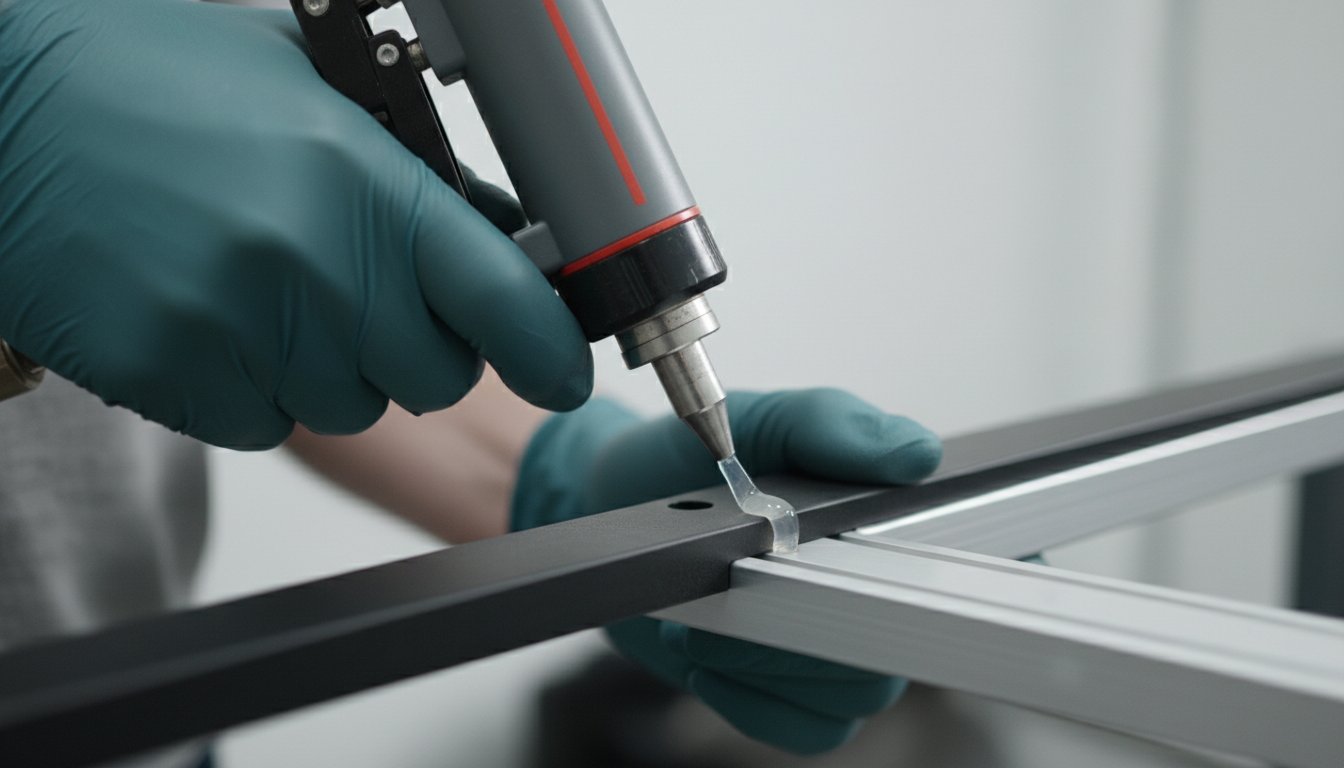
Most industrial bond failures between plastic and metal aren’t caused by a lack of adhesive strength; they’re caused by a fundamental misunderstanding of surface energy and thermal coefficient mismatch. You’ve likely experienced the frustration of a bond that appears secure during assembly but shears away once the temperature fluctuates or the component enters service. Identifying the best adhesive for bonding plastic to metal uk manufacturers can rely on involves moving beyond all-purpose retail glues and into the realm of professional structural chemistry.
We understand that low surface energy plastics like polypropylene and the complexities of specific metal primers often lead to confusion on the factory floor. This guide provides the technical criteria and professional techniques required to achieve a permanent industrial bond between diverse plastics and metal surfaces. You’ll discover how to streamline your manufacturing process using modern adhesives whilst ensuring your material choices meet the latest UK REACH and GB CLP regulatory standards. We will examine structural acrylics, epoxies, and the critical role of surface preparation in preventing environmental stress fractures.
Key Takeaways
- Learn why surface energy and differential thermal expansion are the primary factors in bond longevity between dissimilar materials.
- Identify the specific advantages of using structural methacrylates and epoxies to manage heavy industrial loads and environmental stress.
- Discover the best adhesive for bonding plastic to metal uk manufacturers use to ensure permanent adhesion on low surface energy polymers.
- Understand the critical surface preparation steps required to remove contaminants and create high energy bonding sites on metal substrates.
- Explore how professional dispensing equipment and pneumatic applicators can improve consistency and reduce adhesive waste in your assembly line.
If you require specific technical support for your assembly process, please contact our engineering team for professional adhesive advice.
Understanding the Challenges of Bonding Plastic to Metal
Bonding metal to plastic presents a unique set of engineering hurdles that differ significantly from joining similar materials. Metal is fundamentally non-porous and typically possesses high surface energy, which makes it an ideal candidate for many adhesives. However, industrial plastics vary wildly in their chemical composition. In UK manufacturing environments, where humidity and ambient temperature often fluctuate, these material differences become even more pronounced. If you don’t account for the specific characteristics of both substrates, the bond will likely fail under load.
To select the best adhesive for bonding plastic to metal uk engineers must first evaluate the surface energy of the specific polymer involved. Without this data, the risk of adhesive failure remains high. If the adhesive cannot effectively “wet” the surface of both materials, you cannot achieve a reliable structural join.
To better understand the chemistry behind these bonds, watch this technical overview:
Plastic Polymers and the Surface Energy Barrier
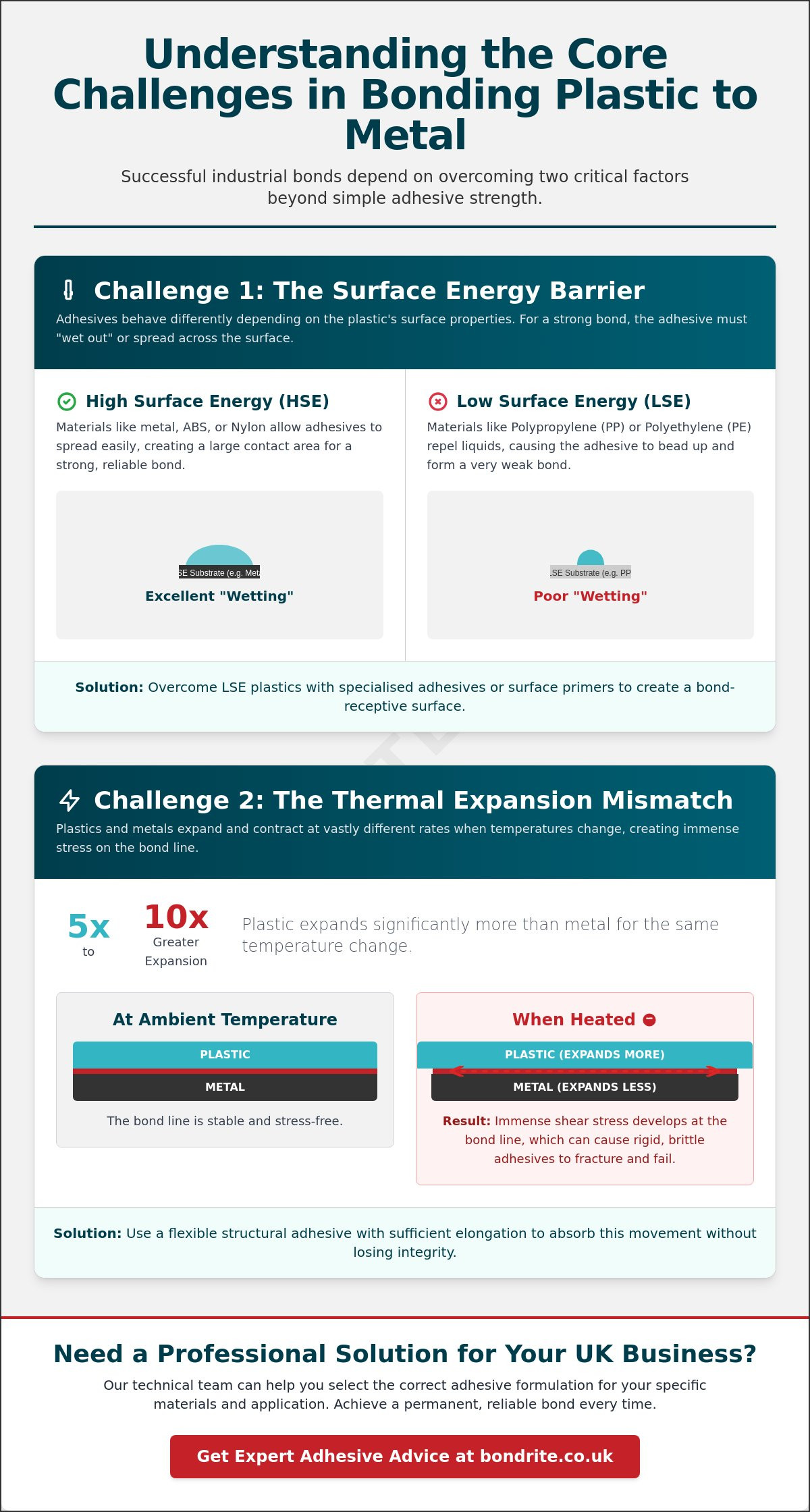
High surface energy plastics like ABS or Nylon are relatively straightforward to bond. However, low surface energy (LSE) plastics such as polyethylene (PE) and polypropylene (PP) act like a non-stick surface. They effectively repel standard adhesives. Achieving a structural join on LSE materials requires specialised plastic adhesives that can chemically interact with the surface or use high-performance primers to create a bridge between the substrate and the adhesive. Understanding basic adhesive bonding principles is essential for overcoming these molecular barriers. If the adhesive cannot wet out the surface, the bond will never reach its rated strength.
Thermal Expansion and Mechanical Stress Management
Metals and plastics react to temperature cycles at vastly different rates. When a bonded component is exposed to heat, the plastic often expands at a rate five to ten times greater than the metal substrate. This creates immense internal shear stress at the bond line. If you select a rigid, brittle adhesive for an application with wide temperature swings, the bond will likely shear or “pop” off the metal surface. Successful industrial joining requires an adhesive with enough elongation to absorb this movement without losing its structural integrity. This is particularly vital in high-vibration environments amongst automotive or aerospace assemblies, where mechanical fatigue can accelerate bond degradation. You must choose a solution that balances high tensile strength with the flexibility to manage these mechanical stresses.
If you need assistance identifying the correct chemical formulation for your specific substrate combination, our technical advisors are available to provide expert adhesive guidance.
Adhesive Technologies for Professional Plastic to Metal Bonds
Selecting the correct bonding agent requires a move away from multi-purpose retail products toward industrial-grade formulations. Whilst many consumer brands suggest that cyanoacrylate is a universal fix, professional fabrication demands higher performance metrics. The best adhesive for bonding plastic to metal uk manufacturers can specify is typically a structural adhesive that offers high shear and peel strength. These values determine how well the bond resists sliding forces and edge-pulling stress during service. If your application involves heavy loads or safety-critical components, you must prioritise structural acrylics or epoxies over standard superglues.
Cyanoacrylates, such as B2001 Ethyl Cyanoacrylate, remain useful for small component bonding and rapid assembly. They provide high tensile strength on non-porous surfaces and cure in seconds. However, their brittle nature makes them unsuitable for joints exposed to impact or significant thermal movement. For large-scale industrial joining, we look toward more robust chemical families that can manage the complexities of modern manufacturing.
Structural Acrylics and Two Part Methacrylates
Structural acrylics and two-part methacrylates (MMAs) are often the primary choice for metalwork applications. They offer a unique ability to bond through light oils and surface contaminants that might otherwise cause bond failure. If you are working with high-viscosity requirements, methacrylates provide excellent gap-filling capabilities, which is essential when bonding irregular plastic mouldings to metal frames. These adhesives create a tough, impact-resistant join that maintains its integrity even when exposed to harsh industrial solvents or oils. Their fast fixture times allow for rapid throughput on assembly lines without sacrificing the structural performance required for long-term durability.
Epoxy Resins and High Performance Contact Adhesives
For maximum durability in extreme environments, two-part epoxy resins like S1010 or S1011 provide a rigid, high-strength join. Epoxies are characterised by their exceptional chemical resistance and ability to withstand high temperatures. If your project involves large surface areas, such as laminating plastic sheets to metal panels, contact adhesives like S1300 are more efficient. These allow for immediate handling strength over broad sections, though they do not provide the structural load-bearing capacity of an epoxy or acrylic. Choosing between these technologies involves balancing the required cure time against the ultimate handling strength. If you are unsure which technology suits your production environment, we recommend you discuss your application with our technical team to ensure the bond meets your specific performance standards.
If you require specific technical guidance on surface preparation for your manufacturing line, please contact our experts for bespoke bonding support.
Surface Preparation Steps for Industrial Adhesion
Surface preparation is the most critical phase of the joining process. Even the best adhesive for bonding plastic to metal uk manufacturers can source will fail if the bond line is compromised by oils, oxidation, or mould release agents. Industrial adhesion relies on achieving intimate contact at the molecular level. If a barrier exists between the adhesive and the substrate, the resulting join will lack the required shear strength. You must view surface preparation as a multi-stage process that begins with chemical cleaning and ends with the creation of a high-energy bonding site.
The objective is to transform a contaminated or low-energy surface into one that is chemically receptive. If you skip these steps, the bond may appear strong initially but will likely fail when exposed to environmental stress or mechanical vibration. Proper preparation ensures that the adhesive wets the surface entirely, which is the foundation of any permanent structural join.
Degreasing and Cleaning Protocols
Industrial environments are often contaminated with airborne lubricants, cooling fluids, or simple fingerprints. When preparing stainless steel or aluminium, use a high-purity solvent like Isopropyl Alcohol (IPA) or a dedicated industrial degreaser. Standard household cleaners should be avoided because they frequently contain surfactants, silicones, or fragrances that remain on the surface after drying. These microscopic layers act as release agents. If you are working with plastic adhesives, ensure the solvent is compatible with the specific polymer to prevent stress cracking or surface softening. Always use a clean, lint-free cloth and change it frequently to avoid spreading contaminants across the work area.
Mechanical and Chemical Pre-treatments
Creating a mechanical key is essential for increasing the bond’s resistance to peel forces. Grit blasting provides the most consistent results for metal surfaces, whilst manual abrasion with a 120-grit emery cloth is often sufficient for plastics like ABS or Nylon. This process increases the available surface area for metalwork adhesives to grip. You must be careful not to over-abrade thin-walled plastic components, as this can induce mechanical weakness in the substrate itself.
When dealing with low surface energy plastics such as polypropylene or polyethylene, mechanical keying is rarely enough. These materials require chemical intervention through specialised primers. These primers work by depositing a high-energy layer that the adhesive can actually bite into. You can verify the success of your preparation using a water break test. Clean water should flow across the surface in a continuous sheet. If the water beads into droplets, it indicates the presence of oils or a surface energy that is too low for a permanent bond. This methodical approach ensures the best adhesive for bonding plastic to metal uk fabrication teams utilise can perform to its maximum technical specification.
If you require technical assistance with selecting the correct dispensing equipment for your assembly line, please contact our specialists for industrial application support.
Application Techniques and Equipment for Consistent Results
Precision in the application phase is as vital as the chemical selection itself. Even the best adhesive for bonding plastic to metal uk manufacturers specify can fail if the application is inconsistent or if the bond line is starved of material. Moving from manual application to professional dispensing systems ensures that every component receives the exact volume of adhesive required for a structural join. This repeatability is essential for maintaining quality standards in high-volume production environments. Mechanical stress concentrations often occur amongst assemblies where adhesive distribution is uneven, leading to premature failure under load.
For certain assembly tasks, especially those requiring rapid fixture or temporary positioning, hot melt adhesive and guns provide a streamlined manufacturing process. Whilst these are frequently used for packaging or light assembly, they can serve as an efficient secondary fixing method or for non-structural plastic to metal joins where speed is the primary driver. Managing the open time and fixture time is critical; if you delay assembly beyond the adhesive’s open time, the bond will be compromised before it even begins to cure.
Manual and Pneumatic Dispensing Tools
Selecting the correct applicator gun for two-part structural adhesives is a technical necessity. Manual guns are suitable for low-volume or repair work, but pneumatic adhesive applicators offer superior precision and reduced operator fatigue. These systems ensure that the two components are mixed in the correct ratio through a static mixing nozzle. If you don’t maintain your dispensing equipment, you risk inconsistent mix ratios, which leads to soft spots and bond failure. Regular cleaning and nozzle replacement are mandatory protocols for any professional fabrication site to ensure repeatable bond quality.
Clamping and Curing Best Practices
Achieving a permanent bond requires more than just applying the adhesive; you must manage the curing environment with precision. Determining the correct clamping pressure is a balance. If the pressure is too high, you may squeeze out too much adhesive, leaving a starved joint that lacks the necessary film thickness for strength. If it is too low, you risk air entrapment. You must also monitor ambient temperature and humidity, as these directly affect cure rates. Handling strength is typically achieved when the adhesive has reached approximately 50 percent of its ultimate strength. To ensure your production team is using the most efficient tools for your specific adhesive choice, consult with our technical advisors.
For technical specifications or to discuss material compatibility for your specific assembly, please contact our advisors for expert adhesive selection support.
Choosing the Correct Solution for Your UK Business
Selecting the best adhesive for bonding plastic to metal uk manufacturers can integrate into their production lines requires a methodical approach to material science. Bondrite supports UK fabrication businesses by providing technical clarity amongst a crowded market of generic bonding agents. We prioritise functional utility, ensuring that every recommendation is based on the specific physical properties of your substrates and the environmental stresses they will encounter. Identifying the correct solution involves more than just matching two materials; it requires a deep understanding of how those materials behave under load and temperature fluctuations over time.
Successful industrial joining relies heavily on testing and validation. We encourage our clients to perform bond strength tests on sample materials before committing to full-scale production. This validation process confirms that the surface preparation protocols and adhesive choices meet the required safety and performance standards. By using plastic adhesives tailored for specific industrial polymers and integrating professional metalwork adhesives into your workflow, you reduce the risk of costly bond failures and assembly rejects.
High Performance Products for Metal and Plastic
Our structural acrylic adhesive range is designed for demanding metal joins where high shear strength and impact resistance are paramount. These formulations are particularly effective when bonding rigid plastics to aluminium or steel frames. If your application requires high strength and exceptional chemical resistance, utilising epoxy resins like S1010 or S1011 provides a durable, rigid join that withstands harsh industrial environments. For rapid plastic assembly or small component fixing, cyanoacrylates offer the versatility and speed required for high-throughput manufacturing whilst maintaining the precision necessary for intricate work.
Expert Consultation and Technical Support
Consulting with a technical specialist is the most effective way to prevent bonding failures that can lead to product recalls or structural integrity issues. Our role is to act as a seasoned mentor, guiding you through the selection of chemical formulations that comply with current UK REACH and GB CLP regulations. We provide full access to technical data sheets and safety documentation to ensure your assembly process meets all formal quality standards. If you are facing complex multi-material bonding challenges, we offer customised advice to help you achieve a reliable, permanent bond. To ensure your material choices are validated by professional standards, we invite you to consult with our technical specialists today.
If you require technical support for a specific manufacturing project, you can contact our engineering specialists for bespoke assistance.
Achieving Permanent Structural Integrity in Plastic to Metal Assemblies
Success in joining dissimilar materials depends on a disciplined approach to surface chemistry and mechanical stress management. By prioritising high energy surface preparation and selecting adhesives with the appropriate elongation properties, you can eliminate the common causes of bond failure. Identifying the best adhesive for bonding plastic to metal uk fabrication teams can rely on is a matter of technical data over trial and error. You must ensure that your chosen formulation manages the differential thermal expansion inherent in these assemblies.
As a UK independent family owned business, Bondrite Adhesives Ltd has provided expert technical support since 2000. Our specialist industrial grade product range is designed to meet the rigorous demands of modern manufacturing whilst adhering to all safety and regulatory standards. If you require expert guidance on selecting the perfect bonding solution for your manufacturing process, please contact our technical team for specialist advice. We look forward to helping you refine your assembly process and achieve the precision your projects demand.
Frequently Asked Questions
What is the strongest adhesive for sticking plastic to metal?
Structural acrylics, specifically two-part methacrylates like B3294, are generally considered the strongest for industrial plastic to metal joins. These adhesives provide high shear and peel strength whilst maintaining enough flexibility to withstand impact. If your application involves heavy loads, structural acrylics offer superior performance compared to standard cyanoacrylates or contact glues. They are the best adhesive for bonding plastic to metal uk manufacturers use for safety-critical components.
Can I glue polyethylene or polypropylene to metal surfaces?
Yes, you can bond these low surface energy (LSE) plastics to metal, but they require a specialised primer or a dedicated LSE adhesive. Without chemical pre-treatment, standard adhesives will fail to wet the surface of polyethylene or polypropylene. Applying a primer creates a receptive molecular layer that allows structural adhesives to bite into the plastic. This process is essential for ensuring a permanent bond on otherwise non-stick polymers.
How do I prepare a metal surface for bonding with plastic?
Proper metal preparation involves a three-step process of degreasing, mechanical abrasion, and final cleaning. Use a high-purity solvent like IPA to remove oils, followed by grit blasting or manual sanding with 120-grit emery cloth to increase surface area. A final wipe with a clean solvent ensures a residue-free site. If you skip these steps, oxidation or surface contaminants will compromise the bond line and lead to premature failure.
Is an epoxy or an acrylic adhesive better for metal to plastic joins?
Acrylic adhesives are typically better for high-vibration or impact-prone joins due to their superior peel strength and faster fixture times. Epoxies provide higher rigidity and exceptional chemical resistance, making them suitable for static, load-bearing applications in harsh environments. If the assembly is exposed to significant thermal movement, the toughened nature of a structural acrylic generally offers better long-term durability than a brittle epoxy resin.
How long does a professional plastic to metal bond take to cure?
Cure times vary significantly between chemical families and ambient conditions. Structural acrylics often reach handling strength in 10 to 20 minutes, whereas two-part epoxies may require several hours to fixture. A full chemical cure typically takes 24 hours at room temperature. You should always refer to the technical data sheet for your specific product to identify the exact window for handling and ultimate strength.
Do I need to use a primer when bonding plastic to metal?
A primer is mandatory if you are working with low surface energy plastics like PP, PE, or PTFE. It is also highly recommended for certain metals like stainless steel or galvanised surfaces to prevent long-term oxidation at the bond line. If you are bonding high energy plastics like ABS or Nylon to clean aluminium, a primer may not be necessary. You should always test the material surface energy before omitting a primer.
Can temperature changes cause a plastic to metal bond to fail?
Temperature fluctuations are a leading cause of bond failure due to the different rates of thermal expansion between materials. Plastic expands significantly more than metal when heated, which induces shear stress at the bond line. If the adhesive is too rigid, it cannot accommodate this movement and will eventually crack or shear. Using a toughened adhesive with high elongation properties is the best adhesive for bonding plastic to metal uk engineers use to manage these stresses.
What equipment is needed for applying two-part structural adhesives?
Professional application requires a dedicated manual or pneumatic applicator gun and static mixing nozzles. These tools ensure the resin and activator are dispensed in the precise ratio required for a complete chemical reaction. If you attempt to mix these materials manually, you risk inconsistent results and soft spots in the bond. Pneumatic systems are preferred in factory settings for their repeatability and ability to deliver consistent bead profiles.

Article by
Lucy Mackay
Lucy Mackay is a Director at Bondrite Adhesives Ltd, an ISO 9001-certified industrial supplier based in Loughborough. With a focus on customer-led solutions and technical reliability, Lucy manages the strategic direction of the business, which has been a staple of the UK adhesive industry since 2002.
Disclaimer
This article is intended for informational purposes only. Please ensure you seek expert advice or carry out your own research to confirm the information is suitable for your specific needs.
Related Industrial Adhesives & Sealants
If you liked this guide then you may also like the following: